 Dallon Avery
Diablo 4 Waking Nightmares Guide Quick Overview
- Waking Nightmares are dungeon-style activities that let you replay some iconic moments from the previous Diablo games.
- There are 3 types of Waking Nightmares: Prime Evil ones, Standard, and small Pop-Up ones
- 3 Prime Evil boss fights in Waking Nightmares: Baal, Mephisto, Diablo
- Pinnacle Capstone Waking Nightmares become available at Torment 10+
- Defeating the final boss in Prime Evil Waking Nightmares grants Splinters of Evil, which unlock boss powers.
Need help leveling up your seasonal character? Buy Diablo 4 Powerleveling service at Skycoach and reach any level you want, which includes access to higher Torment levels and better rewards!


Read closely 
Browse our hottest Diablo 4 Boosting services








What are Waking Nightmares in Diablo 4 Season 15
If this isn’t the sunsetting of a game, I don’t know what is. The entire season of Hell’s Legacy is a celebration of the past games, and Waking Nightmares are pretty unique for what they are. But I bet all of us, Diablo fans, get this bittersweet feeling in our hearts because we know this isn’t just an anniversary celebration; it also marks the end of Diablo 4.
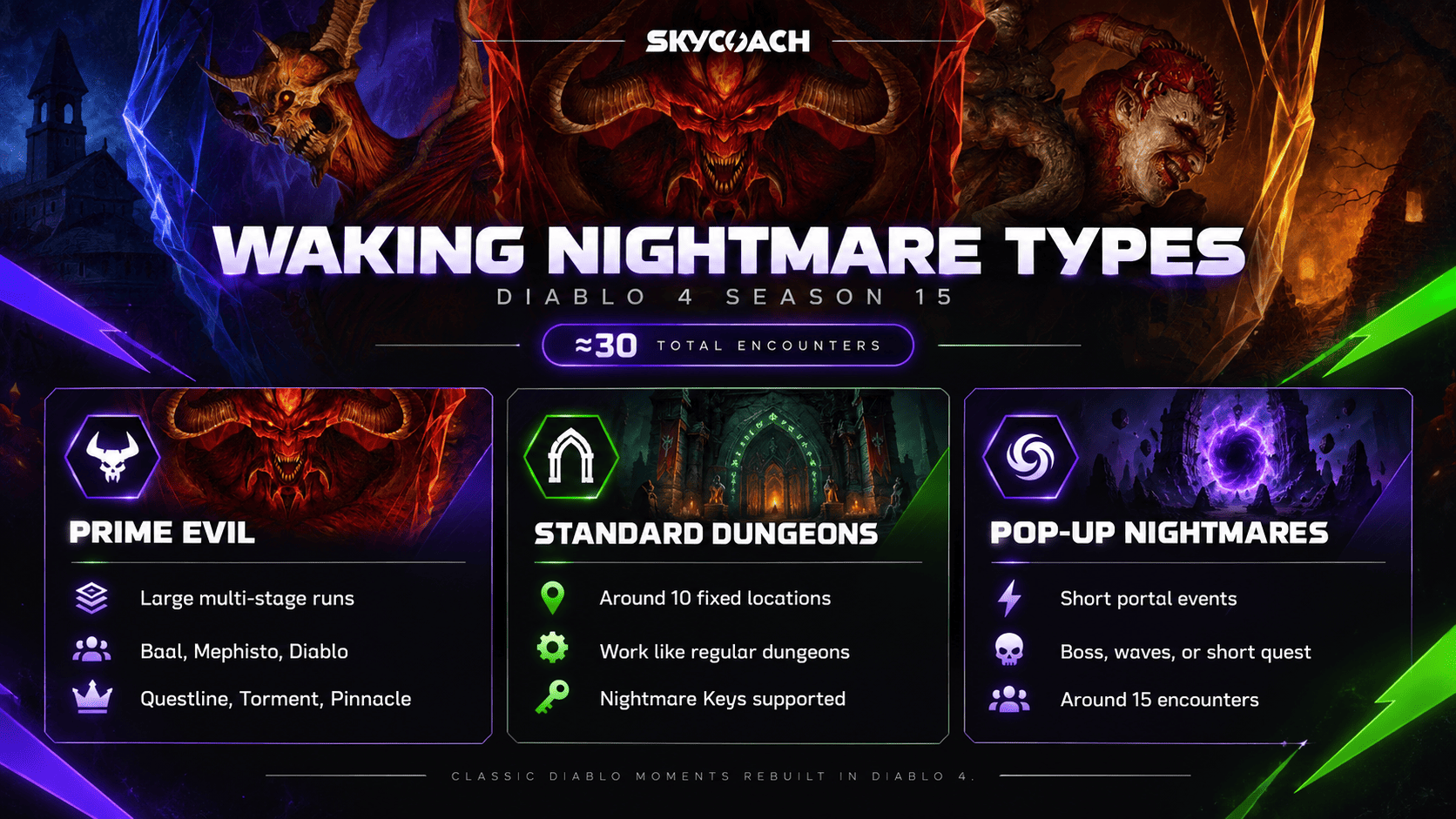
Waking Nightmares are basically recreations of key moments from previous Diablo games, built in the D4 art style. There are 3 different kinds of Nightmares.
- Prime Evil Waking Nightmares
- Standard Waking Nightmare dungeons
- Pop-up Waking Nightmares
Season 15 includes around 30 Waking Nightmare experiences in total. These range from huge multi-stage dungeons to short encounters appearing while exploring Sanctuary. These Waking Nightmares will remain after the season ends and join the core activities roster.
Prime Evil Waking Nightmares
Prime Evil Waking Nightmares are the largest versions of this activity. There are three major Nightmares built around Baal, Mephisto, and Diablo.
Players first experience them during the Season 15 questline. Each one recreates a major journey leading toward its respective Prime Evil.
Harder versions also become available as Capstone Dungeons. Blizzard also introduces Pinnacle Capstones, described as the largest and hardest dungeons created for Diablo 4. These Pinnacle Capstones are balanced around Torment 10 and above.
Baal Waking Nightmare
Baal's Waking Nightmare recreates Diablo 2's Act V finale. The journey begins at Ancients' Way, after which players travel toward Arreat Summit and fight the Ancients.
From there, the Nightmare continues into the Worldstone Keep. Players eventually reach Baal's familiar wave encounter before entering the portal and fighting Baal himself.
The activity effectively recreates the classic progression:
Ancients' Way → Arreat Summit → The Ancients → Worldstone Keep → Baal Waves → Baal
This makes Baal's Nightmare one of Season 15's longest nostalgia-focused encounters.
Mephisto Waking Nightmare
Mephisto's Nightmare recreates the ending of Diablo 2 Act III. Players begin in Travincal and rebuild Khalim's Will.
That involves recovering:
- Khalim's Heart
- Khalim's Eye
- Khalim's Brain
- Khalim's Flail
The completed weapon is then used to destroy the Compelling Orb. Players descend into the Durance of Hate afterward and eventually confront Mephisto.
The progression looks like this:
Travincal → Khalim's Will → Compelling Orb → Durance of Hate → Mephisto
Diablo Waking Nightmare
Diablo's Waking Nightmare is considerably larger. Blizzard describes it as a recreation of almost the entirety of Diablo 1.
Players begin inside the Tristram Cathedral. From there, the Nightmare moves through several classic dungeon layers:
Cathedral → Catacombs → Caves → Hell → Diablo
The journey eventually reaches Hell itself, where Diablo awaits. Of the three Prime Evil Nightmares, this is the one Blizzard's developers specifically highlighted as one of their most ambitious recreations.
Waking Nightmare Capstones
Prime Evil Waking Nightmares are not limited to their seasonal story versions. After experiencing them during the questline, players can tackle harder versions as Capstone Dungeons.
Season 15 also introduces Pinnacle Capstones. Blizzard describes Pinnacle Capstones as the biggest and hardest dungeons the team has created, and they are tuned around difficulty Torment 10 and above.
For guide purposes, Pinnacle Capstones should not be treated as a fourth Waking Nightmare category. Blizzard explicitly says there are three Waking Nightmare types. Pinnacle Capstones instead belong to the harder endgame progression introduced alongside the Prime Evil encounters.
Standard Waking Nightmare Dungeons
The second type consists of normal-sized Waking Nightmare dungeons. Around 10 of these dungeons are placed throughout Sanctuary.
They behave much like ordinary Diablo 4 dungeons. Players can find their entrances in the world, enter them normally, use Nightmare Dungeon Keys with them, and replay classic Diablo encounters inside them.
Unlike Prime Evil Nightmares, these activities focus on smaller individual moments rather than entire acts.
Tal Rasha's Tomb
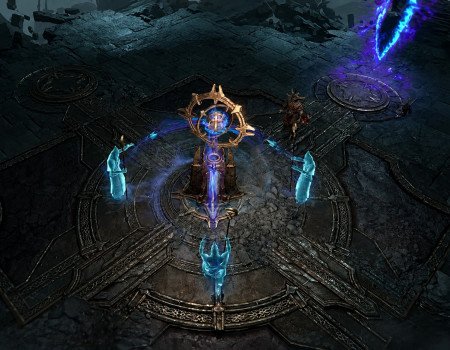
One Nightmare recreates Tal Rasha's Tomb from Diablo 2. Players assemble the Horadric Staff, place it onto its pedestal, and open the hidden chamber.
Tal Rasha's Tomb is one of the most iconic locations from Diablo 2 and the climax of Act II. After assembling the Horadric Staff, players travel through the Arcane Sanctuary and Canyon of the Magi to find the correct tomb among seven possible entrances. Inside, they place the staff into a special altar to open the way forward, only to discover that Baal is already gone and face Duriel instead. The sequence is especially memorable for its puzzle-like buildup, distinctive tombs, and sudden boss fight.
Scouring of Caldeum
Another Nightmare recreates the Scouring of Caldeum from Diablo 3.
Scouring of Caldeum is from Act II, set during the fall of Caldeum. Players fight through the city alongside Leah, cutting through demons and rescuing civilians before pushing toward the Imperial Palace. The sequence ends with the confrontation involving Emperor Hakan II, whose true identity as Belial, the Lord of Lies, is finally revealed. It is one of Act II’s defining moments because it combines a large-scale city battle with the payoff to Belial’s deception storyline.
Den of Evil
The classic Den of Evil from Diablo 2 also returns as a Waking Nightmare. This brings one of Diablo 2's earliest recognizable areas into Diablo 4.
It was the first quest in Diablo II, given by Akara at the Rogue Encampment. Players enter a cave in the Blood Moor and must completely clear it of monsters, including Fallen, Fallen Shamans, Zombies, and the Super Unique zombie Corpsefire. Once every enemy is killed, the cave fills with light, and Akara rewards the player with a Skill Point. In practice, it serves as Diablo II’s introductory combat quest and one of the first places almost every player remembers.
Halls of the Blind
Diablo 1 is represented through the returning Halls of the Blind.
Halls of the Blind comes from the original Diablo. It is an optional quest found on dungeon level 7, triggered by reading the Book of the Blind. The quest opens a sealed chamber filled with Illusion Weavers, enemies that turn invisible while moving and only reveal themselves when attacking. The objective is to survive the ambush and recover the Optic Amulet. It is especially memorable because of the creepy poem attached to the quest, which Blizzard even referenced during the BlizzCon panel.
Browse our hottest Diablo 4 Boosting services






Pop-Up Waking Nightmares
The third category is much shorter and more spontaneous. Pop-up Waking Nightmares can appear while players are already exploring Sanctuary.
For example, a player could be fighting through a Helltide when a portal suddenly appears. Entering it launches a short Waking Nightmare.
These encounters can contain:
- Wave events
- Boss fights
- Short quests
- Recreations of memorable Diablo moments
Blizzard tested an early version of this system through the Challenge Rifts seen on the test server. Season 15 contains roughly 15 pop-up Waking Nightmares.
Pandemonium
One pop-up Nightmare takes players back to Pandemonium from Diablo 2. The encounter involves fighting enemies outside the Soul Prison.
Na-Krul
Na-Krul from Diablo: Hellfire also returns. This is one of Season 15's deeper cuts, bringing content from Diablo's original Hellfire expansion into Diablo 4.
Zaka the Abyssal Worm
Season 15 also pulls from Diablo Immortal. Zaka the Abyssal Worm appears within the Realm of Damnation as another pop-up Waking Nightmare encounter.
Returning Waking Nightmare Bosses
Waking Nightmares are not only about recreated locations. Blizzard built 20 bosses and 25 monsters for Season 15's nostalgic encounters.
Some confirmed returning bosses include:
- Blood Raven
- Queen Araneae
- Archbishop Lazarus
- The Summoner
- Nihlathak
- Coldworm the Burrower
These fights accompany recreated environments from across the Diablo series. Classic monsters also return.
For example, the Maggot Lair features familiar enemy types including lightning-enchanted scarabs and resource-draining fly swarms.
Returning Diablo Characters

Waking Nightmares can also feature familiar NPCs. Several characters from previous games appear as part of these recreated memories.
Confirmed examples include:
- Pepin
- Griswold
- Adria
- Tyrael
- Leah
Blizzard went beyond recreating their models. The developers also imported original voice lines and music from earlier Diablo games.
That means characters such as Tyrael can use their original dialogue while appearing inside Diablo 4's recreated environments.
How Waking Nightmares Fit Into Season 15
Waking Nightmares effectively operate at three different scales. Prime Evil Waking Nightmares are the major story and endgame experiences, recreating long journeys culminating in Baal, Mephisto, or Diablo.
Standard Waking Nightmare dungeons recreate individual locations and quest sequences and behave much like traditional Diablo 4 dungeons. Pop-up Waking Nightmares are short events injected directly into normal world exploration.
Together, these activities cover around 30 recreated Diablo experiences. That makes Waking Nightmares much broader than a single dungeon type. They form one of the main structures connecting Season 15's seasonal story, dungeon content, open-world events, returning bosses, and endgame progression.
Waking Nightmares Rewards
Waking Nightmares aren't only there to revisit classic Diablo encounters. The largest Nightmares form part of Season 15's progression system and can be replayed for increasingly valuable rewards.
Completing the Prime Evil Waking Nightmares during the seasonal questline awards the Splinters of Evil tied to Diablo, Baal, and Mephisto. The Splinter you choose determines your seasonal Iconic Power, reputation track, War Plan modifiers, and associated rewards. If you later want to change paths, you can return to the largest Waking Nightmares and obtain another Splinter.
These encounters also remain useful in the endgame. Their Torment versions can be replayed for rewards, while Pinnacle Capstones become available at Torment 10+ and offer larger loot payouts in exchange for significantly higher difficulty.
Standard Waking Nightmare dungeons can also work with Nightmare Dungeon Keys, making them part of regular Nightmare Dungeon progression and farming.


You got -20% OFF 
Splinters of Evil
The most important reward tied to the largest Waking Nightmares is Splinters of Evil, the core seasonal progression mechanic in Season of Hell's Legacy. These are fragments connected to the three Prime Evils, and bearing one lets your character wield part of that Prime Evil's power.
You first collect all three Splinters of Evil while progressing through the Seasonal Questline. They come from defeating the Prime Evil echoes at the end of their respective Waking Nightmares: Diablo beneath Tristram Cathedral, Baal at Arreat Summit, and Mephisto inside the Durance of Hate. After collecting them, you choose one Splinter to bear at a time.
Each Splinter grants an Iconic Power based on its Prime Evil. This power periodically erupts from your character during combat, essentially letting you borrow a signature piece of that boss's power:
|
Splinter of Evil |
Prime Evil |
Iconic Power Damage |
Activities It Modifies |
|
Splinter of Terror |
Diablo |
Fire |
Helltide, Infernal Hordes |
|
Splinter of Destruction |
Baal |
Cold |
The Undercity, Lair Bosses |
|
Splinter of Hatred |
Mephisto |
Physical |
The Pit, Nightmare Dungeons |
All three Splinters can also modify Tree of Whispers activities.
Choosing a Splinter is therefore more important than simply choosing between three combat effects. Each Prime Evil has its own reputation track, which determines the seasonal progression and rewards you pursue. Every track contains eight activity modifiers and six upgrades to its Iconic Power, allowing the Prime Evil ability to become stronger as you progress. Your chosen Splinter also changes the associated activities through War Plans, so Diablo, Baal, and Mephisto effectively support different endgame routes.
There is a downside to carrying this power. Bearing a Splinter turns your character into a Dark Wanderer and makes you more vulnerable to the Prime Evil connected to it. The Prime Evils can also come after you while you use their power, so the system is deliberately built around gaining a powerful seasonal ability at the cost of additional danger.
Your choice is not permanent. If you want to move to another Prime Evil's reputation track, powers, and rewards, you can return to the largest Waking Nightmares and obtain another Splinter of Evil. This makes these Waking Nightmares relevant beyond their first Seasonal Quest completion, since replaying them is also how you change which Prime Evil path your character follows.
Even if you’re not attempting to reach Torment 10 and try those pinnacle capstone Waking Nightmares, I’d still try out these activities, partly because it's new content and partly because replaying those moments for nostalgia is probably the best idea the devs had for the new season. I wouldn’t even worry much about what you’d get from it; playing through them is worth it as it is.
Also, don’t confuse Splinters of Evil with Soul Splinters. Splinters of Evil are the three major seasonal artifacts tied to Diablo, Baal, and Mephisto, and you can only bear one at a time. Soul Splinters are a separate system of socketable seasonal gems associated with demons such as Andariel, Duriel, Belial, and Lilith, and you can equip up to three of those in Jewelry slots. We have a Soul Splinters guide dedicated to this system; make sure to check that out as well.
F.A.Q.
What are Diablo 4 Waking Nightmares in Season 15?
Waking Nightmares are dungeon-style adventures that let you relive iconic moments from previous Diablo games. Some of them culminate in the Prime Evil fight, while others are reconstructions of specific set pieces, like memorable quests, and so on.
How to start Waking Nightmares in Diablo 4?
Prime Evil Waking Nightmares are part of the seasonal questline, so you will encounter them as you progress through it. Other types are spread around the map of Sanctuary like normal dungeons. Capstone Waking Nightmares are only available at difficulty Torment 10+.
Are Waking Nightmares difficult?
There are 3 types of Waking Nightmares, all of which differ in length. The Capstone Waking Nightmares are the most difficult ones, only available at difficulty Torment 10+. So, Waking Nightmares have a flexible difficulty.
How to unlock Pinnacle Waking Nightmares?
You can unlock Pinnacle Waking Nightmares by first completing their questline versions and then reaching Torment 10 difficulty and higher.
What bosses are in Waking Nightmares?
Waking Nightmares bring back around 20 bosses from throughout Diablo history:
- Blood Raven,
- Queen Araneae,
- Archbishop Lazarus,
- The Summoner,
- Nihlathak,
- Coldworm the Burrower,
- Na-Krul,
- Zaka the Abyssal Worm