 Crispy Jackie
What’s changing for different types of WoW players?
- M+ Pushers: Blizzard is easing the load on tanks and healers. Mistakes on certain mechanics will lower the damage or mobility instead of dealing more damage.
- Raid-Focused Players: Raid loot is worth chasing again. Heroic raid Great Vault rewards move to Myth 1/6, Mythic raid Vault rewards to Myth 6/6, and rolling for a specific raid item costs one Nebulous Voidcore instead of two.
- Casual players: Housing gets up to 50 saved layouts, Blueprints, and pets that can roam indoors. Cursed Fishing adds another progression path on the Coiled Isle.
- Class and Spec Mains: Shadow Priest gets more control over Void Volley, Restoration Druid gets a safer Tranquility, and Unholy DK gets a more interactive Army of the Dead.
- Social Players: Guild chat can now connect directly to Discord. New pings can also share spell status, health, mana, and other player resources.


Read closely 
Browse our hottest WoW Boosting services






M+ Pushers: Mistakes Will Hurt The Player Who Makes Them
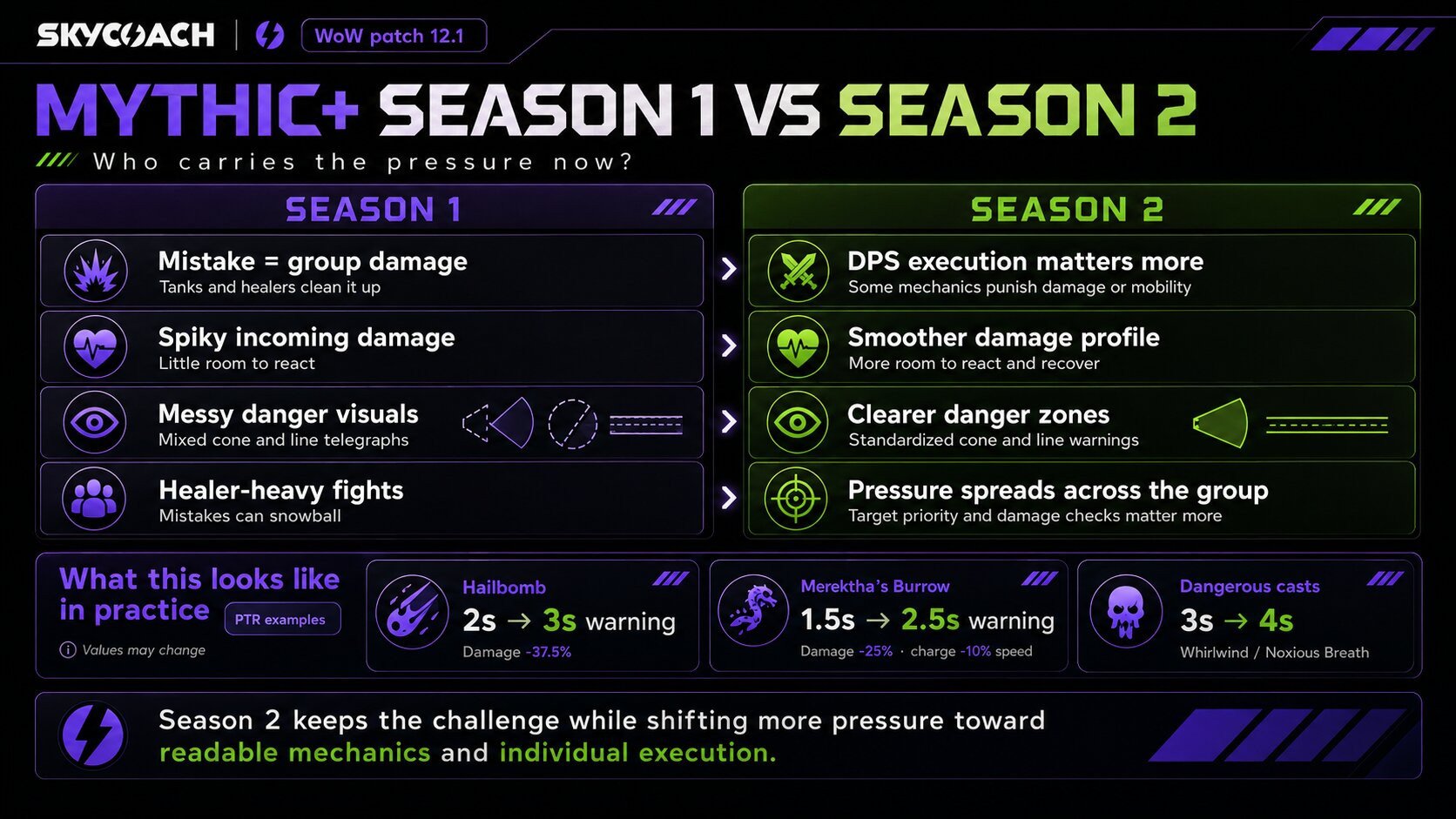
These players push high Mythic+ keys, where a single mistake from one teammate can sink an entire run. One of the biggest frustrations is how often tanks and healers end up having to recover from someone else’s mistake. In Curse of Ula’tek, Blizzard is changing how that pressure is distributed across the group.
Less pressure on tanks and healers. In Season 1, tanks and healers were often the ones expected to salvage a pull after another player made a mistake. In Season 2, Blizzard wants more of that responsibility to fall on the group as a whole. Some mechanics will trade raw damage for penalties to the offending player’s damage output or mobility, making individual execution matter more instead of turning every mistake into another healing check.
Fewer sudden deaths and more time to react. Blizzard is smoothing out incoming damage so it feels less spiky, while also retuning some of the most dangerous encounter abilities. Cone and line attacks are also getting clearer precast visuals. The goal is to give players a better chance to recognize incoming threats and give healers more room to respond before a mistake turns into a death.
Raiders: Raid Loot Is Finally Worth The Wipes
Raiders are willing to sit through hundreds of wipes to bring down a boss, but raid prep has long since become a tedious grind. In Curse of Ula’tek, Blizzard is making things easier for raiding guilds and significantly increasing the value of raid loot. Blizzard acknowledged that Mythic+ rewards had become disproportionately valuable in Season 1, to the detriment of Heroic raiding, and says it wants to better align raid rewards with the time and effort required to kill bosses.
Raiding becomes a real source of top-end gear again. Heroic raid Great Vault rewards now move to the first step of the next-higher upgrade track — Myth 1/6. Mythic raid Great Vault rewards will be Myth 6/6, and Very Rare items and loot from the penultimate and final Mythic bosses will be the equivalent of Myth 9, whether they drop directly or appear in the Great Vault. Blizzard directly ties these changes to its goal of bringing raid rewards back into better alignment with Mythic+.
Targeting a specific raid item gets cheaper. The cost to roll for a raid item is dropping from two Nebulous Voidcores to one. Effectively, each Voidcore a raider saves is now worth twice as much, although additional Voidcores will become available more slowly this season.
Good drops no longer lose their identity when converted to tier. After converting an item through the Catalyst, class set armor now retains the original item’s secondary and tertiary stats, along with certain special cantrip effects. Blizzard specifically cites Ula’tek’s Venomcursed armor cantrip as an example. Previously, non-set armor in tier slots quickly lost value because it was almost inevitably converted into a standard tier piece. Now a lucky drop can keep the stats and effects that made it special after conversion.
Casual Players: Side Activities Finally Get a Real Endgame
Casual players log in to explore the world, collect things, and adventure at their own pace. The biggest change for this audience is that Blizzard is expanding long-term activities that come without timers or a mandatory group meta.
Housing becomes a real creative outlet. Up to 50 layouts can be saved and switched between at any time, and Blueprints let you import another player’s interior, individual room, or exterior and immediately see which rooms and decor you’re missing. Pets can now be assigned to Pet Beds, with indoor pets able to roam around the house. Instead of having to build one "perfect" house, players can keep experimenting and share their creations with others.
Fishing gets its own progression loop. Defeating rare elites spawned by Curse Surges around the Coiled Isle unlocks Cursed Fishing at those locations, and gaining reputation with Tokka’s crew gradually opens up more cursed waters to fish in. That gives players who want to explore the island and collect rewards something to work toward outside raids and Mythic+.
Class And Spec Mains: Major Spec Fixes Are Coming
For class and spec mains, Blizzard is focusing less on raw numbers and more on the mechanics that make certain specs frustrating to play. Some have too much of their power concentrated in short cooldown windows, others have important abilities that are awkward to use, and some have accumulated enough moving parts to create visual clutter. In Curse of Ula’tek, Blizzard is targeting those pain points directly instead of simply handing out another “+5% damage” adjustment.
Shadow Priests get more control over when to use Void Volley. Voidform now grants three uses of Void Volley instead of putting the ability on a repeating cooldown during Voidform. Those uses can be spaced out across the Voidform window and used when they are actually needed, rather than forcing players to cast Void Volley as soon as possible to avoid losing the next use.
Restoration Druids get more protection during Tranquility. During Tranquility, the Druid gains an absorb equal to 60% of their health and is protected from knockbacks. The new Overgrowth talent also causes Nature’s Swiftness to make the next Regrowth apply Lifebloom, Rejuvenation, and Wild Growth’s heal-over-time effect to an ally.
Unholy Death Knights get a more interactive Army of the Dead. Army of the Dead now forms an army of eight Lesser Ghouls for 30 seconds. While the army is active, Scourge Strike executes Orders based on nearby enemies: Death Order sends the Lesser Ghouls at the current target, while Epidemic Order makes them damage nearby enemies. Instead of functioning as another largely passive summon, the army now gives the player a more active role in directing what the undead do.
Social Players: Guild Chat Finally Connects to Discord
Social players often have to bounce between WoW and Discord, organize group activities outside the game, and coordinate with their group in combat. In Curse of Ula’tek, Blizzard is cutting down on that friction in several ways.
WoW guild chat connects to Discord. Guilds can link their in-game chat to a selected Discord channel and send messages both ways. That means players no longer need to launch WoW just to follow a guild conversation or help organize the night’s activities.
Less information has to be called out manually. Players can now ping an ability directly from the action bar or Cooldown Manager to share its status with the group. They can also ping their own player resources to communicate information such as health or mana. Instead of repeatedly asking “Do you have a defensive?” or “Healer, how much mana do you have?”, groups can share some of that information with a single ping.


You got -20% OFF 
So, What’s The Takeaway?
The biggest shift in Curse of Ula’tek is that Blizzard is finally starting to separate challenge from frustration. The patch isn’t making WoW easier. Instead, it’s trying to remove a kind of “gameplay tax”: situations where your enjoyment and results depend less on how well you play and more on other players’ mistakes, pressure to engage with another mode, clunky UI, reliance on Discord on a second monitor, or decisions you can’t easily undo.
How well that philosophy holds up in real high keys and the new raid won’t become clear until Season 2 begins. We’ll find out once we play.
Read our other WoW guides: