 Wayne Halkett
AION 2 Daevanion Board Guide Quick Overview:
- Starting from level 13, Daevanion Boards become your new leveling system. You can unlock stat gains and skill level-ups through six different node trees available at different levels.
- Four base Boards (Nezekan, Zikel, Vaizel, and Triniel) provide basic upgrades that carry into any type of content. Ariel and Azphel are PvE and PvP-exclusive Boards that progress separately.
- You can unlock nodes by using Daevanion points, which are provided as rewards for completing different types of content. You can earn normal Daevanion points by completing side quests and Sealed Dungeons. PvE and PvP-specific points are mostly granted through completing weekly Ascension Trials and Battlefields.
You can rely on Skycoach’s AION 2 Abyss Points Farm to provide you with as many Abyss Points as you need to get your PvP to another level without having to spend hours locked in one area.


Read closely 
Browse our hottest Aion 2 Boosting services








What are Daevanion Boards?
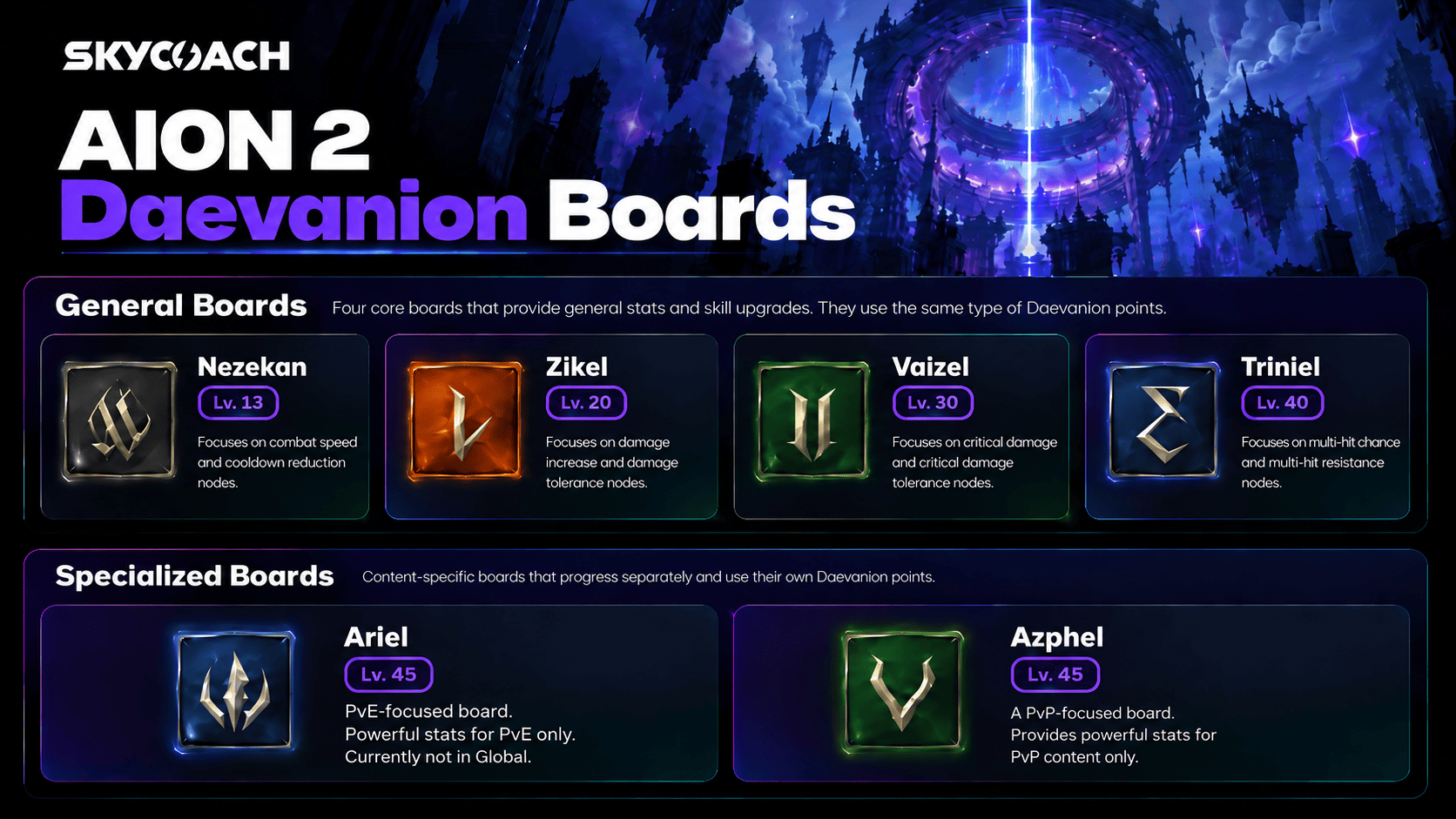
Daevanion boards are yet another part of a complicated leveling system in AION 2. It is essentially a collection of node trees that allow you to further upgrade your character once you’ve reached level 12.
Each node provides a small stats boost, like increasing your character’s HP or Defense, or providing extra crit resistance. On their own, most of these boosts aren’t impressive at all, but since you get to unlock dozens of them, the numbers eventually add up.
Overall, there are four different types of nodes:
- Gray nodes are the cheapest and most prevalent. Costing just 1 point, these provide base stat increases.
- Green nodes allow you to level up your passive skills at the cost of 2 Daevanion points.
- Blue nodes enable you to level up your active skills for 3 Daevanion points.
- Orange nodes, usually located at the edge of the grid, provide percentage increases to your stats at the cost of 4 Daevanion points.
The game features 8 different boards:
- The first four Boards (Nezekan, Zikel, Vaizel and Triniel) are there to provide general stats and skill increases.
- Ariel is a board focused entirely on PvE content. Its boosts don’t transfer into PvP. The board is currently absent on Global.
- Azphel is the opposite of Ariel, focusing entirely on PvP with no impact on PvE content.
- Machutan and Yustiel are mid- and endgame boards that provide general boosts similar to the four basic boards. However, these aren’t available at global launch.
Each board is a large grid with nodes spread out somewhat randomly. You always start in the middle of the board, meaning that you will always have to work your way through multiple gray nodes to get to those valuable green, blue, and orange nodes.
The Four Basic Daevanion Boards
Nezekan, Zikel, Vaizel, and Triniel are your four basic boards. All of them feel very similar and offer simple basic boosts. The only meaningful difference between them lies in orange nodes, which focus on a particular aspect of your kit based on the board.
|
Board |
Unlock Level Requirement |
Orange node specialty |
|
Nezekan |
13 |
Combat speed / Cooldown reduction |
|
Zikel |
20 |
Damage increase / Damage tolerance |
|
Vaizel |
30 |
Critical damage / Critical damage tolerance |
|
Triniel |
40 |
Multi-hit chance / Multi-hit resist |
All four basic boards use the same type of Daevanion points, meaning that you are free to allocate them wherever you like. Note that you cannot max out your four basic boards, so you’ll have to make some choices.
I’d recommend prioritizing your skills, since these first few boards enable you to add four whole levels to all of your active and passive abilities. You won’t be able to do this through other means on global launch, since Ariel and Azphel don’t provide ability level increases.
How to Get Normal Daevanion points?
There are three main ways you can get normal Daevanion points in AION 2.
First of all, completing green side quests will provide these points as a reward. Considering how valuable the skill increases provided by four basic boards are, side content actually becomes mandatory if you expect to have a good time with the game and not fight damage sponges for hours. Do your best to complete all green side quests, and the reward will be more than worth it.
Speaking of side content, Sealed Dungeons also provide normal Daevanion points for mastering them. There are plenty of these scattered across the map, so just go out in the open world and complete them at your own pace.
Finally, if you want to speed things up, AION 2 allows you to purchase 50 Daevanion points per character using the Shugo Festival Shop.
Browse our hottest Aion 2 Boosting services







PvE and PvP Daevanion Boards
Ariel (PvE) and Azphel (PvP) are hyper-focused Boards unlocked at level 45, and they only provide stats for their specific content. It should be immediately clear from the tooltips: +50 PvE Defense is not the same as +50 Defense, after all.
Unlike basic boards, Ariel’s and Azphel’s blue and green nodes don’t help you with leveling your skills — they simply increase various stats related to their content type. Think of increasing boss damage tolerance or something similar. Essentially, if you don’t play PvP, there is no reason for you to bother with Azphel, and vice versa.
Both Ariel and Azphel Boards can be maxed out, as there is no limit on Daevanion Points one can get for them. However, each of the Boards uses its own type of points that are significantly harder to obtain. The game expects you to grind through the according content if you want to become a PvP menace or a grizzled PvE veteran.
How to Get PvE and PvP Daevanion Points?
Getting Daevanion points for PvP and PvE requires much more time and effort, so you should treat it as something akin to the endgame grind. The whole system is based on a combination of crafting and completing weekly objectives.
Weekly Challenges
First of all, participating in the weekly Ascension Trials (PvE) and Battlefields (PvP) is the only really consistent way to get Daevanion fragments, which can be Substance Morphed into Daevanion Crystals. These, in turn, provide the points. The rate is a bit steep for casual players: getting a single Ariel Daevanion Crystal requires combining 100 Ariel fragments with 50 Odyle, for instance.
That said, the game features an additional gambling mechanic for those who are willing to deal with the risks. Substance Morph allows you to spend 1/10th of resources required to try and craft the item with a 10% success rate. On average, the result is the same, but you might get an occasional “free” craft when you’re not feeling like grinding another objective.
Direct Purchase
Since Daevanion Crystals are craftable, they are also sellable on the Auction House, which makes for another way to obtain these as long as you can afford it. You are also free to sell your own Daevanion Crystals to make some quick cash.
Just like with normal Daevanion points, you can purchase a maximum of 50 PvE and 50 PvP Daevanion points from the Nightmare Shop and the Abyss Shop accordingly, all in four separate packages with prices doubling after each purchase. For instance, the first 10 points go for 800 Phantasmal fragments, but then you’ll have to pay 1600 for another ten. After that, 15 additional points are sold at 3200, and the last 15 will cost you 6400.
Content-Specific
Finally, leveling your Monolith by collecting Empyrean Traces (or Feathers) will provide you with some Azphiel Daevanion Crystals, while completing some daily and weekly quests will provide a few PvE fragments.


You got -20% OFF 
Leveling Priority
While you might initially think that your class plays a huge role in your Daevanion Board progression, in reality it might not be as important. Most characters benefit highly from Skill Level increases, so you will have to unlock those as soon as you can if you want to play optimally.
Then, I’d recommend attack-related nodes followed by those that increase survivability, in that order. Clearing content is easier if you deal more damage, and the faster you get through it, the more points per hour you will get. MP and critical resistance seem to be much less important at the moment.
That said, it is okay to skip certain ability level-ups if you are adamant that the ability itself is just not worth much. For example, experienced Korean players tend to ignore Soul’s Cry because they find it underwhelming. However, the global version of the game is a bit different, so you’ll have to try things out yourself.
Read our other AION 2 Guides:
F.A.Q.
What are Daevanion Boards?
Daevanion Boards are special node trees that are used for leveling up your character starting from level 13. Depending on the board, you can get stacking general, PvE, or PvP stat bonuses as well as level-ups for your abilities.
When are Daevanion Boards unlocked?
Your first Daevanion Board, Nezekan, is unlocked at level 12, followed by Zikel, Vaizel, and Triniel at levels 20, 30, and 40. PvE and PvP-specific boards are unlocked at level 45 and are using their own types of Daevanion Points.
How can I earn Daevanion points?
Normal Daevanion points are provided as rewards for completing side quests and Sealed Dungeons. You can also purchase a limited number of them through the Shugo Festival Shop. PvE and PvP Daevanion points can be earned through weekly challenges, content-specific objectives, Auction House, or Nightmare/Abyss Shops.
Which Daevanion Boards nodes are the best?
In general, you want to level relevant active and passive abilities first. Orange nodes are the most expensive, but they are also very impactful, so get them as well. When it comes to gray nodes, prioritize damage followed by some base survivability to clear content most efficiently.