 Dallon Avery
AION 2 Crafting Guide Quick Overview:
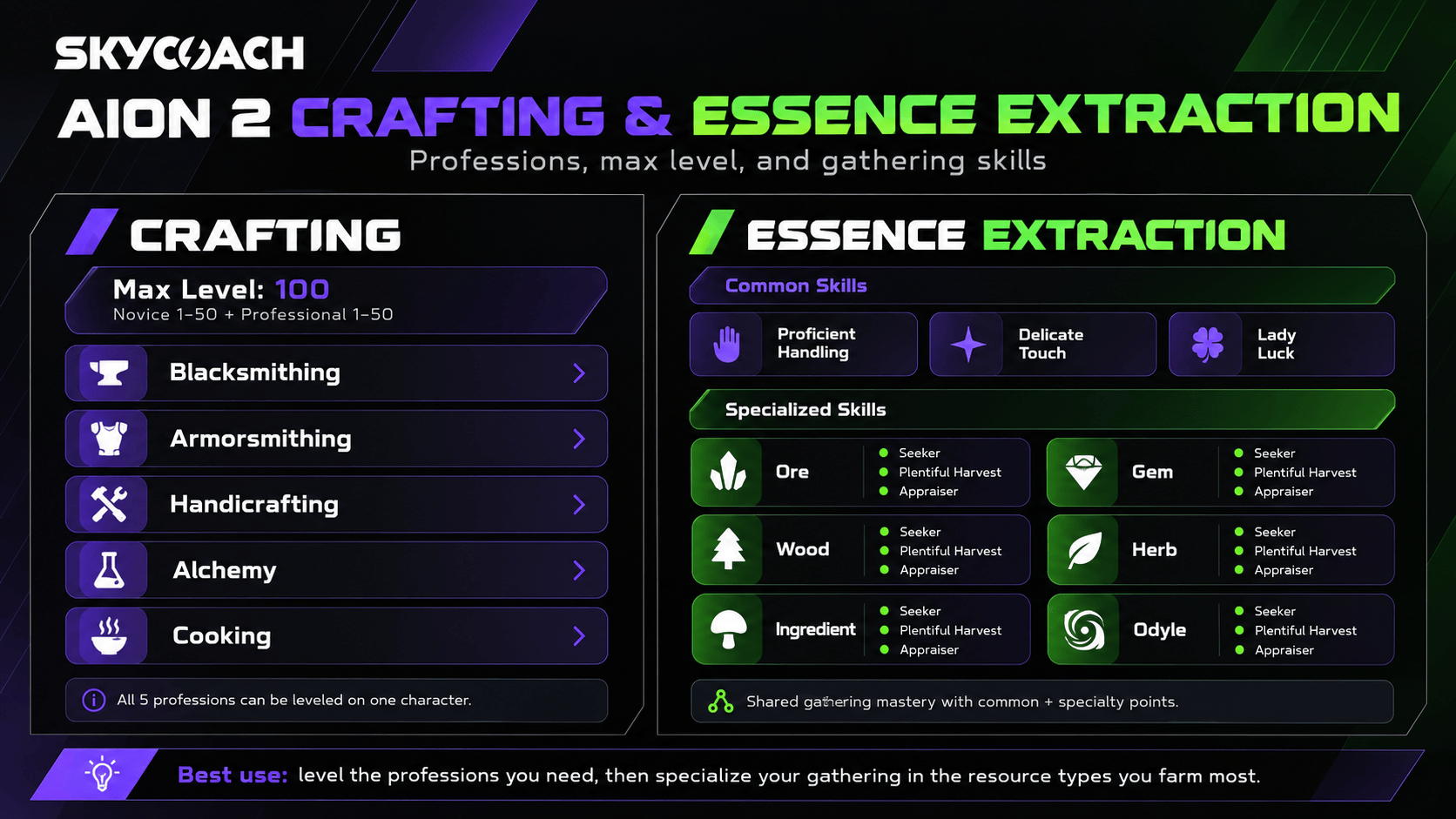
- AION 2 features 5 crafting professions: Blacksmithing, Armorsmithing, Handicrafting, Alchemy, Cooking.
- Each crafting profession recipe usually includes materials gathered in the wilds along with materials acquired from crafting vendors.
- High-level recipes use refined versions of crafting materials
- Gathering in AION 2 is called Essence Extraction
- Essence Extraction has 3 general gathering skills as well as 3 skills for each gatherable material type.
Would you like to level up your professions faster? Buy AION 2 Professions service and get any crafting profession to a desired level, or upgrade your essence extraction skills.


Read closely 
Browse our hottest Aion 2 Boosting services







AION 2 Crafting and Essence Extraction Basics
AION 2 features a fully realized crafting and gathering system. Right off the gate, I’d like to say that players who have an active subscription would like to get busy with crafting mainly to sell the crafted items in the player market to make more Kina, while players without a subscription would like to use crafting and gathering just to sustain themselves by making something useful for their characters. It is entirely possible to craft armor and weapons for your class, although I’m not sure this would be better, easier, or faster than farming better gear in one of the PvE Activities. That being said, crafting gear upgrade resources might be useful to all players. Speaking of upgrades, check out my AION 2 gearing guide where I explain how to upgrade your gear and what kind of resources are used for that.
Both crafting professions and Essence Extraction cap at 100 total proficiency levels. The game splits those 100 levels into two ranks: Novice (Lv. 1-50) and Professional (Lv. 51-100), meaning you can level up your professions and gathering up to level 100. When you reach the level 50 cap, you have to undergo a “promotion” quest, which upgrades you from Novice to Professional and allows you to continue to level up. More on that later.
Lastly, crafting uses recipes, which come with their own level requirements and, of course, the list of required resources or materials needed to make an item. That’s the gist of it. Now, let’s take a closer look at gathering and crafting separately.
AION 2 Essence Extraction Explained

In AION 2, gathering is, for some reason, called Essence Extraction. It has two types of skills that allow you to be better at gathering materials in general, as well as specialize in gathering one of six types of materials. Also, unlike Crafting, gathering doesn’t have dedicated professions.
Before I start talking about skills and skill points, it’s important that you understand how the gathering process happens. Actually, gathering and crafting processes are similar.
Once you start gathering, you’ll see two gauges: one shows success and the other shows failure. Every equal number of seconds, either the success or failure bar fills up by a random amount. If the success bar reaches 100%, you’ll extract the material from the node; if the failure bar reaches 100%, you won’t. Each resource node can be used several times before it is depleted. Therefore, you can either succeed and extract from the same node, let’s say, 3 times, or fail 3 times. And the essence extraction skills, especially common ones, allow you to become more successful at extracting from nodes. That’s how the process works in general.
Common Skill Points
There are 3 Common Essence Extraction skills. These affect every resource you gather.
|
Common Skill |
What It Does |
Maximum Level |
|
Proficient Handling |
Increases how much the Success Gauge fills whenever you get a successful roll |
10 |
|
Delicate Touch |
Reduces how much the Failure Gauge increases on a failed roll |
10 |
|
Lady Luck |
Gives successful rolls a chance to massively increase the Success Gauge |
10 |
Every time you level up essence extraction, you get 1 Common Skill Point, which you can then invest into one of these 3 common skills.
A very important thing to understand here is that a higher level of a skill costs more skill points. Novice levels 1–5 cost 1, 2, 3, 4, and 5 points respectively. Professional levels 6–10 then cost 5 points each. So fully maxing one Common skill costs 40 points.
You also have a chart with 3 axes that shows your alignment with these 3 skills:
- Adeptness = Proficient Handling
- Prudence = Delicate Touch
- Luck = Lady Luck
So that triangular graphic is essentially a visual representation of how you've distributed your Common skills. At Novice Lv. 1, all three are effectively at zero.
It is actually known by how much each of these 3 skills increases the success gauge or decreases the failure gauge, as well as increased luck chances:
|
Skill Level |
Proficient Handling |
Delicate Touch |
Lady Luck |
|
1 |
+5 Success Gauge |
-8 Failure Gauge |
8% chance for ×2.5 Success |
|
2 |
+10 |
-16 |
12% |
|
3 |
+15 |
-24 |
16% |
|
4 |
+20 |
-32 |
20% |
|
5 |
+25 |
-40 |
24% |
|
6 |
+30 |
-48 |
27%, ×2.5 or ×4 |
|
7 |
+35 |
-56 |
30%, ×2.5 or ×4 |
|
8 |
+40 |
-64 |
33%, ×2.5 or ×4 |
|
9 |
+45 |
-72 |
36%, ×2.5 or ×4 |
|
10 |
+50 |
-80 |
40%, ×2.5 or ×4 |
Personally, I’m focused on making sure that I’m extracting successfully every time, so I’m leveling Proficient handling and Delicate Touch equally first.
Specialty Skill Points
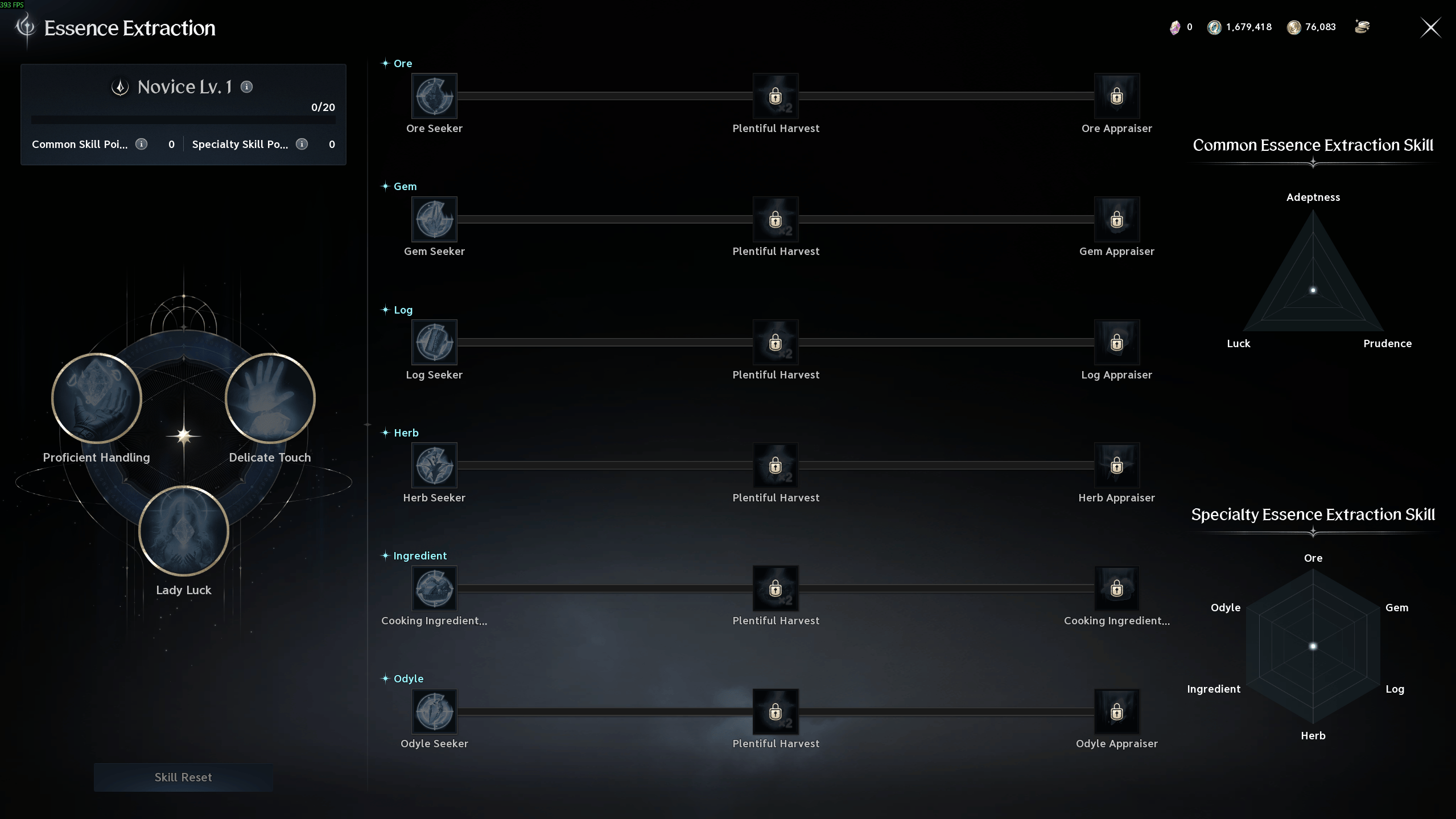
So, Specialty Skill Points refer to specific material types:
- Ore
- Gem
- Log
- Herb
- Ingredient
- Odyle
Each one has 3 skills associated with them, but they’re all similar: Seeker → Plentiful Harvest → Appraiser.
|
Essence Type |
Seeker |
Plentiful Harvest |
Appraiser |
|
Ore |
Shows Ore on minimap |
Up to 30% double Ore |
Up to 30% grade reroll |
|
Gem |
Shows Gems on minimap |
Up to 30% double Gems |
Up to 30% grade reroll |
|
Log |
Shows Logs on minimap |
Up to 30% double Logs |
Up to 30% grade reroll |
|
Herb |
Shows Herbs on minimap |
Up to 30% double Herbs |
Up to 30% grade reroll |
|
Cooking Ingredient |
Shows ingredients on minimap |
Up to 30% double ingredients |
Up to 30% grade reroll |
|
Odyle |
Shows Odyle on minimap |
Up to 30% double Odyle |
Up to 30% grade reroll |
You also get a very limited amount of Specialty Skill Points per essence extraction level:
|
Essence Extraction Level |
Specialty Points Awarded |
|
10 |
+1 |
|
20 |
+1 |
|
30 |
+1 |
|
40 |
+1 |
|
50 |
+2 |
|
60 |
+1 |
|
70 |
+1 |
|
80 |
+2 |
|
90 |
+2 |
|
100 |
+2 |
That’s a total of 14 points. Fully maxing one resource category costs:
- Seeker: 1
- Plentiful Harvest: 3
- Appraiser: 3
That's 7 Specialty Points per resource type. Since you only receive 14 points in total, you could theoretically completely max two of the six resource categories, or distribute those points more broadly. That makes the Specialty tree much more of an actual build choice than the shared Essence Extraction level itself.
Gathered material quality
Ore, Gems, Logs, and Odyle can have several material grades, while Herbs and Cooking Ingredients behave somewhat differently. For example, there are four versions for Ore, Gem, Log, and Odyle nodes, including progressively higher-quality variants. Herbs have a more limited quality structure, and Cooking Ingredients generally don't follow the same four-grade progression.
For example, Odyle has:
- Odyle
- Fine Odyle
- Pure Odyle
- Radiant Odyle
When you interact with a node, you might get lucky and start extracting a higher grade of a material. On top of that, the node can additionally drop Poko's Skin Bundle (Bound) as a bonus item.
Skill Reset
You also have the Skill Reset button which allows you to respect your point investments. But you have to pay 50,000 Kina, which refunds your Essence Extraction skill allocation so you can redistribute it. This matters because 14 Specialty Points aren't enough to build all six branches fully. You're not permanently trapped by an early choice, but changing specialization isn't free.
Aion 2 Crafting Explained

Crafting in AION 2 uses the same basic Success versus Failure system as Essence Extraction. Every recipe has its own Required Proficiency Level, while each crafting profession has a separate Current Proficiency Level. When you start crafting, the game runs a sequence of turns where either the Success Gauge or Failure Gauge increases. If the Success Gauge reaches its target first, the craft succeeds. If the Failure Gauge reaches its target first, the craft fails.
Each recipe has different Success and Failure Gauge values, so recipes do not all have the same base success rate. Your proficiency also matters. The larger the difference between your profession level and the recipe requirement, the better your maximum success chance usually becomes. This increase is not linear, though, and some proficiency differences can result in the same displayed probability.
You can check the exact chance before crafting through the Crafting Chance window. The Expected Probability tab shows the maximum success probability based on the difference between your current proficiency and the recipe requirement. The displayed value also takes the recipe’s gauge information, proficiency adjustments, and other applicable modifiers into account.
For example, a recipe requiring Novice Lv. 1 can have a basic success chance of about 95.20% when your proficiency matches the requirement. With a proficiency difference of +3, that same recipe can reach roughly 95.74%. At higher differences, the chance continues to improve, although not by a fixed amount every level.
|
Proficiency Difference |
Example Basic Success Chance |
|
0 |
95.200927% |
|
1 |
95.587774% |
|
2 |
95.724539% |
|
3 |
95.739046% |
|
4 |
95.739046% |
|
5 |
95.888298% |
|
6 |
96.467538% |
|
7 |
96.837241% |
|
8 |
96.837241% |
A failed craft still consumes the materials used in the attempt. However, both successful and failed crafts contribute proficiency EXP, so failures are not completely wasted from a leveling perspective. You should also avoid starting a craft in a dangerous area. If you are hit while crafting, the process is canceled, counts as a failure, and the materials are still consumed.
Crafting Stations
You can’t craft anything from the crafting menu, instead, you must find crafting stations in one of the major cities or towns for your faction. Only by interacting with a specific crafting station can you actually start crafting.
|
Faction |
Crafting Station Locations |
|
Elyos |
Dawn Legion Base and Zumion Village in Verteron |
|
Asmodians |
Safe Haven and Nornir Assembly in Altgard |
The crafting areas also have profession merchants nearby. These vendors sell the supplementary materials used in recipes, such as solvents, oils, powders, seasonings, and other profession-specific reagents. A simple early example is Orichalcum Ingot, which combines gathered Orichalcum Ore with Orichalcum Solvent bought from the Blacksmithing Shop.
There are six crafting-related merchant types worth mentioning:
|
Merchant |
Shop |
|
Blacksmith Merchant |
Blacksmithing Shop |
|
Armorsmith Merchant |
Armorsmithing Shop |
|
Handicraft Merchant |
Handicrafting Shop |
|
Alchemy Merchant |
Alchemy Shop |
|
Cooking Merchant |
Cooking Shop |
|
Morph Merchant |
Substance Morph Shop |
The first five naturally correspond to the five crafting professions. The Morph Merchant is slightly different because it serves Substance Morph rather than a normal crafting profession. Current Global shop data lists Blacksmithing, Armorsmithing, Handicrafting, Alchemy, Cooking, and Substance Morph Shops in Verteron and Altgard.
Crafting Materials and Recipe Requirements
Every recipe has its own material list and proficiency requirement. Basic recipes usually combine gathered materials with reagents purchased from crafting vendors. Higher-level recipes can also require processed materials, upgraded resource grades, monster drops, or materials obtained from PvE activities.
A simple early Blacksmithing recipe is Orichalcum Ingot:
|
Recipe |
Required Materials |
|
Orichalcum Ingot |
Orichalcum Ore ×2, Orichalcum Solvent (Bound) ×1 |
Processed materials like ingots are then used in more advanced recipes. This creates a natural crafting chain where raw gathered resources are first refined and later turned into equipment, consumables, or other materials.
Crafting quantity can also be adjusted before starting. The interface lets you increase the number of items you want to make or use MAX to craft as many as your current materials allow.


You got -20% OFF 
Crafting Combo
Certain recipes can trigger an additional mechanic called COMBO crafting. A Combo can only happen after a normal craft succeeds. If the recipe supports it, a separate Combo activation chance is checked, allowing you to attempt an improved result.
The game tracks Basic crafting probability and Combo probability separately. You can switch between them in the Expected Probability menu to see how your proficiency affects both.
Combo crafting is especially important for equipment recipes because it can produce improved versions of crafted items. In some progression chains, these upgraded results are required for later recipes, so simply succeeding at the normal craft is not always the final step.
The basic flow looks like this:
- Meet the recipe's proficiency requirement.
- Provide the required materials.
- Start the craft.
- Success and Failure Gauges compete.
- The craft either succeeds or fails.
- Materials are consumed either way.
- Profession EXP is gained.
- If the recipe supports COMBO, a successful craft can trigger an additional Combo attempt.
Crafting Profession Levels
Each crafting profession levels separately. Raising Blacksmithing does not increase Armorsmithing, Handicrafting, Alchemy, or Cooking.
All five professions use the same overall progression:
|
Rank |
Levels |
|
Novice |
Lv. 1–50 |
|
Professional |
Lv. 51–100 |
At Novice Lv. 50, you need to complete the corresponding promotion before continuing as a Professional. This means every profession can reach 100 total proficiency levels.
Higher proficiency does two things at once: it unlocks recipes with higher requirements and improves your success chances on recipes below your current level. Because of that, leveling a profession is useful even after you have already unlocked the recipe you want to make.
Crafting Recipe Categories
Each profession also divides its recipes into its own categories. For example, Blacksmithing includes:
|
Crafting Profession |
Exact Crafting Categories |
|
Blacksmithing |
Greatswords, Longswords, Daggers, Maces, Guards, and Blacksmithing Materials |
|
Armorsmithing |
Chest Armor, Leg Armor, Helms, Pauldrons, Gloves, Boots, Cloaks, and Armorsmithing Materials |
|
Handicrafting |
Bows, Staves, Necklaces, Earrings, Rings, Bracelets, and Handicrafting Materials |
|
Alchemy |
Spellbooks, Orbs, Potions, Serums, Scrolls, Manastones, Soulstones, and Alchemy Materials |
|
Cooking |
Food and Cooking Materials/Seasonings |
The other four professions use their own recipe categories, which makes it easier to find the type of item you want to craft.
AION 2 Crafted Item Quality
Crafted items in AION 2 use the same item-grade system as the rest of the game. For equipment currently available in the Global client, the relevant grades are Common, Rare, Epic, and Unique. Heroic and Mythic exist in the broader item-grade system, but current weapons, armor, and accessories top out at Unique.
Crafted gear does not stay at the same grade throughout its progression. As you move through a crafting line, later recipes create higher-grade versions of the same equipment type. For example, an Orichalcum weapon starts at Common, while later Expert, Artisan, and Dragon Lord versions move through Rare, Epic, and Unique grades.
AION 2 also uses Splendent versions of crafted equipment. Splendent is not a separate item grade by itself. It is an improved crafting result that can appear through Crafting Combo and is often higher-grade than the normal result. These Splendent items are important because later recipes can require them as ingredients for the next step in the crafting chain.
A simple weapon progression looks like this:
|
Crafted Item |
Grade |
|
Orichalcum weapon |
Common |
|
Splendent Orichalcum weapon |
Rare |
|
Expert's Orichalcum weapon |
Rare |
|
Expert's Splendent Orichalcum weapon |
Epic |
|
Artisan's Orichalcum weapon |
Epic |
|
Artisan's Splendent Orichalcum weapon |
Unique |
|
Dragon Lord weapon |
Unique |
This is separate from the quality variants used by some gathered materials, which I covered earlier in the Essence Extraction section. In crafting, Common, Rare, Epic, and Unique describe the grade of the finished item, while terms such as Splendent describe a particular crafting result or step in the recipe progression.
Read our other AION 2 guides:
F.A.Q.
What is the best crafting profession in AION 2?
There is no single best profession for every character. Blacksmithing, Handicrafting, and Alchemy are especially useful for class-specific weapons, while Armorsmithing covers armor and Cooking provides useful consumable buffs.
How do you level up crafting in AION 2?
You gain proficiency EXP by crafting recipes from that profession, including failed attempts. Each profession progresses from Novice Lv. 1–50 to Professional Lv. 51–100, with a promotion required at Lv. 50.
How do you level up Essence Extraction in AION 2?
Gather any resource node to earn Essence Extraction EXP. Ore, Gems, Logs, Herbs, Cooking Ingredients, and Odyle all contribute to the same shared gathering proficiency.
Can crafting fail in AION 2?
Yes. Crafting uses competing Success and Failure Gauges, and a failed craft still consumes the required materials. Raising your proficiency above the recipe requirement generally improves your expected success chance.
What are the gathering professions in AION 2?
AION 2 has one gathering profession called Essence Extraction rather than separate Mining or Herbalism professions. It covers six resource categories:
- Ore
- Gems
- Logs
- Herbs
- Cooking Ingredients
- Odyle