 Dallon Avery
Mage Guide for TBC Anniversary Quick Summary:
- Mage Pros & Cons
- How to play a mage in TBC Anniversary
- Best race, Stat priority for this class
- Best mage builds
- Leveling, BiS gear, rotations, and more!
Want to level up your mage even faster? Buy TBC Anniversary Powerleveling service at Skycoach and get to a desired level with the help of our professional WoW players. Get access to all of Anniversary endgame content - heroic dungeons, raids, competitive PvP, and access to Outland!
Note: At Skycoach, you can Buy TBC Anniversary Boost at the best prices with fast delivery. Use our special PROMO CODE (in green) hidden in this article for a 20% DISCOUNT.
Browse our hottest TBC Anniversary Boosting services








Mage Changes in TBC Classic Anniversary

TBC Classic Anniversary Mage gameplay receives a noticeable upgrade when moving from Classic into The Burning Crusade on these new servers.
One of the biggest changes is the introduction of new core abilities.:
- Arcane Blast allows Arcane Mages to create an actual rotation, as it builds damage as you cast it, but at the cost of higher mana consumption.
- Invisibility gives Mages a reliable threat drop and escape tool.
- Spellsteal allows Mages to steal and use enemy buffs, adding a versatile, unique tool to Mages.
- Ice Lance gives Frost Mages a reliable burst everywhere Ice is Frozen.
- Molten Armor is a damage version of Mage Armor.
Overall mana management has improved as Evocation is now baseline with a decent mana return, making it a reliable cooldown across the board. With some streamlining of tier set bonuses and Evocation, Mages are no longer forced to play with downtime and extreme conservativism.
Arcane Focus is reworked, lessening the early gearing pressure and making Arcane a full-fledged raid spec from the get-go. The hit cap is now 16%, meaning Mages can focus on damage early as opposed to gearing.
Also, if you’re looking for the Mage DPS guide TBC Classic Anniversary, it’s worth knowing that Dual Spec lets you, basically, be a two-in-one class. So, it's actually possible to spec for raiding and leveling at the same time, for instance. The fact that there’s no more limit on buffs and debuffs inside raids means that your DPS in instanced content will increase by a huge margin, provided your party members use their buffs on you.
Mage Pros & Cons
Mage is strong and versatile, but is not without its trade-offs. Knowing both sides will help set realistic expectations ahead of time.
Pros
- Throughout most of the expansion, Arcane and Fire will be able to dominate the raid damage meters, meaning there is top-tier DPS potential.
- Through Polymorph, slows and roots, and with interrupts and other unique tools, Spellsteal, Mages have extraordinary crowd control and utility, which makes them valuable to any group composition.
- Mages have the best rate of leveling, the best AoE farming, and the best all-around convenience. Having access to portals, food, and water allows Mages to advance and make gold.
Cons
- Because of all the previous positive traits, there is also heavy class competition, which makes raid or dungeon participation difficult during the start of the game.
- Mistakes in the raid because of mana, cooldowns, position, or class restrictions will be punished more harshly than if you were using a tank class.
- Mages are very squishy outside of using their cooldowns. This requires a lot of control and PvE or PvP awareness to survive.
Players who enjoy controlling the game, making plans, and optimizing the game will enjoy Mages, but it requires a fully focused and aware player to be able to perform well.
How to Play Mage in TBC Classic Anniversary

If you’re not sure how to play mage in TBC Classic Anniversary, it’s all shaped as much by system changes as by class mechanics. While Mage abilities and talents follow authentic TBC design, features like Dual Spec, phased progression, and faster leveling significantly change how the class is played and optimized.
One of the defining elements of Mage gameplay on Anniversary servers is Dual Spec. This allows Mages to maintain two fully optimized builds at all times, removing the need to compromise between different types of content. Most players will take advantage of this by pairing a raid-focused damage spec with a control-oriented setup for PvP, dungeons, or farming.
Most potentially used dual-specs:
- Arcane for raids and Frost for PvP or Heroics
- Fire for later raid phases and Frost for open-world and dungeon control
This flexibility makes Mage one of the most adaptable classes throughout the expansion.
Leveling and early progression also favor Mage heavily. Faster leveling during the pre-patch amplifies AoE strengths, allowing efficient dungeon cleaves or open-world farming. Once in Outland, Mage crowd control becomes essential in early Heroic dungeons, where Polymorph, slows, and roots often matter more than raw damage.
Raid gameplay focuses on planned damage windows rather than constant casting. Arcane revolves around short, high-impact bursts with strict mana management. Fire provides steadier damage that scales strongly with crit and gear in later phases. The removal of buff and debuff limits improves damage consistency and allows Mage talents and procs to function without restrictions.
PvP gameplay is dominated by Frost Mage. With easy access to Dual Spec, Frost can be dedicated entirely to arenas and battlegrounds. Control, positioning, and fight resets define success, using tools like Ice Barrier, Ice Block, and Polymorph to dictate tempo rather than chase sustained damage.
In TBC Classic Anniversary, Mage rewards players who plan ahead. Dual Spec reduces friction, phased content determines spec value over time, and strong control tools define Mage impact across all content types.
Mage Best Race in TBC Classic Anniversary
Choosing the best race for Mage in TBC Classic Anniversary depends largely on whether your focus is PvE or PvP. While racial bonuses are not strong enough to make or break the class, some races offer clear advantages that align well with Mage strengths, especially in raids and arenas.
On Alliance, racial choices lean toward consistency and utility, while Horde races offer stronger offensive and PvP-oriented bonuses. With Dual Spec available, many players will value racials that support both raid performance and survivability.
Alliance Mage Races
|
Race |
Why It’s Good for Mage |
|
Gnome |
The strongest Alliance choice overall. Expansive Mind increases Intelligence by 5 percent, boosting mana pool and spell scaling. Escape Artist adds an extra tool for breaking roots and slows, which is valuable in both PvE and PvP. |
|
Draenei |
A solid group-focused option thanks to Inspiring Presence, which grants 1 percent spell hit to your party. This eases early gearing and is especially helpful in dungeon and raid environments. |
|
Human |
A neutral choice with no direct damage or mana bonuses for Mage. Offers no clear advantage compared to Gnome or Draenei in PvE or PvP. |
Horde Mage Races
|
Race |
Why It’s Good for Mage |
|
Troll |
The best Horde race for PvE. Berserking provides a powerful casting speed increase, which pairs extremely well with burst windows and cooldown stacking in raid encounters. |
|
Undead |
The top choice for PvP. Will of the Forsaken removes fear, charm, and sleep effects, giving a major advantage against Warlocks and Priests in arenas and battlegrounds. |
|
Blood Elf |
A flexible but weaker option. Arcane Torrent provides a small AoE silence and mana return, which can be useful situationally but does not compete with Troll or Undead racials. |
Overall, Gnome and Troll are the best choices for TBC Classic Anniversary Mage PvE-oriented gameplay, while Undead stands out clearly for PvP. Thanks to Dual Spec in TBC Classic Anniversary, racial choice can be optimized around your preferred content without locking you into a single playstyle.
Mage Stat Priority
Mage stats and their priority in TBC Classic Anniversary follow standard TBC rules and are not changed by Anniversary systems. Dual Spec and faster progression affect build flexibility, but stat scaling and caps remain the same. Your priority depends on specialization, especially at level 70.
Below are clear stat priority lists for each PvE DPS spec, followed by general stat explanations.
 Fire Mage Stat Priority
Mage stat priority for this spec focuses on sustained damage and scaling, becoming stronger in later phases as gear improves.
- Spell Hit Rating up to hit cap
- Spell Haste
- Spell Power
- Critical Strike Rating
- Intellect
Arcane Mage Stat Priority
Arcane is centered on burst damage and mana management, making Intellect far more important than for other Mage specs.
- Spell Hit Rating up to hit cap
- Spell Power
- Intellect
- Critical Strike Rating
- Spell Haste
Spell Hit Rating
Spell Hit determines how often your spells successfully land. For PvE at level 70, the spell hit cap is 16 percent, though talents reduce how much rating you need. Even at the cap, spells always retain a small chance to resist.
Spell Power
Spell Power is the most consistent damage stat for all Mage specs. While different spells scale at different rates, Spell Power always increases overall damage and remains valuable throughout the expansion. BLOG20
Spell Haste
Spell Haste reduces cast times and directly increases damage output. It is especially valuable for Fire and Arcane during cooldown windows, but should be balanced with Spell Power early on.
Critical Strike Rating
Critical Strike synergizes with all Mage specs through talents and procs. It is generally weaker than Spell Power early, but becomes more valuable later, particularly for Fire.
Intellect
Intellect increases mana pool, spell crit chance, and mana regeneration. It is essential for Arcane and useful for other specs, but usually secondary to damage stats outside of Arcane builds.
Spirit and Stamina
Spirit provides mana regeneration but is a low priority due to Mage mana tools. Stamina is mainly relevant for TBC Classic Anniversary Mage PvP, like battlegrounds and arenas.
Optimal gearing comes from balancing stats based on spec, phase, and available gear rather than stacking a single stat.
Best Mage Builds TBC Classic Anniversary
You can make lots of different builds with for this class. The arcane build is almost always chosen as the go-to build for PvE - leveling, raiding, no matter. While frost builds are often used in PvP. So, here’re some of the best mage builds in TBC Anniversary.
Arcane PvE Build
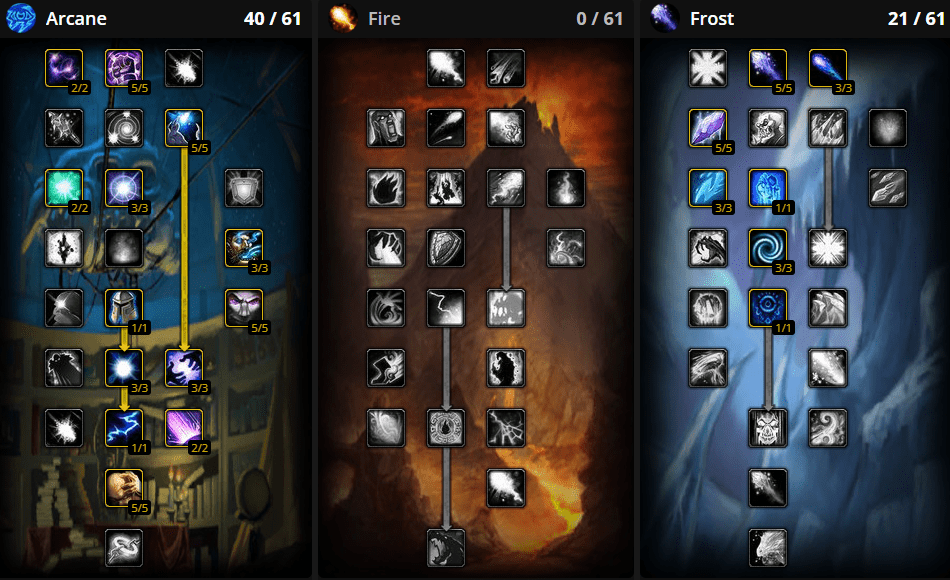
This build is kind of standard for mages who want to convert their mana into damage. You’ll see that you’ll want to invest most of your talent points into the Arcane tree and about half of that amount into the Frost talent tree. There are some important talents you need to look for in the Arcane tree to make your damaging spells more effective. On the Frost talent tree, you gotta make sure to pick up the most important talents and spells like the Icy Veins and other iconic skills, and make sure they work well. Your filler spells need to be there as well, so don’t miss the Ice Shards and the like.
Frost PvP Build
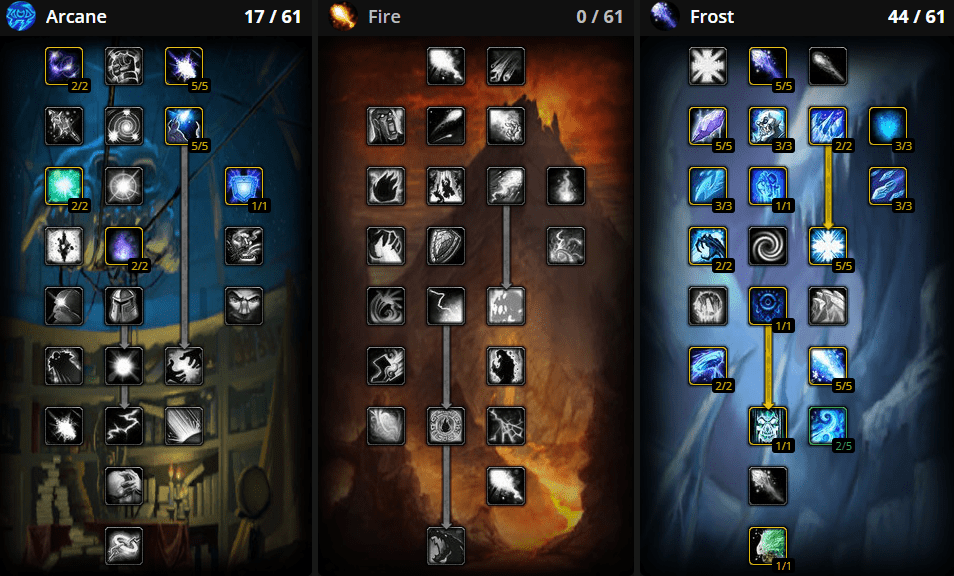
While you don’t need to think too hard about your PvE build, the PvP build requires some skill in execution. This one is one of the most default pvp builds for mages, and it is, obviously, based on the Frost spec. In PvP, you want to try to stay alive as long as possible, which is hard to do on this class. The second thing you need to try to achieve is having good crowd control. This build covers both things pretty well. For control, you have the improved version of Frost Nova with the reduced cooldown and the Permafrost talent, which increases the duration of all of your slowing debuffs. Things like the classic shield of Ice Barrier and the Arcane Fortitude from the Arcane tree help with survivability.
Browse our hottest TBC Anniversary Boosting services








Mage Leveling Guide TBC Classic Anniversary
TBC Classic Anniversary mage leveling is faster, safer, and more flexible than in original TBC, thanks to the new systems layered on top of Mage’s already strong toolkit. Faster pre-patch leveling, improved mana tools, and Dual Spec all work heavily in Mage’s favor from level 1 to 70.
Several Anniversary-specific factors directly improve the Mage leveling experience:
- Reduced experience required from levels 20 to 60
- Increased quest experience starting from level 30
- Earlier and cheaper mounts
- Dual Spec allows easy swaps between leveling and endgame builds
These changes make Mage one of the fastest classes to reach level 70, especially when leveraging AoE and dungeon play. Also, when playing as Mage you can choose your leveling method, because several of them will be pretty effective.
 Open-World AoE Grinding
This is the fastest solo leveling method for experienced Mage players.
- Pull large packs of enemies
- Root and slow with Frost Nova and Blizzard
- Kill efficiently with minimal damage taken
Dungeon Spell Cleave Groups
Mage is a core class for fast dungeon leveling.
- Consistent AoE damage and crowd control
- Strong synergy with Warlocks and healers
- Faster experience than questing when groups are available
Questing
Questing is safe but slower compared to AoE methods.
- Best combined with AoE pulls where possible
- Useful during off-hours when dungeon groups are scarce
Leveling from 60 to 70 in Outland
Outland leveling favors Mage even more than Classic zones.
- Dungeon grinding remains extremely efficient
- Frost control tools are valuable in harder Outland zones
- Fire AoE builds become viable with Ice Block and better gear
Mage’s ability to control packs makes leveling in Hellfire Peninsula, Zangarmarsh, and later zones both fast and low risk.
Mage Best in Slot Gear in TBC Classic Anniversary
Phase 3 Mage best in slot gear comes primarily from Black Temple and the Battle for Mount Hyjal, but several pieces from Serpentshrine Cavern and Tempest Keep remain essential. Arcane Mages generally retain four pieces of Tier 5 Tirisfal Regalia, while Fire and Frost Mages work toward the four-piece Tier 6 Tempest Regalia bonus.
The exact setup can change depending on your spell hit, raid composition, faction, and available support buffs. The table below presents a strong Phase 3 single-target PvE BiS setup for each Mage specialization.
Zhar’doom is a two-handed weapon, so Chronicle of Dark Secrets is only equipped when using Tempest of Chaos or another one-handed weapon. Ring of Ancient Knowledge is not Unique, allowing Fire and Frost Mages to equip two copies.
Arcane remains the main exception to the usual Phase 3 tier progression. Its four-piece Tier 5 bonus remains exceptionally powerful, so Cowl, Mantle, Robes, and Gloves of Tirisfal continue to form the core of its set. Fire and Frost instead pursue four pieces of Tempest Regalia through the shoulder, chest, hand, and leg slots, using Cowl of the Illidari High Lord as their off-piece.
Phase 3 also reduces the importance of early crafted sets. Spellfire, Frozen Shadoweave, and Spellstrike remain useful while progressing, but Black Temple, Hyjal Summit, and Phase 2 raid gear eventually replace them. Tailoring still provides valuable items such as Bracers of Nimble Thought and Belt of Blasting, while the strongest overall upgrades include The Skull of Gul’dan, Zhar’doom, and the Tempest Regalia set bonuses.
Best Mage Rotation

WoW Mage rotations TBC Classic Anniversary are spec-defining. Fire and Arcane dominate PvE, while Frost remains niche for raids but still follows a clear and consistent structure. Below are the core ability sequences for each spec, followed by an explanation of how and why each part of the rotation works in real encounters.
Fire Mage PvE Rotation
Molten Armor → Scorch (5 stacks) → Fireball → Fire Blast (movement or execute filler)
Molten Armor should always be active before combat, as it provides a direct damage increase through critical strike scaling. Fire Mage damage revolves around Ignite and frequent crits, making this armor mandatory.
Scorch is used at the start of the fight to apply and maintain five stacks of Improved Scorch. This debuff increases all Fire damage taken by the target and benefits every Fire Mage in the raid. Once fully stacked, Scorch is only refreshed if the debuff is about to expire.
Fireball becomes your primary cast once Scorch is stacked. It has the best spell power and crit scaling available to Fire Mages and represents the majority of your damage in single-target encounters.
Fire Blast is used sparingly. It works as a movement filler or finishing tool when you cannot complete a Fireball cast. Overusing it will negatively impact mana efficiency.
Cooldown usage revolves around stacking effects. Combustion, Icy Veins, trinkets, and Bloodlust are most effective when layered together, ideally during execute range to benefit from Molten Fury, though they can also be used earlier on longer fights.
Arcane Mage PvE Rotation
Mage Armor → Arcane Blast → Arcane Blast → Arcane Blast → Arcane Blast (burn phase) → Frostbolt (regen phase)
Arcane is the best Mage TBC Classic Anniversary for raiding, so a proper rotation is a must if you want to stay at the top of the DPS leaderboard.
Arcane Blast is the core damage spell. Each cast increases its damage while also increasing its mana cost, stacking up to three times. During burn phases, Arcane Blast is spammed aggressively to maximize damage output.
Arcane does not follow a fixed rotation. Instead, it alternates between burn phases and recovery phases. During burn windows, cooldowns like Arcane Power, Presence of Mind, Icy Veins, trinkets, and Bloodlust are stacked together to unleash massive burst damage.
Once mana becomes an issue, you transition into a recovery phase. Frostbolt is used as a low-cost filler while waiting for mana regeneration from Mage Armor, Shadow Priest support, Mana Gems, and Evocation.
Cold Snap is used to reset Icy Veins, allowing a second high-impact burn window during the same encounter. Managing mana and cooldown timing is the main skill requirement for Arcane Mage performance.
Frost Mage PvE Rotation
Mage Armor → Frostbolt → Frostbolt → Frostbolt → Ice Lance (on movement or frozen targets)
Mage Armor is used to maintain steady mana regeneration throughout long fights.
Frostbolt is your primary spell and should be cast continuously. It offers strong mana efficiency and reliable damage, making Frost Mage stable and easy to manage in early raid phases.
Ice Lance is used when targets are frozen or when movement prevents a full Frostbolt cast. While its base damage is low, it becomes effective when benefiting from Shatter mechanics.
Frost scales poorly compared to Fire and Arcane in later phases, but its rotation remains safe, consistent, and forgiving, making it suitable for utility roles or early gearing situations.
Mage AoE Rotation
Frost Nova → Blizzard → Blizzard → Blizzard → Cone of Cold or Flamestrike
Frost Nova is used to lock enemies in place and create safe spacing before AoE damage begins.
Blizzard is the primary AoE spell, especially when paired with Improved Blizzard for consistent slowing and control over large packs.
Cone of Cold acts as a high-damage finisher when enemies close the gap, particularly effective for Frost builds.
Flamestrike is mainly used by Fire Mages during stacked AoE situations, especially while leveling or clearing dungeon trash.
This AoE setup allows Mages to deal heavy area damage while maintaining control, one of the class’s defining strengths in TBC Classic Anniversary.
Best Mage Professions in TBC Classic Anniversary

Since you can’t really go without any, you might as well pick the best mage professions in TBC Classic Anniversary. If you want to stay relevant throughout the entire lifespan of an expansion, your profession choices matter more here than they did in Vanilla.
Tailoring
Tailoring is mandatory for any Mage focused on PvE performance. It allows you to craft several best-in-slot pre-raid items that remain competitive deep into the expansion.
Key reasons Tailoring is so strong for Mages:
- Access to the Wrath of Spellfire set for Arcane and Fire Mages
- Access to the Spellstrike Infusion set, shared across all Mage specs
- Frozen Shadoweave pieces for Frost Mages
- Many of these items remain BiS through Phase 1 and Phase 2
Because these crafted items are Bind on Pickup, Tailoring must be learned on your Mage. You cannot rely on another player to craft them for you. This makes Tailoring a core progression profession rather than an optional one.
Enchanting
Enchanting is the best second profession for players who want to min-max their Mage.
Its main advantage comes from ring enchants, which are exclusive to Enchanters:
- Enchant Ring – Spellpower
- +12 Spell Power per ring
- +24 Spell Power total
This bonus works in all content and scales perfectly with every Mage specialization. Enchanting also allows you to disenchant unwanted dungeon and raid gear, providing a steady source of materials and gold.
Best Mage Consumables

With world buffs gone and longer encounters becoming the norm, proper consumable usage directly affects your damage, mana sustain, and survivability. Below is a list of the best mage consumables for TBC Classic Anniversary edition. You might not need to have them all in your inventory at all times, but they’re all pretty handy.
- Flask of Pure Death – Best flask for Fire and Frost Mages, providing a large flat boost to spell damage that scales well and persists through death.
- Flask of Blinding Light – Arcane-focused flask that increases Arcane spell damage, mainly worth using with strong mana support or in shorter encounters.
- Adept’s Elixir – Top Battle Elixir for Arcane Mages, offering Spell Power and Spell Crit that synergize perfectly with burn phases.
- Elixir of Draenic Wisdom – Best Guardian Elixir for Arcane Mages, increasing Intellect to boost mana pool, regeneration, and overall spell scaling.
- Blackened Basilisk – Provides Spell Power and Spirit, making it one of the best food buffs for all Mage specs.
- Crunchy Serpent – Identical stats to Blackened Basilisk and equally effective, often chosen based on availability or price.
- Poached Bluefish – Same stat bonus as the other food options, allowing flexibility without performance loss.
- Brilliant Wizard Oil – Best weapon oil for Mage DPS, granting additional Spell Power and a small crit bonus.
- Super Mana Potion – Core mana recovery potion for all Mage specs, essential for maintaining uptime during longer fights.
- Destruction Potion – Best damage potion when mana is not a concern, used during cooldown and burst windows.
- Mana Potion Injector – A more convenient version of Super Mana Potions that stacks higher and saves bag space.
- Mana Emerald – Mandatory Mage consumable that restores mana instantly without triggering the global cooldown.
- Flame Cap – Strong secondary damage consumable for Fire Mages, adding extra fire damage but sharing a cooldown with Mana Gems.
- Nightmare Seed – Emergency defensive consumable that absorbs damage and does not disappear on logout.
- Kreeg’s Stout Beatdown – Extremely valuable for Arcane Mages, as the Spirit bonus significantly improves mana regeneration.
- Scroll of Spirit V – Free Spirit boost when Improved Divine Spirit is not available, especially helpful for Arcane mana sustain.
- Scroll of Protection V – Extra armor that can prevent deaths during threat spikes or dangerous trash pulls.
- Heavy Netherweave Bandage – Situational healing option that can save you when healers are occupied.
Using these consumables consistently ensures you are fully prepared for raids and dungeons in TBC Classic Anniversary, giving you maximum control over damage output and mana management from pull to pull.
Changelog
August 26, 2026 - updated the guide for Phase 3.
Read our other TBC Classic Anniversary guides:
F.A.Q.
How to level Mage in TBC Classic Anniversary?
Mage leveling is fast and efficient thanks to strong AoE tools and crowd control. Frost is the safest option early, while Fire AoE builds work well from 60 to 70. Dungeon spell cleave groups and outdoor AoE grinding both perform extremely well.
Are Mages good in TBC Classic Anniversary?
Mages are one of the strongest classes in the expansion. They excel in raids, dungeons, PvP, and gold farming. Their flexibility and damage make them valuable in every phase.
Is Mage hard to play in TBC Classic Anniversary?
The class is easy to start but hard to master. Fire and Frost are straightforward, while Arcane requires precise mana and cooldown management. High performance comes from planning and execution, not complex rotations.
What is the best profession for Mage in TBC Classic Anniversary?
Tailoring is the best profession by far.
- Unlocks Spellfire, Spellstrike, and Frozen Shadoweave sets
- Provides long-lasting pre-raid and early raid BiS gear
Enchanting is the best second profession for pure damage optimization.
Is Mage good in PvE in TBC Classic Anniversary?
Mage is top-tier in PvE for most of the expansion. Arcane dominates early raid phases with burst damage, while Fire scales into later content. Frost remains viable for utility and early progression.
How do I maximize DPS as Mage in TBC Classic Anniversary?
Maximizing DPS comes down to preparation and execution. Use Tailoring gear, follow proper stat priorities, stack cooldowns correctly, and manage mana efficiently. Raid positioning and consumable usage also make a major difference.