 Dallon Avery
Welcome to the Ashes of Creation crafting guide. In the current state of the game, the crafting system is very deep, and with the rest of the content kept at a bare minimum, it almost feels like you need to be using professions and crafting not only to make money but also to gear up your character. Sadly, there’s zero to no explanation of how to craft things in the game. This AoC crafting guide will teach you how to craft items, use crafting stations, refine materials, and much more. By the end of this guide, you will be able to make anything the game allows you to and understand what you need to gather, refine, or buy to make something. We’ll also briefly go over selling your crafted items and how to make gold while crafting.
Speaking of gold, if you need a little extra coin for crafting purposes or any other reason, you can always just buy Ashes of Creation gold at Skycoach. This is a fast and simple service where you only need to select the amount of gold, the server you're playing on, and that amount will be delivered to you.
Read our other Ashes of Creation guides:
Note: At Skycoach, you can Buy Ashes of Creation Boost at the best prices with fast delivery. Use our special PROMO CODE (in green) hidden in this article for a 20% DISCOUNT.
Browse our hottest AoC Boosting services






Crafting Overview – How Crafting Works in Ashes of Creation
Ashes of Creation crafting is not a side system. The game doesn’t explain how the whole thing works particularly well, but it does have one of the starting quests that takes you through the entire process. Unfortunately, that quest is too basic to cover everything, so here’s a little overview for you.
At its foundation, crafting follows a simple but interconnected loop.
Gathering → Processing → Crafting
Every item you create moves through this chain. Raw materials are collected first, refined into usable components, and then turned into finished items. Each step exists to create dependency between professions and players, rather than allowing one character to do everything alone.
Gathering is always the starting point. You collect raw resources directly from the world using profession-specific tools. These resources are intentionally basic and cannot usually be used for crafting in their original form.
What gathering involves:
- Using the correct tool for the profession
- Interacting with nodes, creatures, or the environment
- Receiving raw, unrefined materials
- Progressing gathering proficiency separately from other professions
Once resources are gathered, most of them must be refined through Ashes of Creation professions responsible for processing. Processing turns raw materials into crafting components such as ingots, planks, thread, or treated hides. This step exists to slow the flow of materials and create meaningful value between raw gathering and final crafting.
Processing generally means:
- Using dedicated stations found in towns or settlements
- Converting raw materials into refined components
- Supplying materials to multiple crafting professions
- Spending a noticeable amount of time compared to other steps
The final step is crafting itself. Crafting professions consume refined Ashes of Creation crafting materials and produce usable items such as gear, tools, or equipment. Crafting cannot happen unless all requirements listed on a recipe are met.
To craft an item, you need:
- The recipe learned on your character BLOG20
- The required proficiency level in that profession
- Any necessary certifications
- The listed materials and gold cost
- Access to the correct crafting station
This structure explains why crafting feels deep even early on. A single item might rely on multiple gathering and processing professions before it ever reaches the crafting window.
There is also an expectation built into the Ashes of Creation crafting system that players will not be fully self-sufficient. The game quietly nudges you toward interacting with vendors and other players instead of mastering everything yourself.
Crafting, Gathering, and Processing Professions
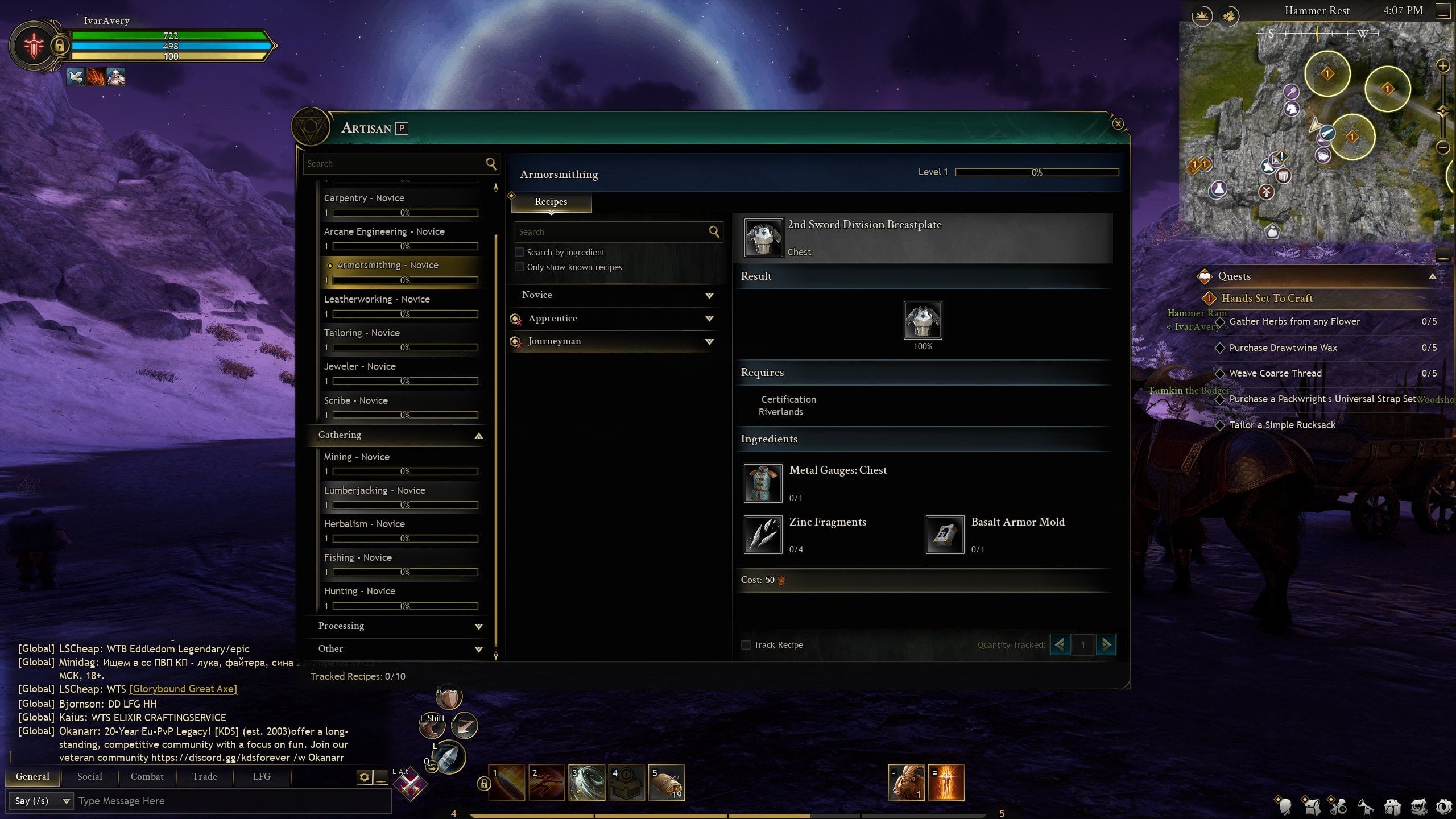
The Artisan menu divides professions into three main categories. Each category plays a specific role in the crafting loop.
| Profession Type | Profession | What It Does |
| Crafting | Weaponsmithing | Crafts melee and ranged weapons |
| Carpentry | Crafts wooden weapons and components | |
| Arcane Engineering | Crafts magical and mechanical items | |
| Armorsmithing | Crafts heavy armor | |
| Leatherworking | Crafts leather armor and gear | |
| Tailoring | Crafts cloth armor, bags, and textiles | |
| Jeweler | Crafts rings, necklaces, and jewelry | |
| Scribe | Crafts scrolls, books, and inscriptions | |
| Gathering | Mining | Gathers ore and stone |
| Lumberjacking | Gathers wood from trees | |
| Herbalism | Gathers plants and herbs | |
| Fishing | Gathers fish and aquatic resources | |
| Hunting | Gathers materials from creatures | |
| Processing | Metalworking | Refines ore into metal components |
| Stonemasonry | Refines stone materials | |
| Weaving | Turns fibers into thread and cloth | |
| Tanning | Turns hides into leather | |
| Lumber Milling | Turns logs into planks | |
| Farming | Produces cultivated resources | |
| Animal Husbandry | Raise and train creatures | |
| Alchemy | Processes reagents and chemicals | |
| Cooking | Turns raw food into consumables |
This table mirrors how professions are presented in game and helps you trace any crafting recipe back through processing and gathering to understand exactly where each material comes from.
The game introduces all of this theory through a single early quest. Instead of explaining the system outright, it asks you to perform each step once and figure out the rest yourself. This is where many new players get stuck.
Gathering Tools Explained
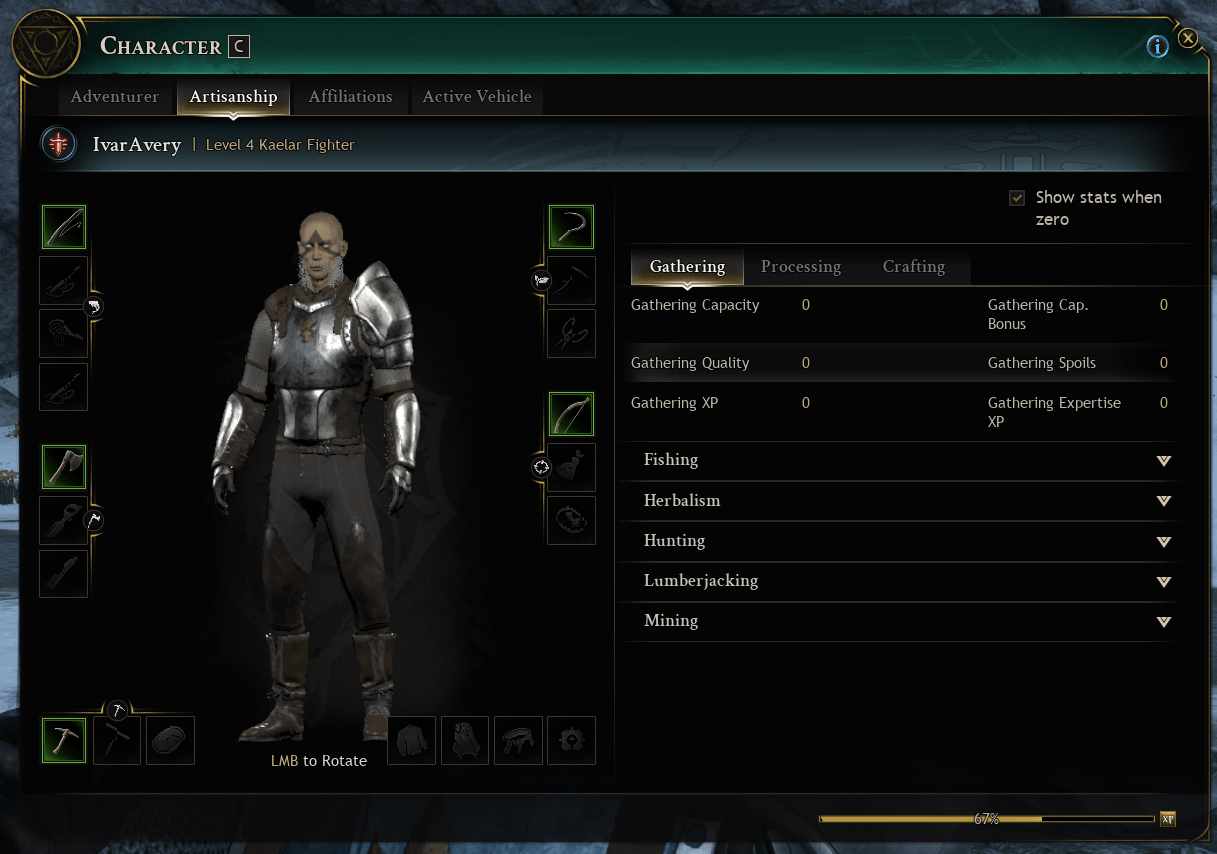
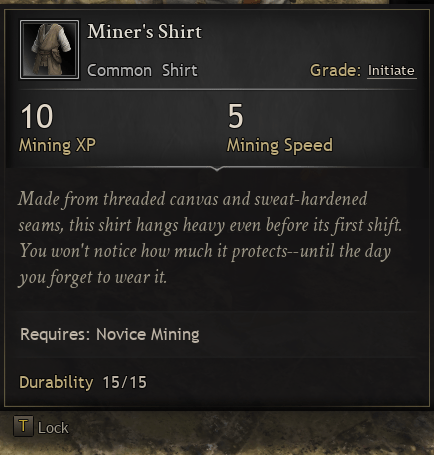
Ashes of Creation gathering tools are used to collect raw materials. You cannot harvest resources by simply interacting with the world. Every gathering profession requires the correct tool to be equipped, and the game enforces this rule silently. If the tool is missing, gathering will not work.
Tools are part of the Artisan gear system and are equipped through the Artisanship tab on your character screen. Each gathering profession has its own set of dedicated tool slots, which determine what actions your character can perform and what types of resources you are able to collect.
Early on, the game provides basic tools through quests, which makes gathering feel straightforward. As you progress, tool quality, durability, and specialization become increasingly important, affecting efficiency, yield, and access to higher-tier resources.
Tools also have durability and are consumed through use. Over time, they must be replaced, tying gathering progression back into crafting and the player-driven economy.
Each gathering profession uses multiple tools. Not every slot is required at the beginning, but all of them become relevant as professions progress and specialize.
| Profession | Tool Slot | Purpose |
| Fishing | Fishing Pole | Core tool for fishing interactions |
| Lure | Improves fishing efficiency and results | |
| Net | Used for bulk or area-based fishing | |
| Harpoon | Used for targeted or active fishing | |
| Lumberjacking | Axe | Primary tool for chopping trees |
| Saw | Used for cutting and processing wood on site | |
| Tap | Used for extracting resources from trees | |
| Herbalism | Sickle | Primary tool for harvesting plants |
| Scythe | Used for gathering larger plant clusters | |
| Shears | Used for precise plant harvesting | |
| Hunting | Hunting Bow | Used to harvest materials from creatures |
| Bait | Used to attract or influence wildlife | |
| Trap | Used to capture or harvest creatures | |
| Mining | Pickaxe | Primary tool for mining ore and stone |
| Drill | Used for advanced or efficient mining | |
| Pan | Used for extracting fine mineral materials |
At the start of the game, most players will only actively use one tool per profession. The additional slots exist to support deeper progression, higher efficiency, and access to more specialized resource interactions later on.
How to Complete the “Hands Set to Craft” Quest
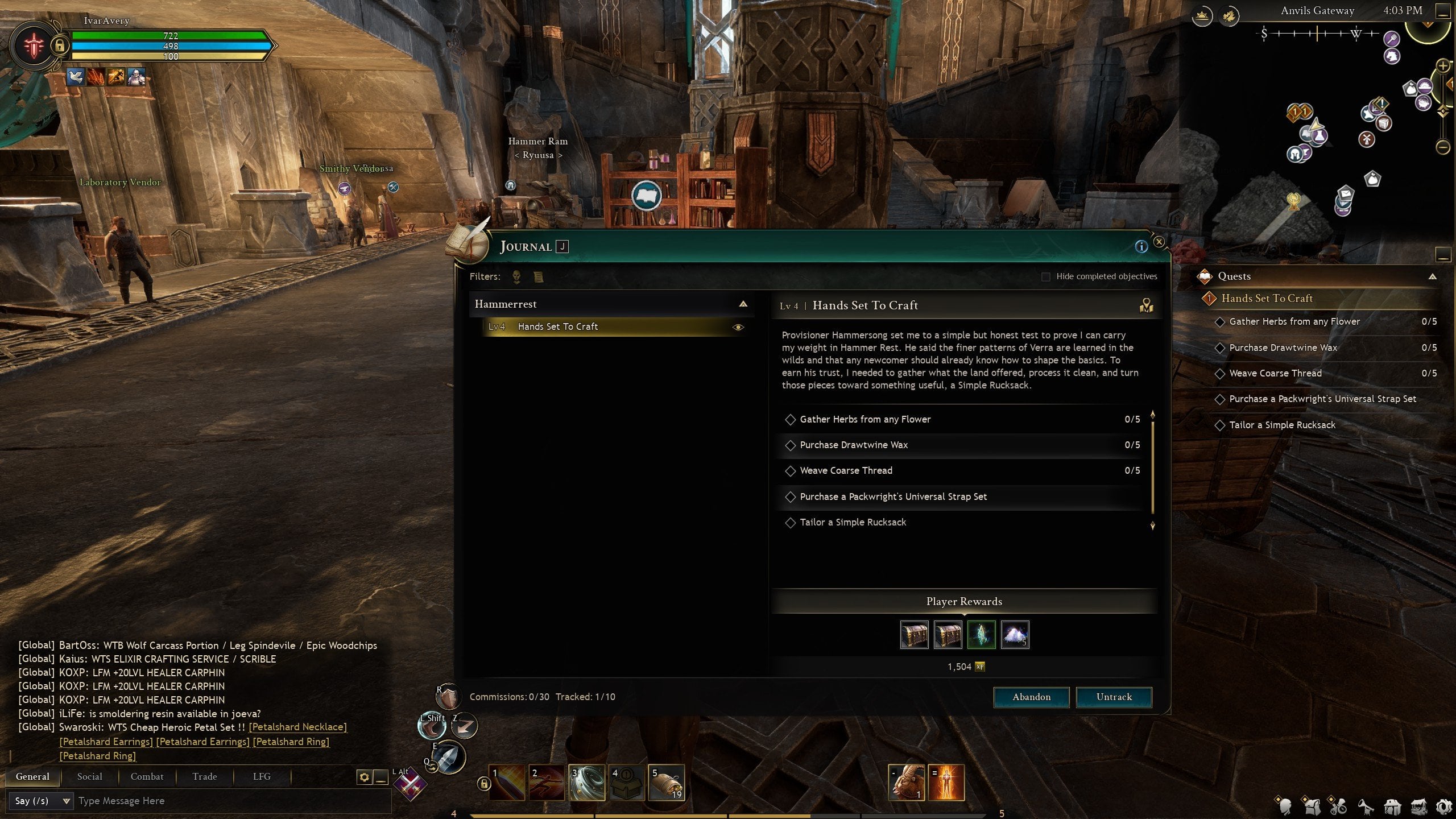
The Hands Set to Craft quest is the first time the game asks you to engage with multiple parts of the crafting loop in sequence. Instead of explaining systems through text, the quest forces you to gather, buy materials, and process them, teaching you how to craft in AoC.
Before going step by step, it helps to see all objectives at once so the flow makes sense.
Quest objectives:
- Gather Herbs from any Flower (0/5)
- Purchase Drawtwine Wax (0/5)
- Weave Coarse Thread (0/5)
- Purchase a Packwright’s Universal Strap Set (0/1)
- Tailor a Simple Rucksack (0/1)
Each objective introduces a different part of the crafting system. Below is how to complete each step without getting stuck.
Gather Herbs from Any Flower
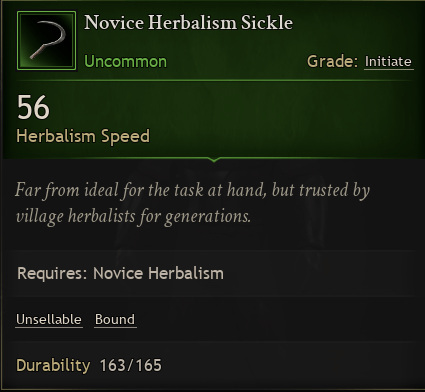
The first objective is straightforward and serves as a basic introduction to gathering.
Herb locations are marked directly on your map. Travel to the marked area and interact with flowers using the Herbalism tool that was given to you as a reward from a previous quest. You do not need a specific type of plant. Any flower node counts toward progress.
Once you gather five herbs, the objective completes automatically.
Purchase Drawtwine Wax
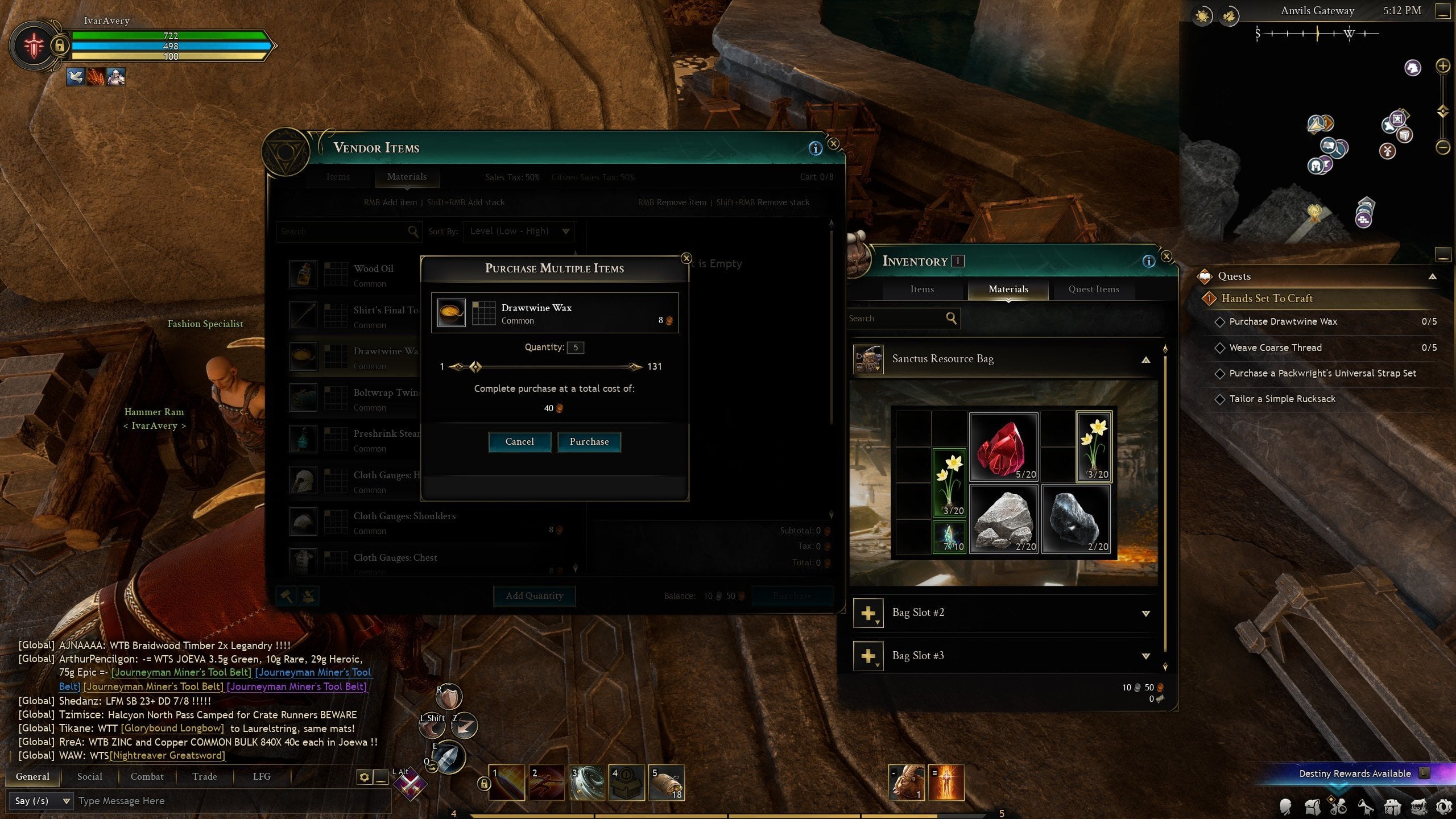
This is the first point where many new players get confused. The quest asks you to purchase Drawtwine Wax, but it does not tell you where to buy it.
To purchase Drawtwine Wax, you need to find an NPC called the Textile Mill Vendor. This vendor sells both recipes and materials related to weaving and tailoring.
Interact with the Textile Mill Vendor and switch to the Materials tab. Drawtwine Wax is usually the third item in the list.
Buying items from NPC vendors follows a specific flow:
- Select the item
- Select the quality
- Add the desired quantity to your cart
- Complete the purchase
Each Drawtwine Wax costs 8 coins. You need five, which means a total cost of 40 coins.
At this point, there is a good chance you will have little or no money. You also cannot sell most items in your inventory yet, since they are usually bound starter gear or tools.
If you do not have enough money, you need to earn some before continuing.
How to Get Money Early
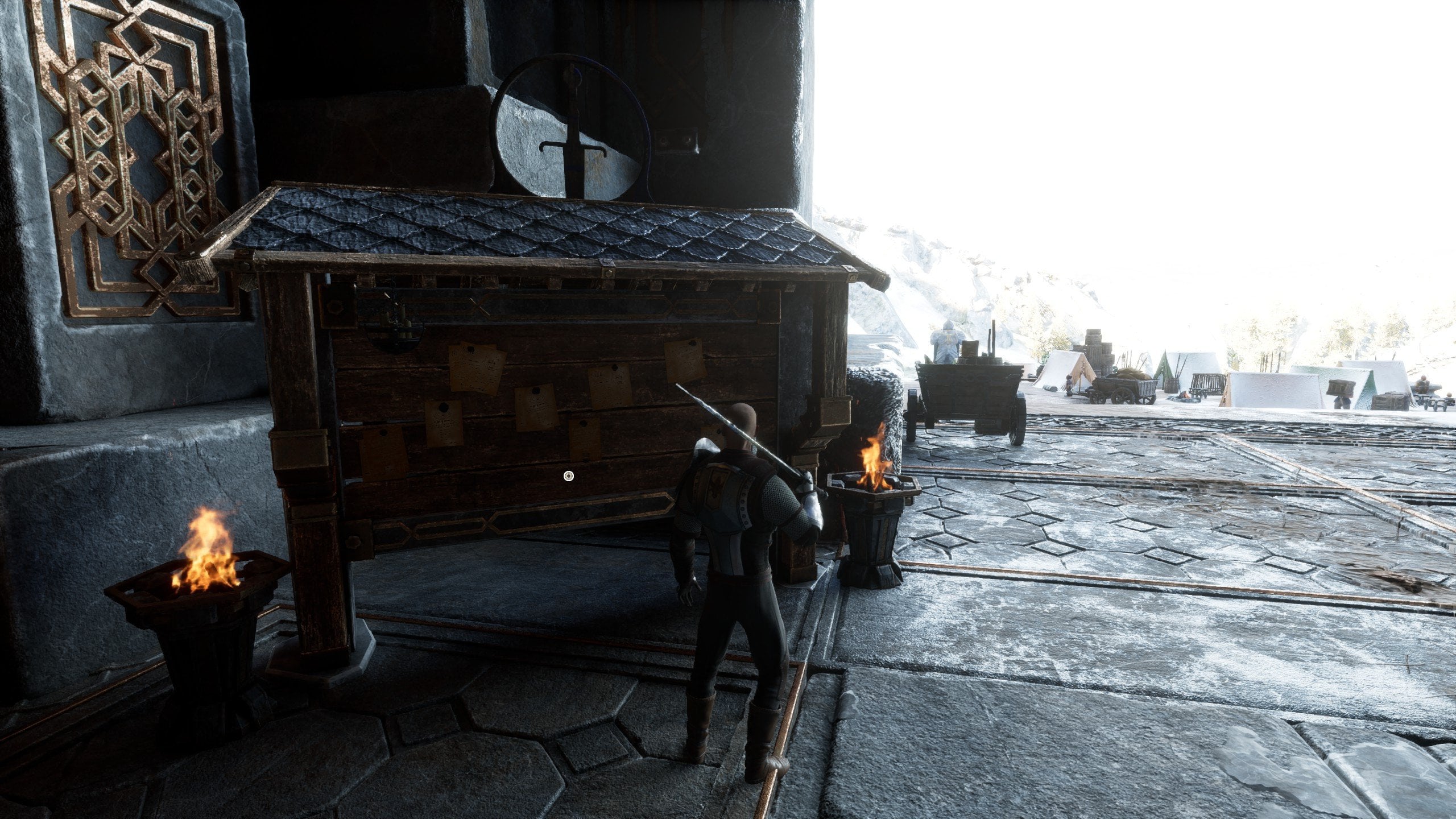
The fastest way to earn money at this stage is by using a Commission Board. Commission Boards offer repeatable tasks that reward currency and experience.
If you started the game in Hammer’s Rest, the Commission Board is located on the left side of the gates that lead outside the settlement, near the tanning station.
Accept and complete one or more commission tasks. Once finished, open your journal and click the quest completion button to receive the rewards. You do not need to return to the board to turn them in.
Next, open your inventory and switch to the Materials tab. Look for Glint, which is a resource you can convert and sell.
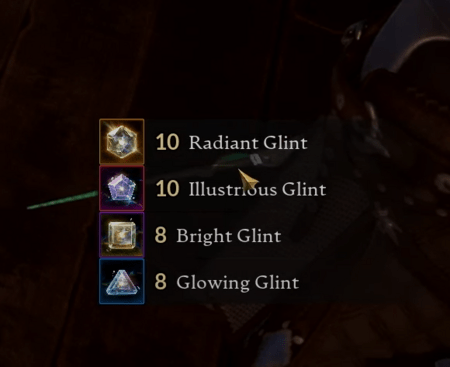 Glint comes in multiple rarities:
- Common (grey): Dull Glint
- Uncommon (green): Dim Glint
- Rare (blue): Glowing Glint
- Heroic (yellow): Bright Glint
- Epic (purple): Illustrious Glint
- Legendary (orange): Radiant Glint
If you have multiple stacks of lower-rarity Glint, convert full stacks into higher-rarity Glint. Higher rarities sell for more money.
You can sell Glint directly to the Textile Mill Vendor. Simply right-click the Glint in your inventory to sell it.
Once you have enough copper or silver, purchase five Drawtwine Wax to complete the objective.
Weave Coarse Thread
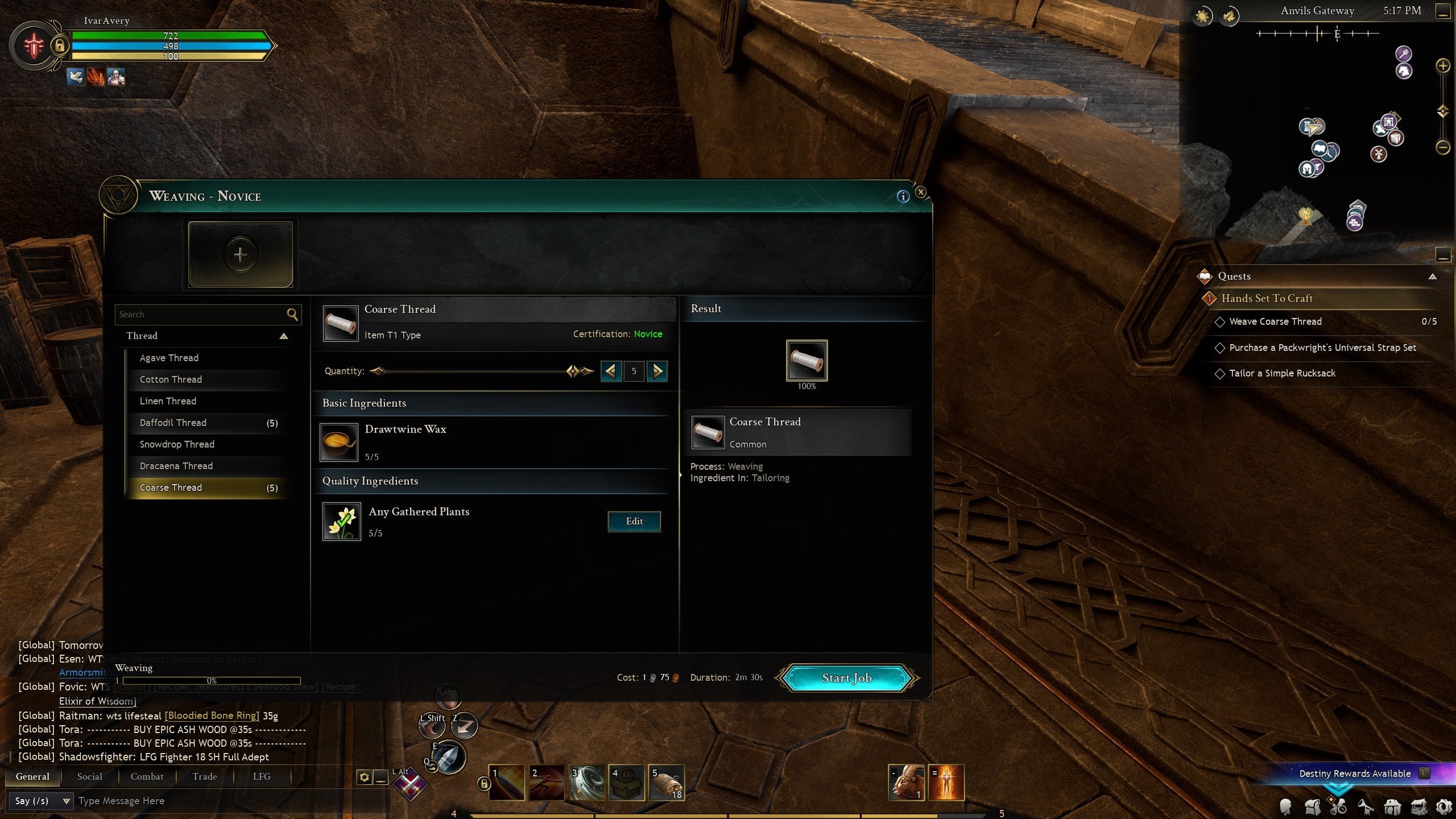
With the Drawtwine Wax purchased, move to the Weaving Station – Novice located right next to the Textile Mill Vendor.
Interact with the station and open the Weaving interface. From the menu on the left, select the Thread category, then choose Coarse Thread.
Set the quantity to five. You will also need to add Quality Ingredients. In this case, any gathered plants will work, including the herbs you collected earlier.
After adding all ingredients, the interface will show:
- The crafting cost
- The duration of the job
- Click the Start Job button to begin the weaving process.
Once the job starts, you are free to leave the station. You do not need to wait there. When the timer finishes, return to the station to collect the completed Coarse Thread. BLOG20
When the weaving job finishes, the station will play a short sound effect to let you know the process is complete. You do not need to stay nearby while the job runs, but you do need to return to claim the result.
Claim the Coarse Thread
Return to the Weaving Station and open its interface. At the top of the menu, you will see the completed job ready to be claimed.
When claiming Coarse Thread, you have two options:
- Send it directly to your inventory
- Send it to the warehouse
Either option works for this quest. Once claimed, the Weave Coarse Thread objective will complete in your journal.
Purchase the Packwright’s Universal Strap Set
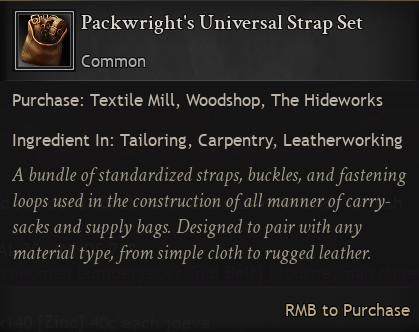
The next step is to buy the Packwright’s Universal Strap Set, another vendor-sold crafting component.
Go back to the Textile Mill Vendor and open the Materials tab again. Scroll down to the bottom of the list. The Packwright’s Universal Strap Set is usually the last item available.
The strap set costs 8 copper coins, plus tax. Purchase one and keep it in your inventory. This completes the purchase objective and unlocks the final crafting step.
Tailor a Simple Rucksack
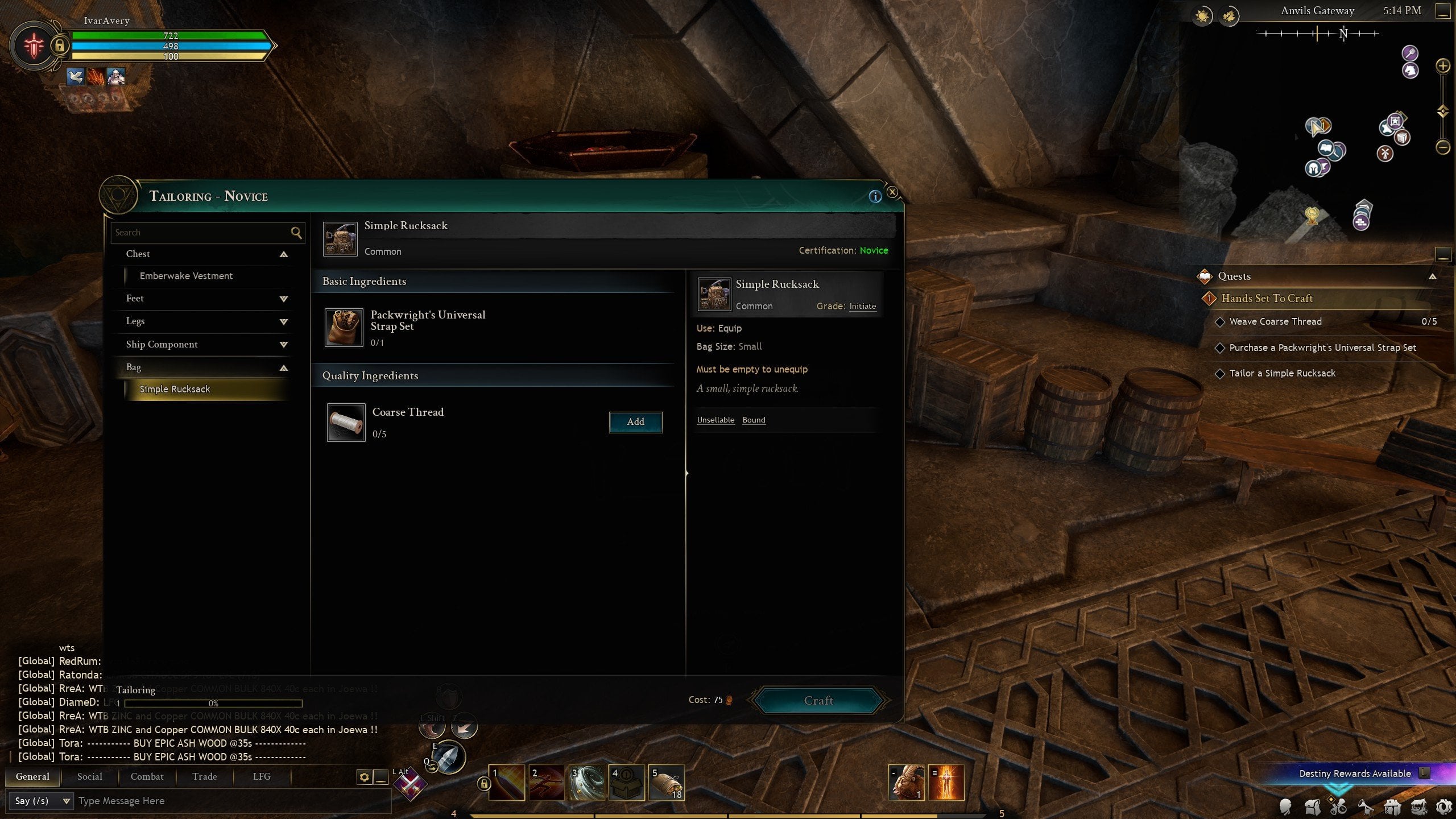
With all materials ready, move to the Tailoring – Novice station nearby and interact with it.
In the menu on the left, select the Bag category, then choose Simple Rucksack. The recipe will show the required components and ingredients.
To proceed:
- Add the Packwright’s Universal Strap Set
- Add Coarse Thread as the Quality Ingredient
- Review the crafting cost and duration
Unlike weaving, tailoring the rucksack only takes a few seconds. Click Start Job to begin the crafting process.
Once completed, claim the Simple Rucksack from the station. You can equip it immediately as an additional materials bag, increasing your carrying capacity.
Complete the Quest
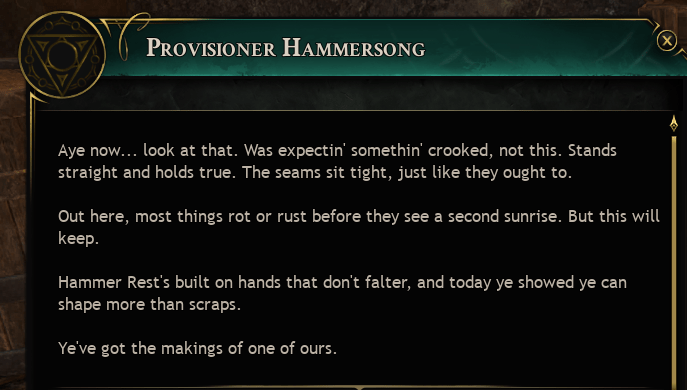
With the Simple Rucksack crafted, return to the quest giver, Provisioner Hammersong, and turn in the quest.
Completing Hands Set to Craft marks the first full pass through Ashes of Creation’s crafting loop. You gather raw materials, buy vendor components, process resources at a station, and finally craft a finished item. From this point on, the game expects you to recognize these steps without explicit guidance, which is why understanding this quest is so important early on.
Browse our hottest AoC Boosting services






Crafting Certifications and Progression Tiers

Crafting progression is built around AoC crafting certifications, not just raw experience. Gaining XP alone is not enough to unlock better recipes, tools, or stations. Instead, crafting skills are divided into progression tiers, and each tier must be formally unlocked through certification.
Every crafting profession follows the same core structure. As you gain crafting experience, you advance toward the next certification threshold. Once that threshold is reached, progression pauses until you complete the required certification step with the appropriate NPC. Until you do that, you can keep crafting basic items, but you will not gain access to the next tier of recipes or crafting options.
The certification tiers follow a clear ladder:
- Novice
- Apprentice
- Journeyman
- Master
- Grandmaster
Each tier represents a meaningful jump in what your character is allowed to do. Unlocking a new certification usually enables access to higher-tier Ashes of Creation crafting stations, additional recipes, and stronger artisan tools or gear tied to that profession.
One important thing to understand early is that crafting progression is intentionally slower than gathering and processing. This is by design. Crafting is the final step in the production chain and is meant to be more selective and investment-heavy. While gathering and processing tend to unlock most of their recipes automatically as you level, crafting does not work that way. Even after earning a new certification, you will typically only gain access to a small set of basic recipes for that tier.
Another key detail is that crafting certifications are profession-specific. Advancing in one crafting profession does not carry over to others. This encourages specialization and makes it difficult for a single character to dominate every part of the crafting economy.
Progression is also separate from your adventuring level. You can be a low-level adventurer with a relatively high crafting certification, or the other way around. That said, crafting progression is still indirectly tied to the wider world. Higher-tier crafting often assumes access to better materials, safer travel routes, and settlements with more advanced infrastructure.
How to Get Recipes in Ashes of Creation
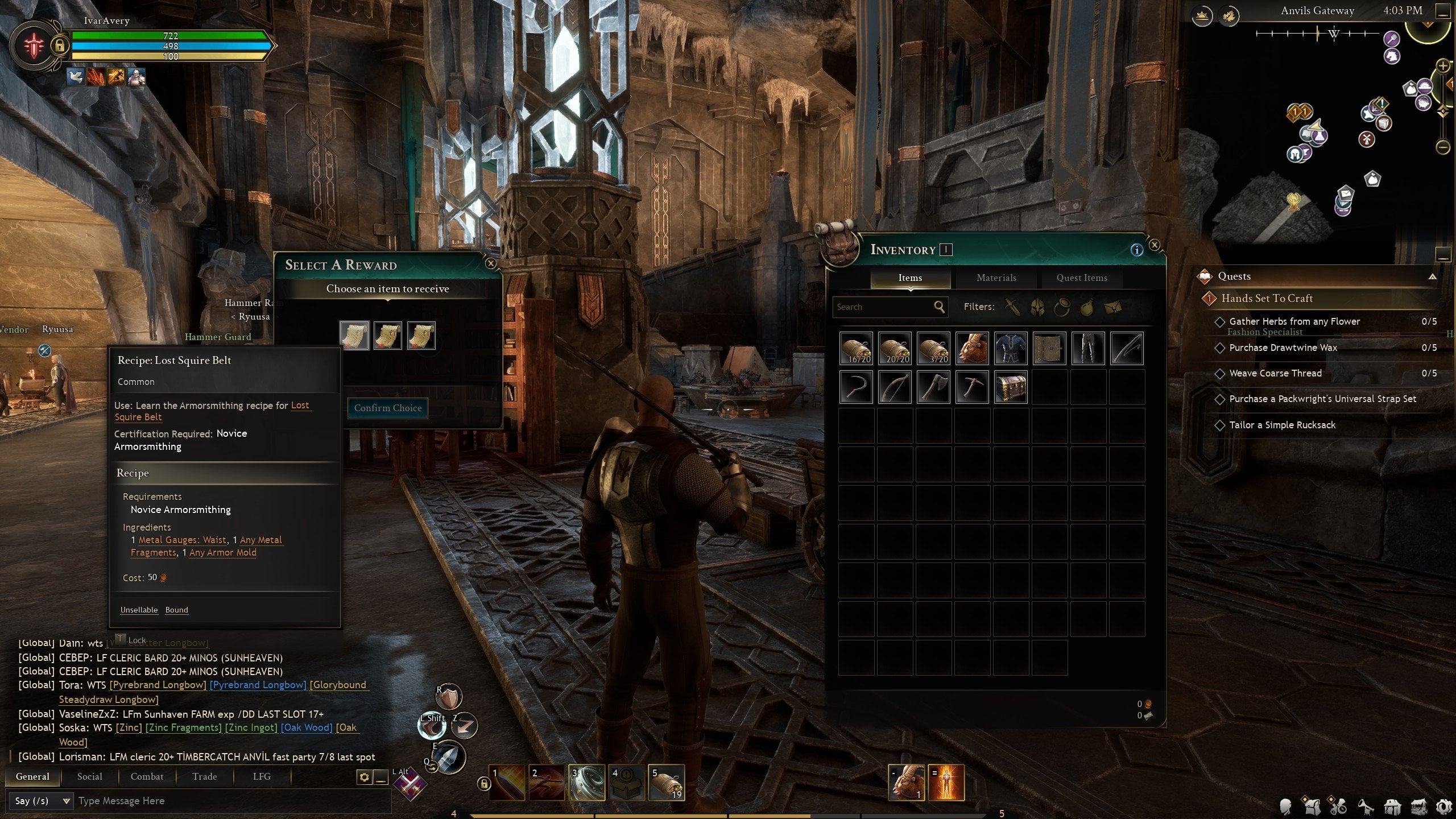
Recipes are not unlocked automatically as you progress. Even after reaching a new certification tier, most professions only gain access to a small set of basic recipes. Everything else must be discovered, earned, or purchased. This design makes recipe acquisition just as important as leveling the profession itself. So, let’s learn where to get recipes in Ashes of Creation.
Recipes enter the game through several distinct systems, each serving a different purpose in the crafting ecosystem.
- Profession Vendors
These NPCs sell foundational recipes tied to a specific crafting discipline. Vendor recipes are usually affordable and easy to access, making them ideal for early progression and utility crafting. However, they rarely include specialized or high-value items. - Enemy Drops
Many crafting recipes drop from mobs, elites, and bosses. These recipes often unlock items with better stat potential, higher rarity ceilings, or more efficient material conversions. Because they are not guaranteed drops, these recipes tend to hold significant value on the player market. - Player Trading
Recipes can be traded or sold before being learned. This creates an active recipe economy where players can bypass farming by buying knowledge directly from others. Once a recipe is learned, it becomes permanently bound to your character and cannot be shared. - Quests and Progression Rewards
Certain quests reward crafting recipes directly. Early crafting quests usually provide simple recipes to introduce systems, while later questlines may unlock more specialized or situational items. - Reputation and Settlement Progression
As settlements develop and your reputation increases, additional recipes may become available through local vendors or faction systems. This ties crafting progression to the world’s political and economic growth.
Some recipes remain relevant for a very long time because they produce utility items, artisan gear, or components that other crafters depend on. Others gain value later as settlements develop and demand shifts.
Crafting Buffs and Consumables
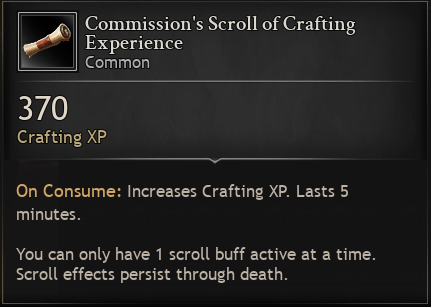
Crafting can be heavily influenced by temporary buffs. These bonuses do not change recipes or stations, but they significantly affect how fast you progress and how efficient your resource usage is. Ignoring buffs makes crafting slower and more expensive than it needs to be, especially once you move beyond the novice tier.
Ashes of Creation crafting buffs come from three main sources. Each one serves a different purpose, and they can be combined for better results.
| Buff Type | Source | Key Effects | When to Use |
| Artisan Gear | Equipped artisan gear | Increases crafting XP per craft and improves crafted item quality | Always equipped, especially important at higher certification tiers |
| Scroll Buffs | Vendor-bought or crafted scrolls | Boosts crafting experience gains and persists through death | Long, planned crafting sessions aimed at leveling |
| Elixirs | Crafted through alchemy | Strong bonuses to crafting XP, efficiency, or quality | Short, focused crafting runs or expensive recipes |
| Food Buffs | Cooked food | Minor crafting bonuses plus combat-related effects | Mixed crafting, gathering, and adventuring sessions |
Crafting buffs are most effective when used deliberately rather than constantly. Using scrolls, food, and elixirs together during a focused crafting session can dramatically reduce time and resource costs. Using them casually, one craft at a time, often wastes their potential.
Buffs also scale well with higher-tier crafting. The more expensive and time-consuming a craft becomes, the more value you get from even small percentage bonuses.
How to Make Money with Crafting
Crafting is not just a progression system in Ashes of Creation. It is one of the most reliable ways to generate silver and gold, especially in the early and mid-game when raw farming and mob drops feel unrewarding. The key difference compared to many MMOs is that profit rarely comes from crafting finished gear alone. Instead, money is made by understanding conversion, demand, and risk.
Below are two proven approaches for how to make money crafting Ashes of Creation that work even on fresh servers and low-level characters.
Commodity Crates Explained

Commodity crates are a system that turns crafted goods and raw materials into transportable trade items. These crates can be delivered to other settlements for profit, with rewards scaling based on distance, rarity, and risk.
At a high level, the loop looks like this:
Gather or process materials → Craft a commodity crate → Transport it to another settlement → Turn it in for currency or reputation
To create Ashes of Creation crates, you need to interact with a Market Commodity Station and purchase Commodity Certificates from the nearby vendor. Certificates come in different rarities, and higher rarity certificates produce more valuable crates.
Important things to understand about crates:
- Crates do not give fixed payouts
The displayed price is an estimate. Final rewards depend on supply, demand, and how many players are running the same route. - Rarity matters more than volume
Higher rarity materials and certificates result in significantly better payouts, even if you run fewer crates. - Crates use glint, not coins
Crafting crates consumes glint instead of copper or silver. This makes glint more valuable than it initially appears and worth saving instead of vendoring. - Risk is part of the reward
Crates flag you as a valuable target. The longer the route and the farther the destination, the higher the profit potential, but also the higher the PvP risk.
Crates are especially useful when your storage fills up with uncommon or rare materials you are not ready to use. Turning those materials into crates lets you store value and convert it into money later.
Turning Cheap Stone into Profit Through Processing
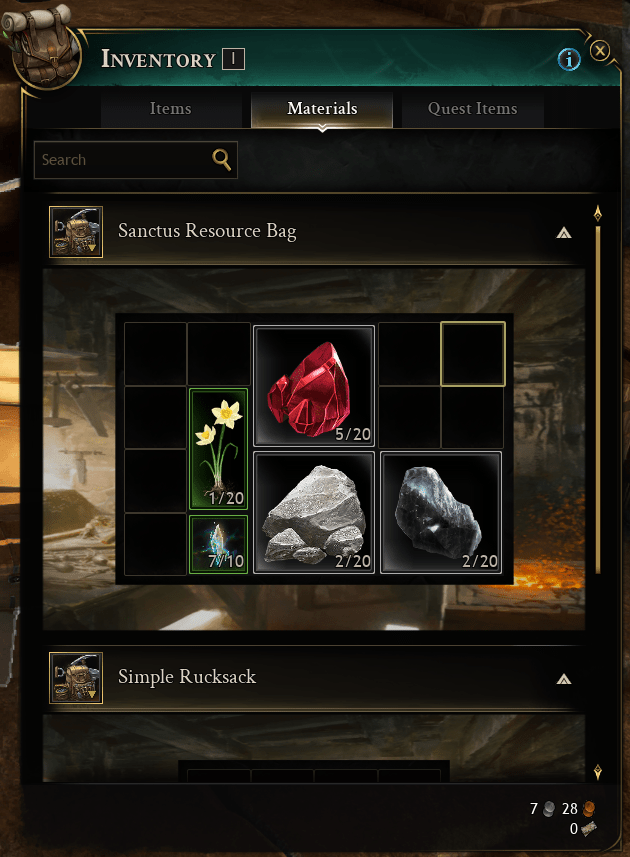
One of the most overlooked money-making methods involves processing stone that most players throw away. Basalt, granite, and sandstone are often considered useless early on, which is exactly why they are valuable. BLOG20
Instead of vendoring stone, you can refine it through specific Ashes of Creation processing stations for a chance of higher-value output.
The basic idea works like this:
→ Buy or gather low-demand stone
→ Process it at Stone Masonry or Metalworking
→ Roll for higher-tier outputs such as rubies, copper, coal, or fragments
→ Sell valuable results and reuse the rest
This method is often called “gambling,” but the risk is lower than it sounds.
This method scales extremely well. Early on, it can be used with common stone for fast leveling. Later, higher-tier stone can be processed for rare materials that sell for significant profit.
Combining Profit with Progression
The most effective crafting players rarely focus on profit alone. The strongest strategies combine:
- Experience gains
- Material conversion
- Market demand
- Storage management
Commodity crates free inventory space while building wealth. Stone processing converts trash into value while leveling professions. Together, these systems allow you to fund expensive crafting, certification progression, and future investments without grinding mobs for hours.
Once you understand that crafting is about transforming value rather than creating finished items, the economy opens up in a much more predictable and controllable way.
If you want, next we can tighten this section further with a comparison table or move on to a concluding section that ties crafting, progression, and economy together.
Conclusion
Crafting is a massive and crucial aspect of Ashes of Creation. It is so deep and varied that you can completely forget about the rest of the game and roleplay a craftsman, and it wouldn’t be for nothing. With crafting and professions, you can level up your character, gear u,p and make money, which is everything that all the other activities in the game can offer. The problem with such a big system is that it is not intuitive enough. Even those who played other MMO’s will likely get stuck. So, hopefully, this guide has explained and taught you how to use crafting, how it works, and what it can be used for.
F.A.Q.
How to craft in Ashes of Creation?
Crafting follows a simple loop: gather materials, refine them if needed, then craft at the appropriate station. You must have the correct recipe, required materials, and sufficient crafting certification to start a job.
Where to find required crafting materials in Ashes of Creation?
Materials come from gathering professions, processing stations, NPC vendors, and the player market. Some crafting reagents can only be purchased from profession vendors under the Materials tab.
What can I craft in Ashes of Creation?
You can craft weapons, armor, tools, bags, consumables, artisan gear, and trade goods. What you can make depends on your crafting profession, certification tier, and the recipes you have unlocked.
How to make money crafting in Ashes of Creation?
Crafting makes money by converting materials into higher-value goods rather than selling raw resources. Common methods include:
- Running commodity crates
- Processing cheap materials into valuable outputs
- Crafting high-demand utility items and artisan gear
How can I increase my crafting level in Ashes of Creation?
Crafting levels increase by repeatedly crafting items in a specific profession. Using artisan gear, scrolls, elixirs, and food buffs significantly reduces the time and resources needed to reach new certification tiers.
Where to get more recipes in Ashes of Creation?
Recipes are obtained from profession vendors, mob drops, quests, settlement reputation, and other players. Most advanced recipes are not unlocked automatically and must be earned or purchased.