 Crispy Jackie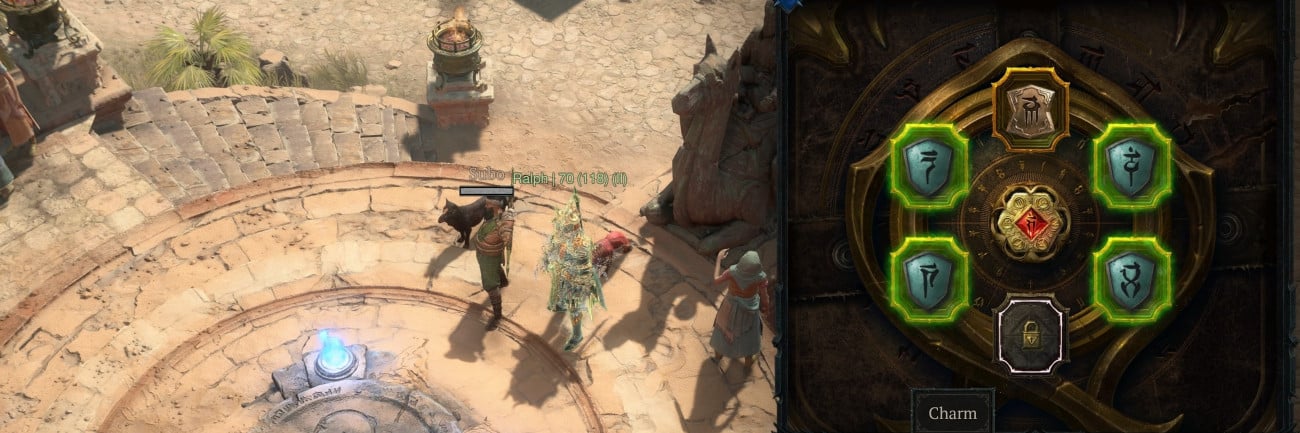
Talisman System Complete Guide Quick Summary:
- You get access to the Talisman system when you start progressing through the LoH campaign.
- Seals go in the center and control how many Charms you can equip in your Talisman tab.
- Charms provide you with bonuses like stats, set effects, and Unique affixes from items you don’t need to wear to get them.
- You can find Seals and Charms by participating in any content, but a higher Torment level gives a better drop chance. But Set Charms drop only from Torment I and higher.
At Skycoach, we can help you Get to Level 70 in D4 in no time to enjoy the game in a way you like. Unlock all the endgame content right away instead of farming your way to it forever.


Read closely 
Browse our hottest Diablo 4 Boosting services







What Is the Talisman System in Diablo 4?
The Lord of Hatred has brought the Talisman system to help you power up your characters. It brings back the idea of set bonuses, but without forcing you to wear full gear sets like we did in older Diablo games. And that’s honestly the best part for me.
Instead of replacing your helmet, chest, gloves, or other main gear slots, the Talisman has its own separate tab in your inventory. You open it, slot stuff into it, and your character gets extra power from there. To me, it’s a great way to get new bonuses and keep my build flexible. Talisman works around two main item types in Diablo 4:
|
Talisman Item |
What It Does |
|
Seals |
Go to the center of the Talisman and decide how many Charms you can use. It depends on the rarity of the Seal you’ve inserted |
|
Charms |
Go around the outer edge and give you bonuses, Unique powers, or set effects |
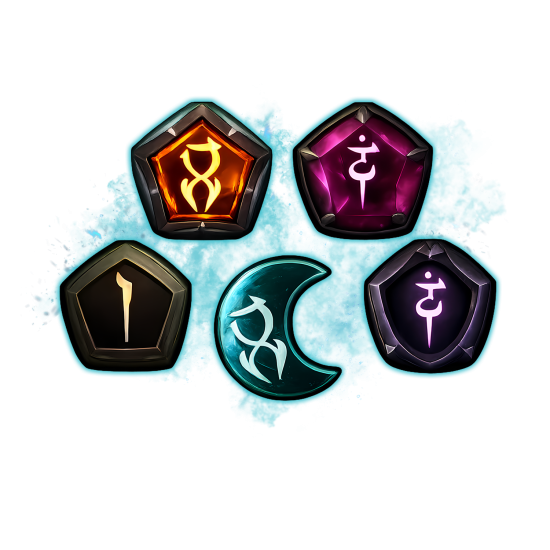
Seals act as your slot controller if I can say so, and Charms are what give you bonuses you were after in other Diablo titles years ago. To equip more Charms at once, you’ll have to insert higher rarity Seals. This will unlock extra slots for you. Later on, you’ll eventually get Mythic Seals, and they offer the largest number of slots to insert your Charms. They also have special Mythic-style bonuses.
How to Unlock the Talisman System
You unlock the Talisman system early during the Lord of Hatred campaign. Only one short questline separates you from it. Also, there are no requirements in terms of level. But I gotta say that this system’s full potential is unlocked exactly during the endgame. Yet don’t be shy and give this feature a go before you get to level 70, too.
Once Talisman is unlocked, you can access it any time straight from your inventory screen. It has its own separate tab on the right of the Equipment button. I would say the whole unlock and usage flow of Talisman looks like this:
- Start progressing through the Lord of Hatred campaign
- Unlock the Talisman tab early in the story by completing a short Last of the Horadrim questline
- Equip a Seal in the middle of the interface (you won’t have too many slots at first)
- Add Charms around the outer edge to see the effects
- Upgrade your setup over time as better Seals and Charms drop
And what I like most about this system is that it’s not tied to any particular activity or endgame events. You can find Seals and Charms everywhere in D4. And yeah, maybe there’s a slightly better chance of them dropping somewhere, but you’re not locked into one boring farm spot anyway.
Diablo 4 Seals Explained
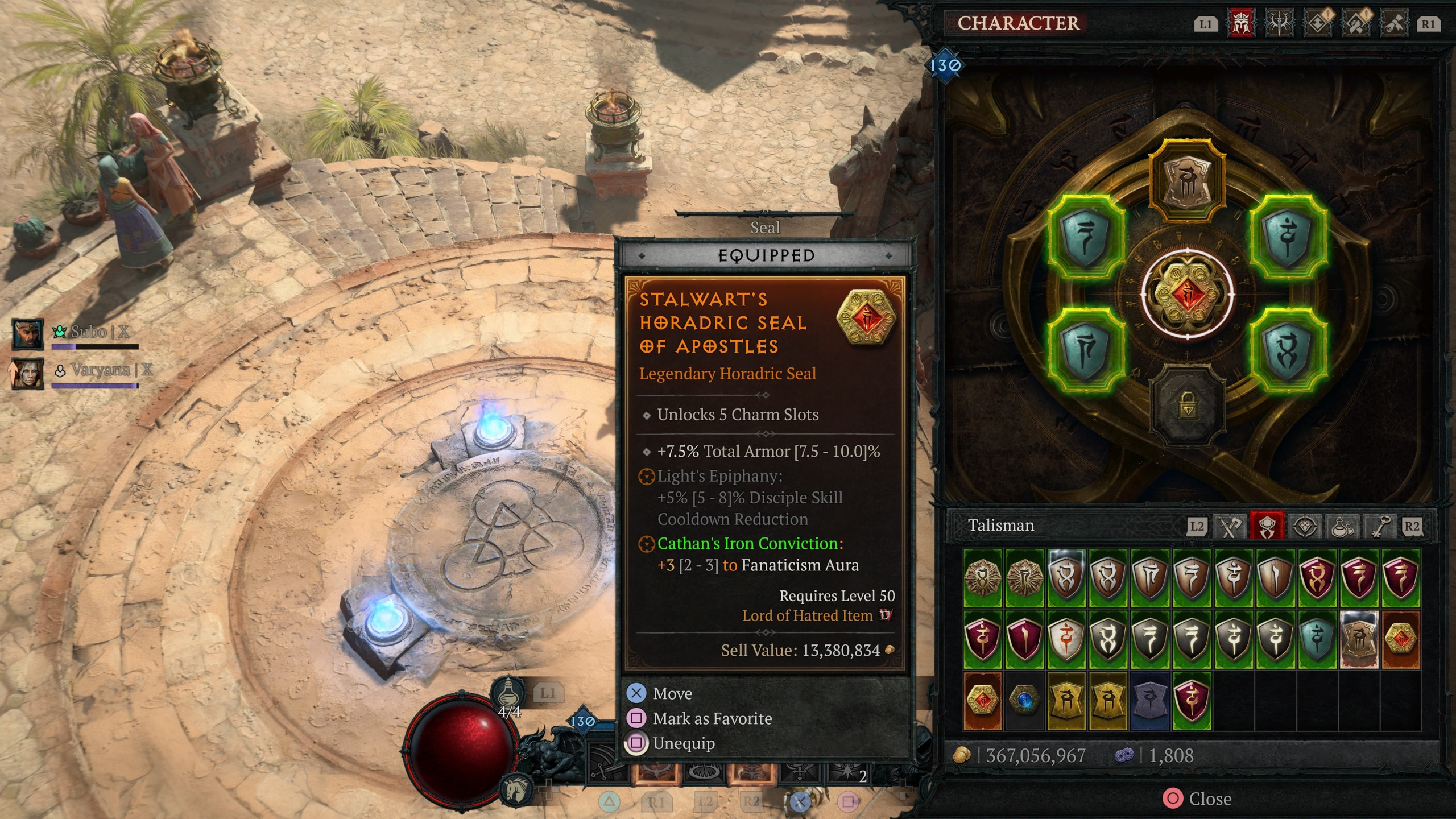
Everything starts by inserting your first Seal in the middle of the Talisman system. Depending on its rarity, you’ll have access to a limited number of Charms you can equip around it. A bad Seal means fewer Charm slots, but getting at least a Rare Seal would mean you have 4 Charm slots available. And that’s something to work with.
Get the highest-rarity Seal you can. More Charm slots means more Unique effects, more Set Charm progress, and more room to mix bonuses without sacrificing your actual gear pieces. Mythic Seals are basically the biggest goal. They not only let you use the maximum number of Charms, but they also allow you to roll more powerful extra effects. One of them is reducing how many Set Charms you need to activate a set bonus.
That’s absolutely huge. It means you can unlock a set bonus with fewer pieces, and then use the remaining slots for Unique Charms or other bonuses you get. But remember that not every Seal will always fit every Charm plan. Specific ones can limit what you’re allowed to slot. If a Charm doesn’t go in even though the slot looks open, the Seal might be the reason.
Diablo 4 Charms Explained
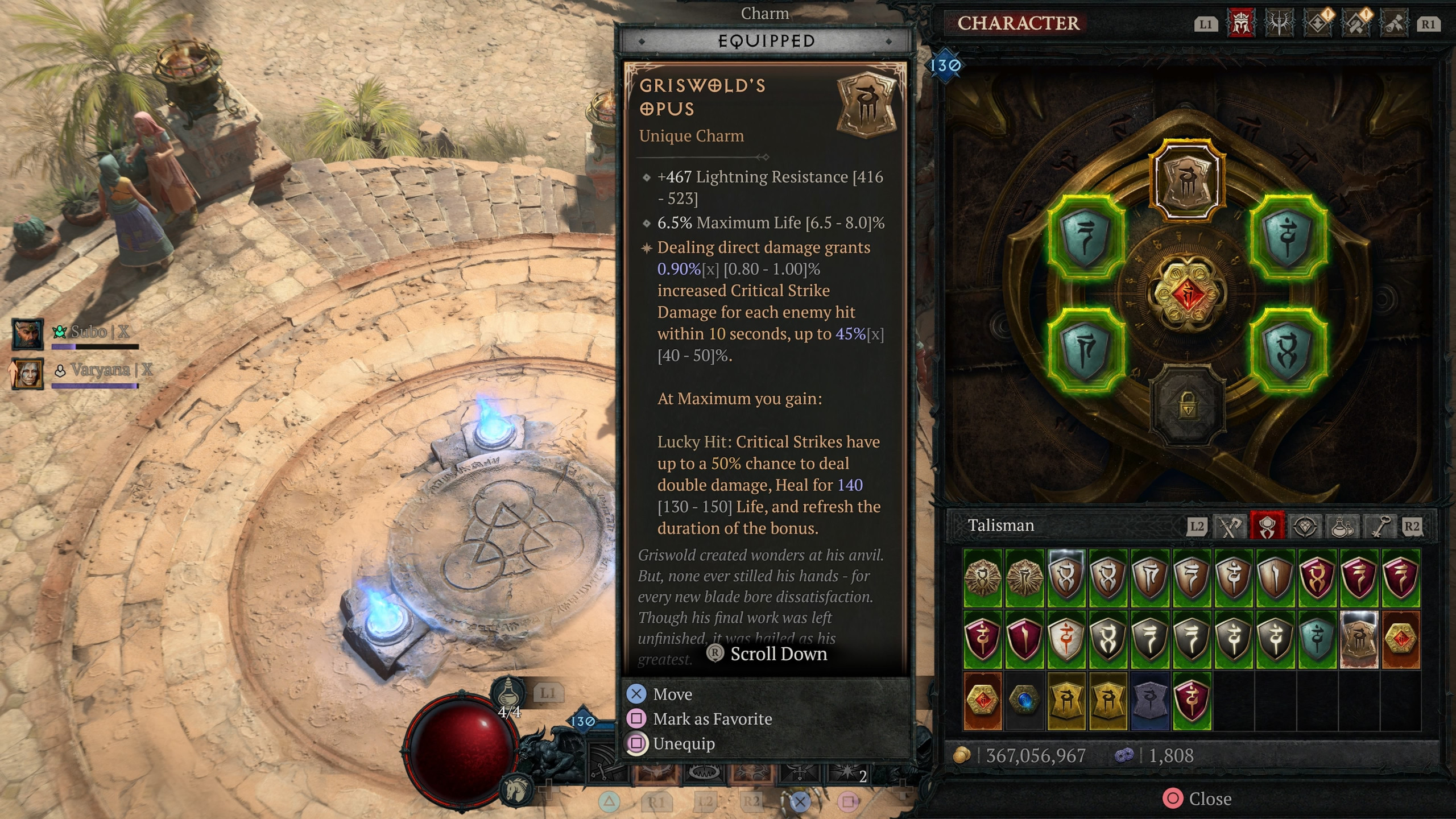
Charms are what you insert after you’re okay with the Seal you’ve chosen. They provide you with the bonuses you’re after once you place them around the outer edge of the Talisman interface. And each one adds something to your character. One of the many examples can be Griswold’s Opus you see in the screenshot. It gives +467 Lightning Resistance and 6.5% Maximum Life, as well as a unique bonus described on the item.
In this table, you can see four main Charm types in Diablo 4 now:
|
Charm Type |
What It Does |
|
Regular Charm |
Gives a simple bonus and works as an early filler |
|
Unique Charm |
Carries a Unique affix from a Unique item |
|
Set Charm |
Activates set bonuses when you equip matching Charms |
When your character is only during the growing phase, you’re most likely to use Magic and Rare Charms only. They’re not that powerful, but they’ll allow you to move through the campaign much faster and experiment with various builds. A Rare Charm you may find can carry you for a larger part of the LoH campaign, especially if it boosts something your build already uses.
Unique Charms can carry the Unique affix from certain Unique items. It’s a huge bonus, and you can create amazing builds with this feature. You get the bonus, but you don’t have to wear the item itself. Just think of what the Talisman system unlocks for you. Unbelievable.
Finally, you’ve got Set Charms that work exactly like set items, but you’re not forced to wear actual armor pieces. You equip multiple Charms from the same set, and then the bonus turns on. Remember that certain set bonuses are generic, which means any class can use them. But you’ll also discover class-specific ones that work only for Rogue, for example, but they’re much rarer and stronger.
Also, you can stack bonuses from Charms if they bring the same stats. For example, two Charms with +4% Maximum Bonus Life each yield +8% when equipped together.
Browse our hottest Diablo 4 Boosting services






Unique Charms and Unique Affixes
I want to underline how strong Unique Charms is one more time. Just imagine – you can now keep the power of the item you need for the build, but free up the gear slot. That means your build will no longer be stuck with wearing a specific Unique just because you need this effect.
The easiest example is Godslayer Crown. Let’s say you want its Unique effect, but you don’t want to use that helmet slot. With a Unique Charm, you can get that same Unique affix through your Talisman instead. Now your helmet slot is open for something else, and the power still stays in your build.
This gives so much freedom when planning endgame setups. You can already see players asking the devs to bring both the Talisman and the Horadric Cube to future Diablo games like Diablo 5. So far, I’ve enjoyed both of these systems so much since LoH launched. They open the horizons I’ve never dreamt of.
Note: But there’s a clear restriction – if you already have the physical piece of gear equipped, the game will not let you equip the associated Charm version
Set Charms and Set Bonuses
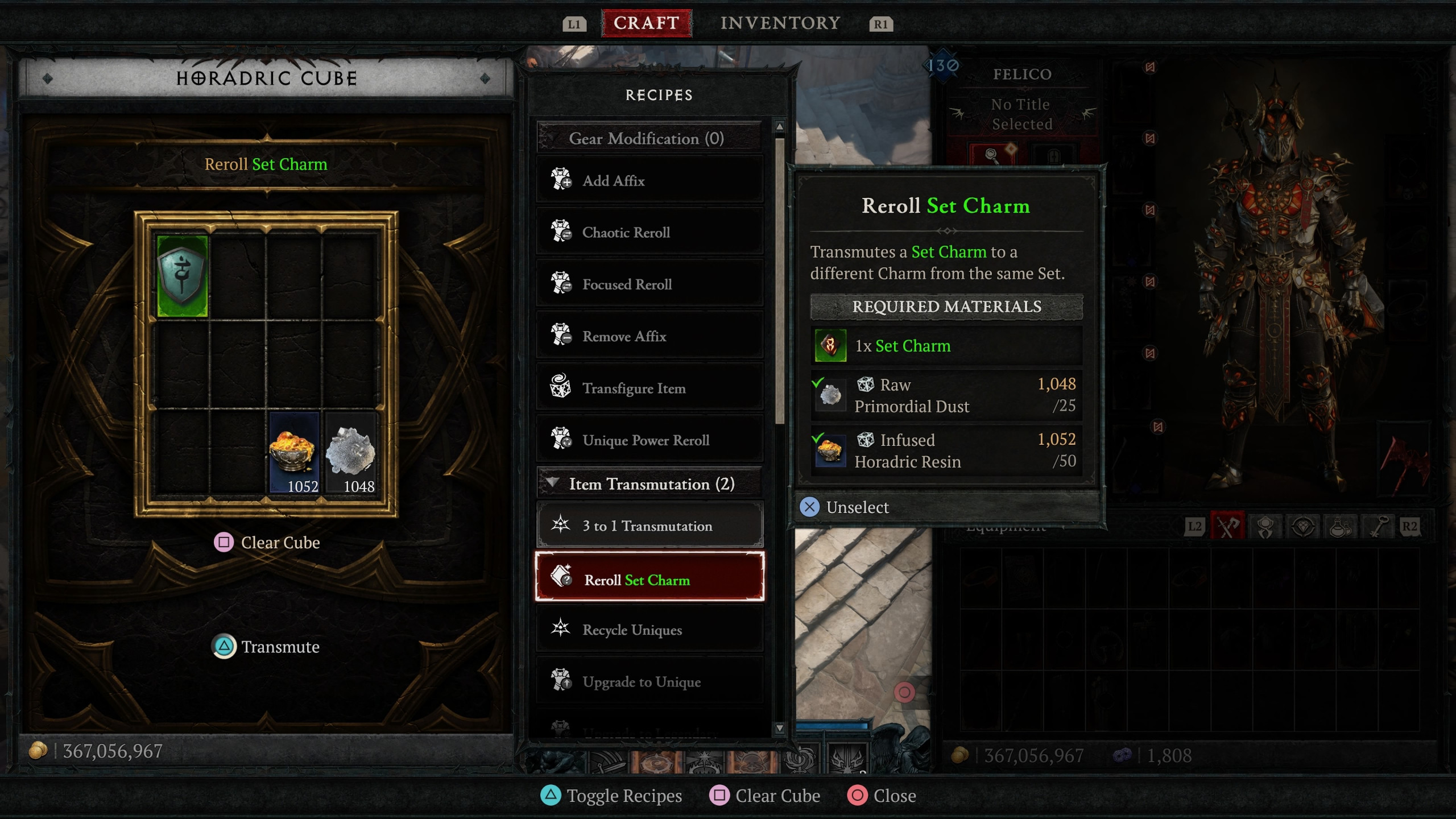
The way set bonuses work in Diablo 4 has now become much simpler. You collect Charms from the same set, place them into your Talisman window, and once you have enough matching pieces, the set bonus activates. Set bonuses unlock at 2-piece, 3-piece, and 5-piece thresholds. If your build wants a specific bonus, your goal becomes finding the missing Charm pieces instead of rebuilding your entire armor setup.
|
Set Charm Type |
What It Means |
|
Generic Set Charms |
Usable by any class and easier to find |
|
Class-Specific Set Charms |
Designed for one class, stronger, and harder to get |
|
Partial Set Bonus |
Activates when you equip enough pieces from the same set |
|
Full Set Setup |
Uses more Charm slots but gives a stronger build direction |
Generic Set Charms would be your starting point, as they offer nothing crazy. Just use them to make your character stronger to finish the campaign faster. Later on, you’ll find rarer and stronger pieces to push all the content the current season has to offer.
How to Get Seals and Charms
As I’ve said already, you can get both Seals and Charms in Diablo 4 by just playing the game. Both item types can drop from any activity in Lord of Hatred. The rarity will grow accordingly as you move from early stages to the endgame.
When you get to higher Torment difficulties, you’ll find stronger Charms that can become a part of your core build for good. So far, this is how you get Seals and Charms in Diablo 4 Season 14:
|
Source |
What You’re Looking For |
|
Campaign and general drops |
Early Seals, Magic Charms, Rare Charms |
|
Any regular activity |
Basic Talisman upgrades while progressing |
|
Higher Torment difficulties |
Better Charms, rarer Set Charms, Unique Charms |
|
War Plans |
A strong repeatable source for Seals and Charms |
|
Undercity with Horadrim Tribute |
More focused Seals and Charms farming |
|
Horadric Cube |
Target crafting Unique Charms from Ancestral Uniques |
And my biggest advice here is not to stress too much about what Charms you get at the start. Use what gives you better stats for your current build, and don’t plan on using it for too long.


You got -20% OFF 
Best Ways to Use Talismans in Season 14
With the introduction of both Talisman and Horadric Cube, the way you treat build creation has changed forever. These systems shape your character at any stage of the game, and this influence only becomes stronger towards the endgame. That’s especially true for Unique Charms since they’ve basically broken down everything we knew about class setups before.
I would use Talismans in Diablo 4 Season 14 the following way:
- You start from the early findings, like Magic or Rare Seals and Charms. Don’t overthink it, as you can use practically anything you find just for a bunch of extra stats and a nice little bonus on top
- Then you gradually replace weaker pieces with better one drop
- Eventually, you’ll loot a Unique Charm or Set Charm that might give extra power to your main skill or damage type you’re building around
- See what works better for you, because sometimes a 2-piece or 3-piece bonus plus one strong Unique Charm is better than going all-in on one set
- Also, don’t forget to upgrade your Seal before chasing stronger Charms. You need more slots to work with, especially when you enter higher Torment levels
The Talisman system doesn’t look too complex on the surface. But I’ve already found out that it’s not that simple either. You can do a variety of builds and experiments, and that’s what I like most about it. I hope you do so, too.
F.A.Q.
What is the Talisman System in Diablo 4?
The Talisman system is a new Season 14 character customization feature that lets you equip Seals and Charms for extra bonuses, Unique powers, and set effects.
How do you unlock Talismans in Diablo 4?
You unlock the Talisman System early during the Lord of Hatred campaign. After that, you can access it from a separate tab in your inventory.
What are Seals in Diablo 4 Talisman system?
Seals go in the center of the Talisman interface and decide how many Charm slots you can use. Higher-rarity Seals give you more room for stronger setups.
What are Unique Charms in Diablo 4?
Unique Charms can carry Unique affixes from certain Unique items. This lets you use that power without wearing the original gear piece.
How do you get Seals and Charms in Diablo 4?
Seals and Charms can drop from many activities, but stronger ones are mainly found in higher Torment content, War Plans, Undercity runs, and Horadric Cube crafting.