 Rick Flair
Complete Forza Horizon 6 Tuning Guide Quick Summary:
- Forza Horizon 6 tuning is all about finding what your car does wrong and fixing that exact problem.
- The biggest rule is simple: change one thing at a time, test it, then move on. Otherwise, you’ll never know what actually helped.
- Tires, ride height, springs, camber, anti-roll bars, and damping shape how the car feels through corners.
- Brakes, differential, aero, and gearing fine-tune how the car slows down, puts power down, grips at speed, and reaches top speed.
- You always wanna work with small changes, especially when fixing understeer, oversteer, bouncing, or poor corner exits.
This article talks a lot about finding the right car and turning it into your dream project, but if you have already found one and don’t have the credits for it yet, check out our Forza Horizon 6 Credits. Get any car you want, whether it’s from the auction or straight from the auto show now.


Read closely 
Browse our hottest Forza Horizon 6 Boosting services


How Tuning Works in Forza Horizon 6
Before I break down each setting, you need to understand what is the goal of tuning a car. In simple terms, you do it to solve the problems the car might have after installing new parts, or even with the stock ones. But in order to solve these problems, you have to drive consciously. Notice the behavior of the car and what it does instead of taking it as the car’s intended way of driving. I’ll teach you how to do that, too. It’s also important to go over some terms so that we’re on the same page. Let’s start with tuning and its goals:
- Grip: If your car loses grip easily and goes sliding into the turn, tuning solves it.
- Speed/Acceleration: Coming out of the corner, the car takes forever to accelerate. Tuning solves it.
- Turning: If the car doesn’t turn or turns too much, tuning solves it.
- Braking: Does the car drop speed too much or too little when braking? You know the answer.
In short, tuning can turn a mediocre car into a good one and a good one into a great one. There’s always room for improvement, so no wonder that for some people, tuning is a big part of the game. Now, how do you understand if you have a problem with any of these issues listed above? I once read the five easy rules taken from here that you need to follow to create great car tunes:
- Solve the Root Cause: If your car turns poorly, don’t tune the part that makes it turn better. Tune the part that makes your car turn badly. You’re not solving the issue if you do it the other way around.
- Change One Thing at a Time: When tuning, always focus on one thing. Never tune multiple things at once, cause you will never know what worked and what didn’t.
- Look Deeper: If your car oversteers, understand why it does that. Understand at what specific point of cornering it oversteers. Does it oversteer when entering the corner? Might be a camber or a differential problem. You’ll learn to analyze the car the more you practice it.
- Tune in Small Increments: If you’re tuning something, always tune it in small steps. If your rebound settings are set at 18.0 and you feel that the car is too jumpy, don’t drop it to 15 or raise it to 20.
- Don’t Sit on Tuning: If you feel that what you did only made the car worse, reset and start over. Before you do that, analyze where you went wrong.
Following these five rules will already make you better than some highly-rated community tuners. Finally, let’s talk a little about the most important Forza Horizon 6 tuning terminology:
- Understeer/Oversteer: When the car doesn’t turn into the corner enough, or, on the contrary, turns too much, causing you to spin. Under - not enough, over - too much. Simple.
- Drivetrain: Further in the article, I’ll be using abbreviations like AWD, FWD, and RWD. These are all cars’ drivetrains, which stand for all-wheel, front-wheel, and rear-wheel drive, respectively. The drivetrain’s type shows what wheels are getting powered by the engine.
- Bottom Out: Happens when your suspension compresses to its limit, where it can’t do it anymore. As a result, you lose the grip. Basically, a fancy way of saying that you’re crashing.
For the most part, this is what you need for this article. I'm not gonna use any complex technical jargon so that it reads better. Let’s move on to the actual tuning guide.
Tuning Your Car to Perfection
First thing you have to know - there’s no single solution for all cars. Tuning is an individual process, and considering that there are over 550 car models without duplicates and Forza Editions, you’ll go bald by the time you tune all of them, at least as a beginner. Find a few cars that you like, it doesn’t matter whether they’re visually appealing or you like driving them, or even have them in real life, and tune them. Don’t tune too much, or you’ll burn out. Treat it like a project that you’ll be working on for some time. Secondly, there’s never a perfect tune. You’ll always find something to improve, but if you don’t stop at the right moment, it’s gonna ruin tuning for you, I promise you that. Take your time. Pick any of the best cars in the game and drive it in a stock state. Work out the feel for it. Then, tune it a little. Below, I’ll list the order in which you need to tune your car. Usually, you start with tires and then work your way up. Don’t forget to drive and have fun. The order in which you will tune your car parts is as follows:
- Tires
- Springs and Ride Height
- Camber, Toe, and Caster
- Anti-roll bars
- Damping
- Brake
- Differential
- Aero
- Gearing
This is the exact order you need to follow to tune your car, and remember the most important rule of tuning: always tune one thing at a time. The sections below will explain everything in very simple and understandable phrasing. I’ll avoid complex technicalities and nuance, first of all because it will scare you away, second of all because Forza Horizon 6 is a simcade and not Assetto Corsa. You also have to know that tuning differs not only for individual cars, but also for the way you control your vehicle. You'll be tuning your car differently when you use a wheel or if you're on a controller.
Tires Tuning
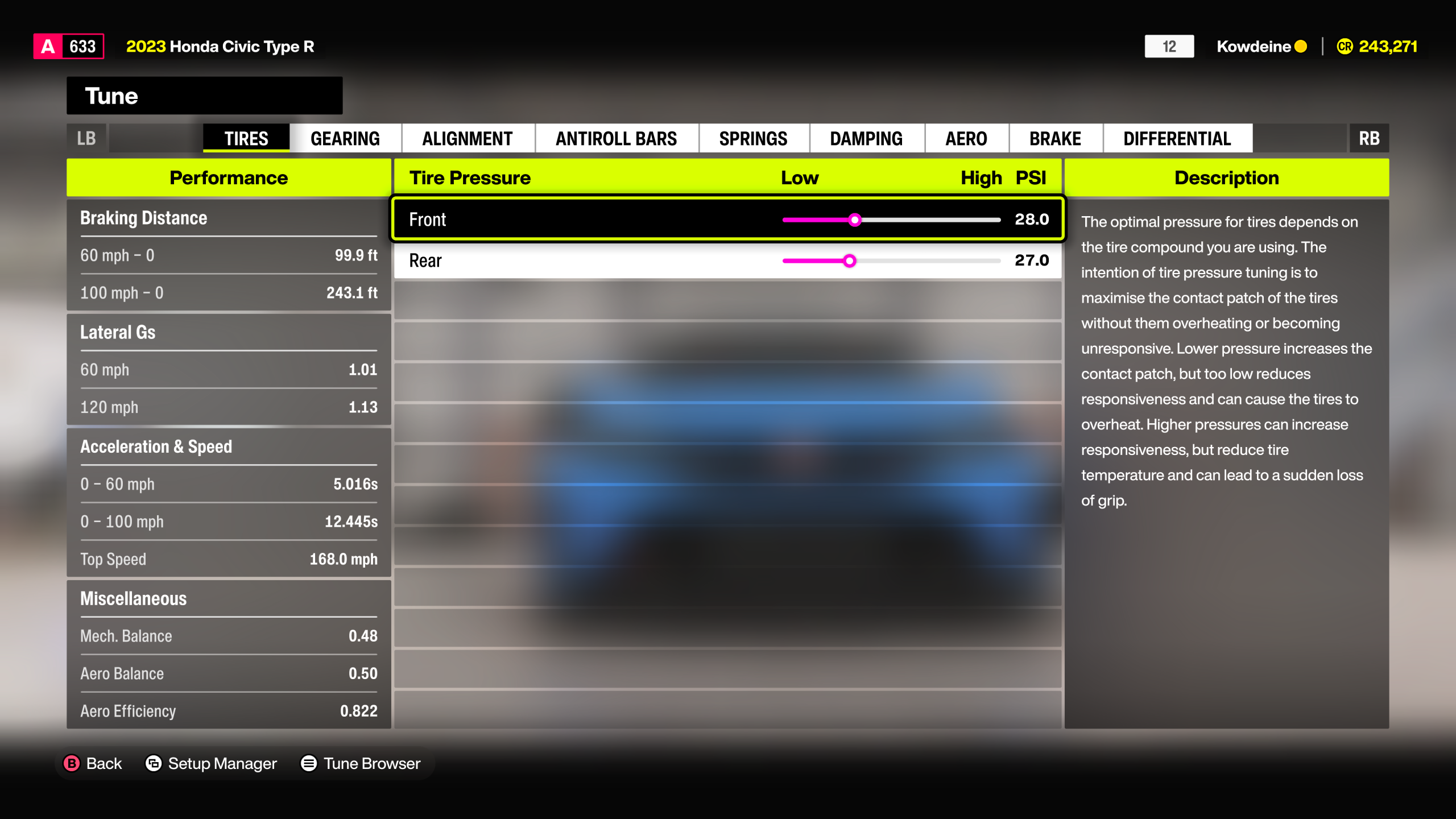
Tires are the main and most important tuning part. We always start with that. You tune the tires by raising and lowering the pressure in them. If the pressure is high, the car is quick and responsive, but it starts sliding. If the pressure is low, the car is slower and has more grip, but has a harder time turning:
- If the car won't turn, fix the front
- If you're sliding too much, fix the rear
If the car slides too much in the corners, lower tire pressure slightly. If the car feels slow or sluggish, raise it slightly. For most AWD, you usually start around 28 PSI in the front and 27-28 in the rear. Make small changes, half the PSI at a time. Note that the heavier the car, the higher the pressure needs to be. For trucks, put the pressure to 32 PSI. Some racing cars also require higher pressure, as well as drift, but you generally put pressure to either ~27 PSI or to 32 PSI 99% of the time.
Springs and Ride Height Tuning
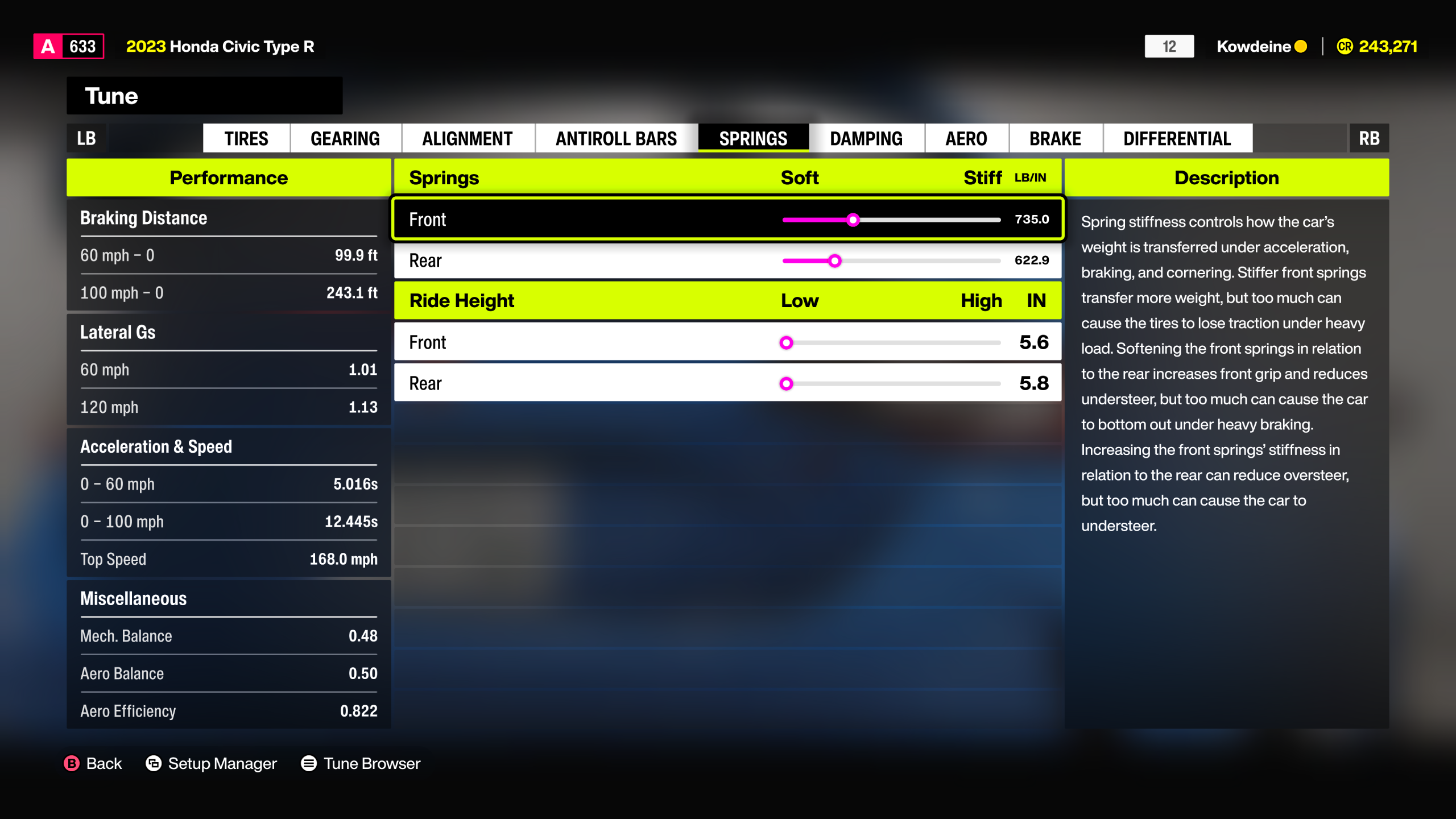
Suspension stiffness is what the springs control. While this is different in real tuning, in Forza, most AWD builds run either the softest or close to the softest settings on both front and rear. The reason for that is that a softer suspension helps the tires stay on the ground and gives more grip. If you feel that the car bounces too much or is just too wonky to drive, stiffen them very slightly.
Ride Height is as simple. Lower height improves cornering. Too low and the car starts scraping the floor. Race builds typically benefit from being low. Here’s a general ruling for car types:
- Race Cars: 4-6
- Street Cars: 5-7
- Prototypes: 3.5-4.5
- Off-roaders: 5-7
This is very rough, but it’s a good starting point for checking the minimal height for your car. Start at the lower point, both wheels should be the same height, then raise from there only if there are serious problems with the car.
Camber, Toe, and Caster Tuning
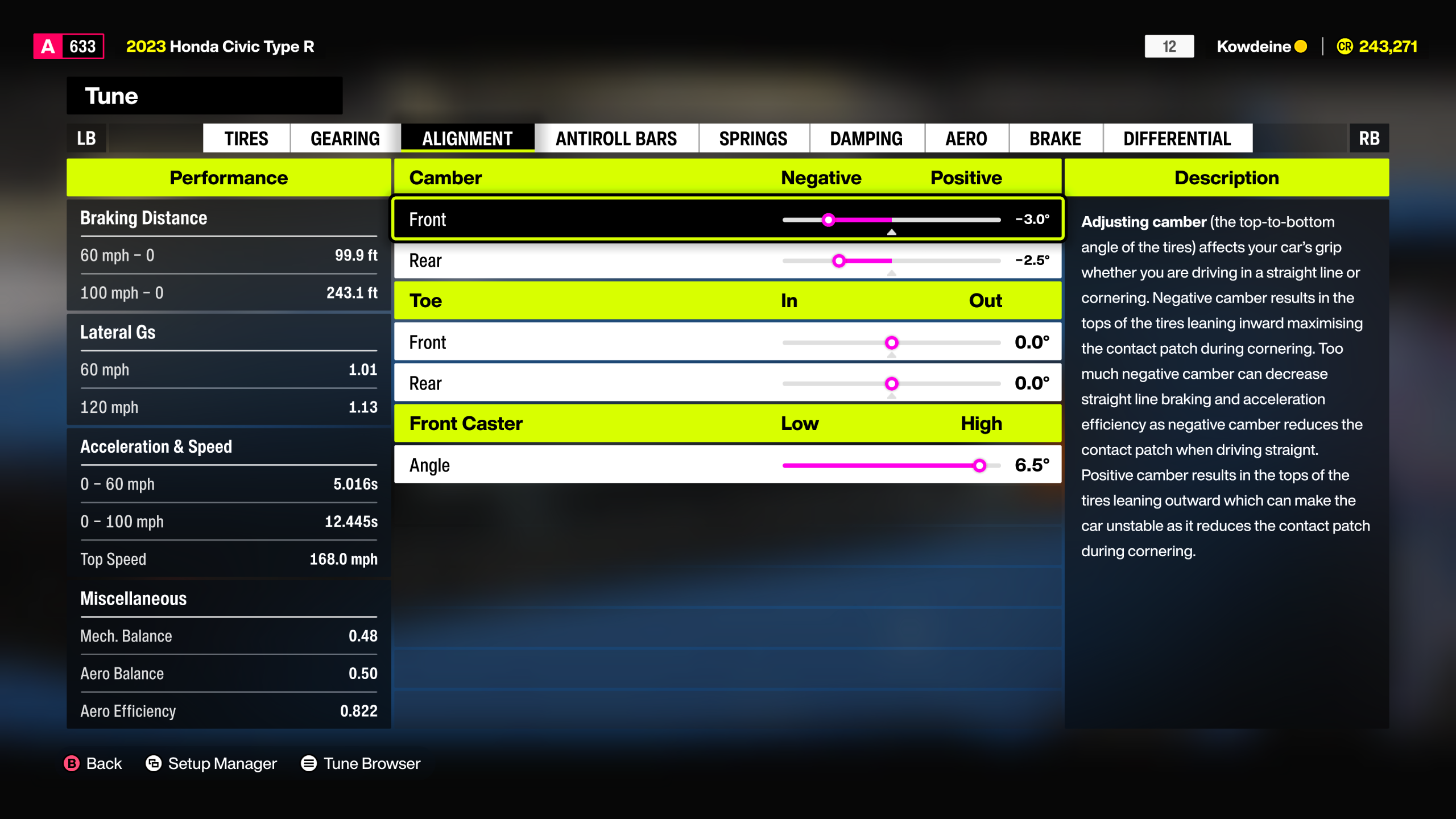
In layman's terms, it's the angle of the wheels. Negative camber makes the top of the tires lean inward. Positive camber makes the bottom of the tires lean inward. Negative camber is useful for cornering grip. In Forza Horizon, you always need negative camber because of the way the game works. Again, omitting detail on that. If you lean your tires too much, your braking and acceleration will suffer. AWD starts around -1.5 to -2 degrees on the front and -1 to -1.5 in the rear:
- If the car doesn't turn, reduce the front camber.
- If the car is too loose, reduce the negative camber in the rear.
To avoid confusion, when I say reduce, I mean move the slider to the right, not to the left. So from -1.5 to -1.3, not to -1.7. It’s important that you have your ride height settled before dealing with camber, as with ride height, the camber changes, too. Now toe & caster.
Toe changes the stability and responsiveness. Front toe out helps turning, rear toe in helps stability. For the most part, don't change that. Keep it close to zero. Only ever slightly change that if the car feels weird. Caster affects how steering feels. A higher caster gives more stability and better cornering grip. Lower caster increases sensitivity. For racing, keep this high, above 5.5 at least.
Anti Roll Bars Tuning
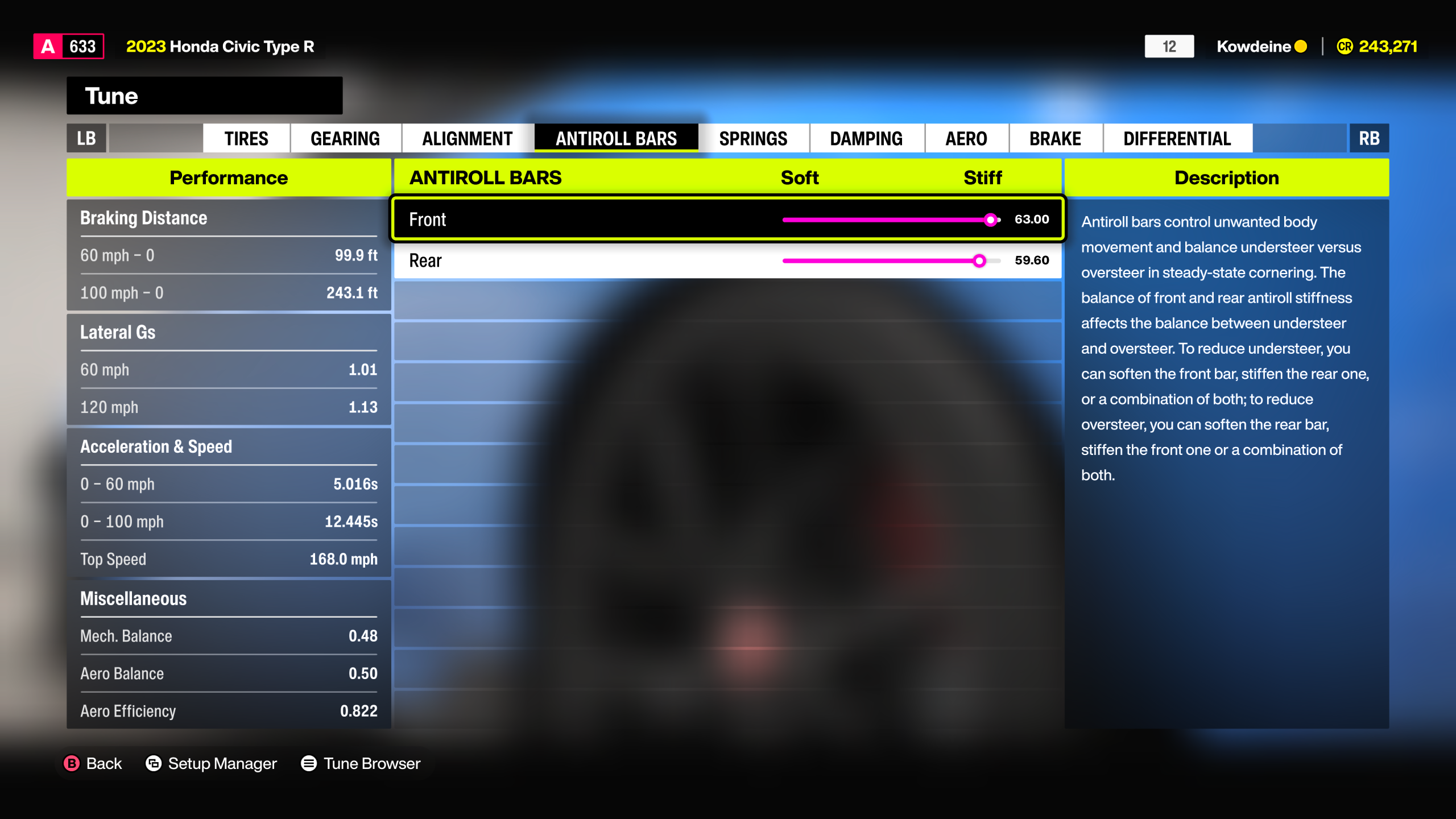
An anti-roll bar is a long bar that connects wheels to each other. It stops the wheels from spinning individually. It's also one of the easiest things to tune. For AWD cars, stiffer is usually better. It improves cornering and makes the car feel snappier. Most AWD builds max out both anti-roll bars:
- If you lower ARBs, the front gets more grip. This is useful in borderline cases where the car refuses to turn.
- If you lower the rear anti-roll bar, the rear gets grippier and more stable. This is useful when your car keeps sliding out on the rear.
Basically, a car understeers = lower the front. Rear moves too much = lower the rear. But generally speaking, a higher ARB is better than a lower value.
Browse our hottest Forza Horizon 6 Boosting services


Damping Tuning
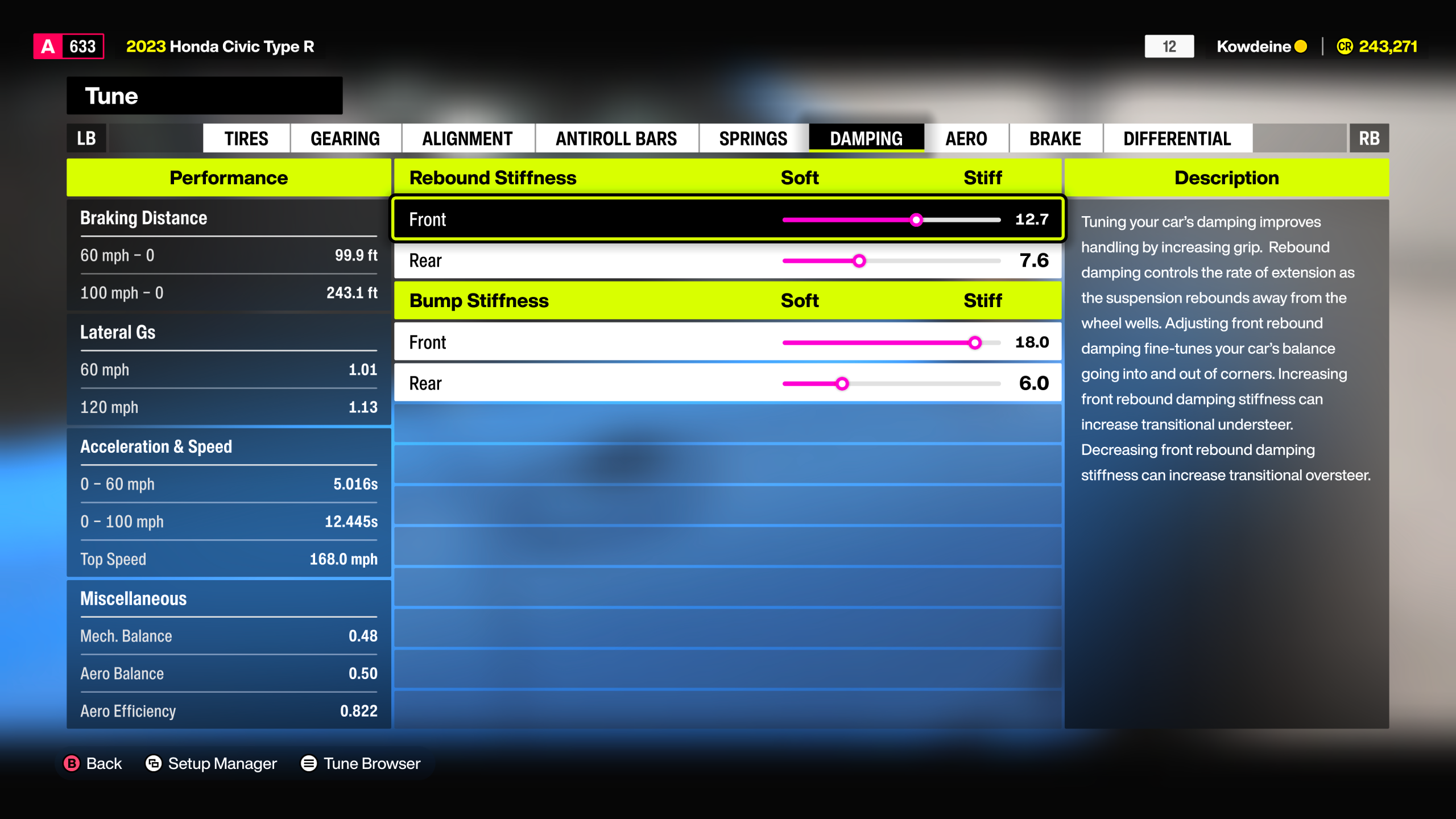
This setting is somewhat complicated to understand, so I'll try to explain it as simply as possible. For now, just set the rebound and bump stiffness as shown in the image above (FRONT and REAR at 18.0/6.0).
- If the front is too unresponsive when entering corners, lower front damping slightly.
- If the rear is unstable, lower rear damping.
Rebound controls how quickly the suspension comes back up, and bump controls how quickly it compresses. If the car is too bouncy even with the springs stiffened, increase the rebound just a tad bit. If the car feels too sensitive and responsive, lower the rebound. As a rule of thumb, rebound should stay much higher than bump.
Brakes Tuning
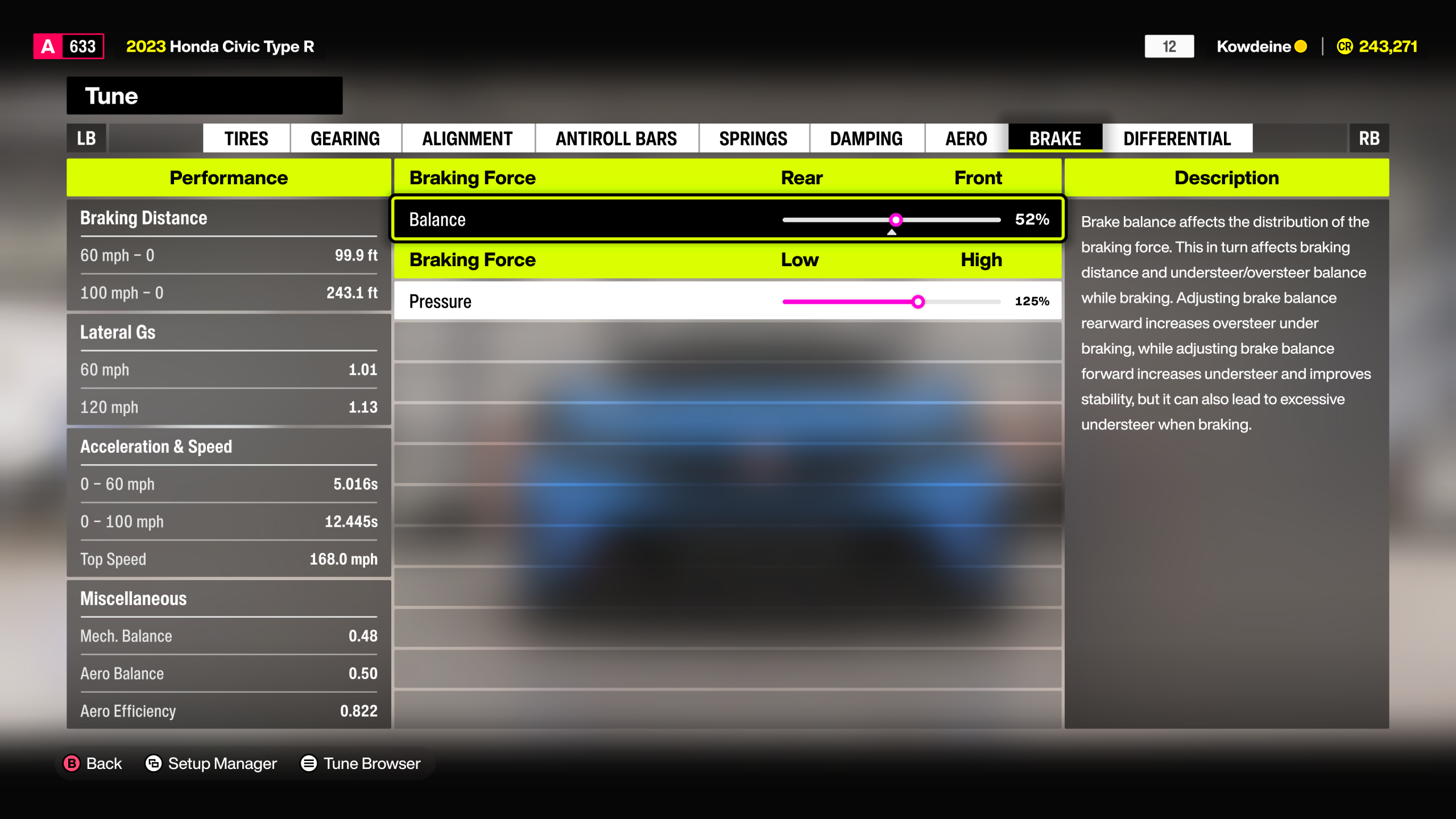
Start at 10% increase for the front balance. More front brake balance = safer, stable braking. More rear brake balance = easier cornering, but the car will spin out if you lower it too much. Brake force is easy. High brake force means stronger braking, but easier to lock up your pedals. Lower brake force is easier to control. Don't change it too much and keep it around the middle.
Differential Tuning
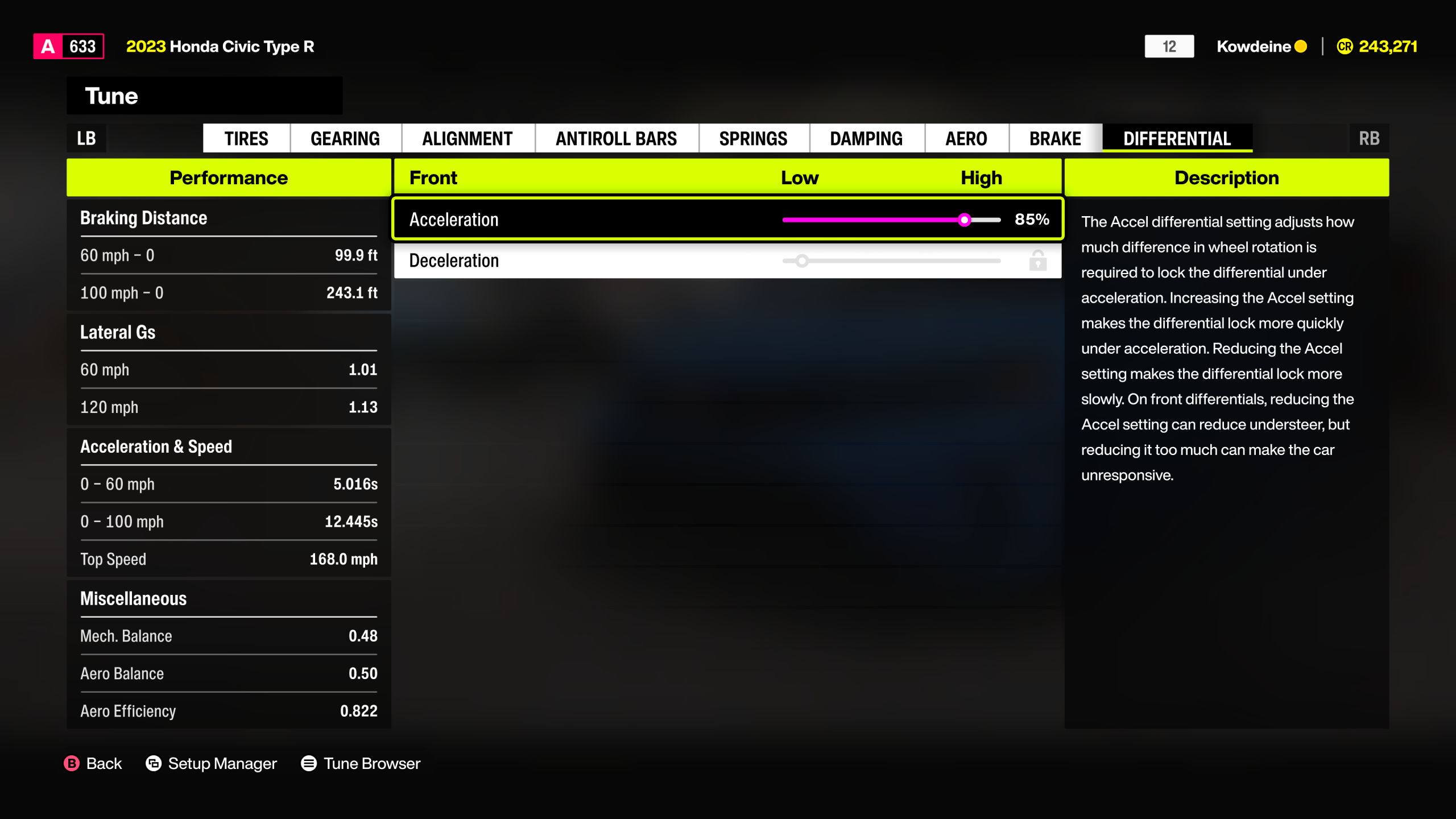
This setting is kind of complex on paper, but in reality, you can boil it down to the following rules. If you're driving an RWD car, only adjust the rear differential. For FWD, only the front differential. Now, where it gets hard is with AWD cars cause you'll need to adjust both differentials:
- Acceleration: Should be kept as high as possible. Helps traction when coming out of the corner. If the car understeers a bit too much when accelerating, lower the acceleration just a little.
- Deceleration: Put this lower, but if the car feels unstable when coming into corners, raise deceleration a bit.
- Center Balance: This decides how the car behaves as a front-wheel or rear-wheel drive car. More front means the car is safer and easier to drive, but add too much and you'll cause understeer.
The rear balance will make the car faster and more aggressive, but too much and your car will oversteer. It's usually preferred, but I personally like it more when the balance is skewed towards the rear.
Aero Tuning
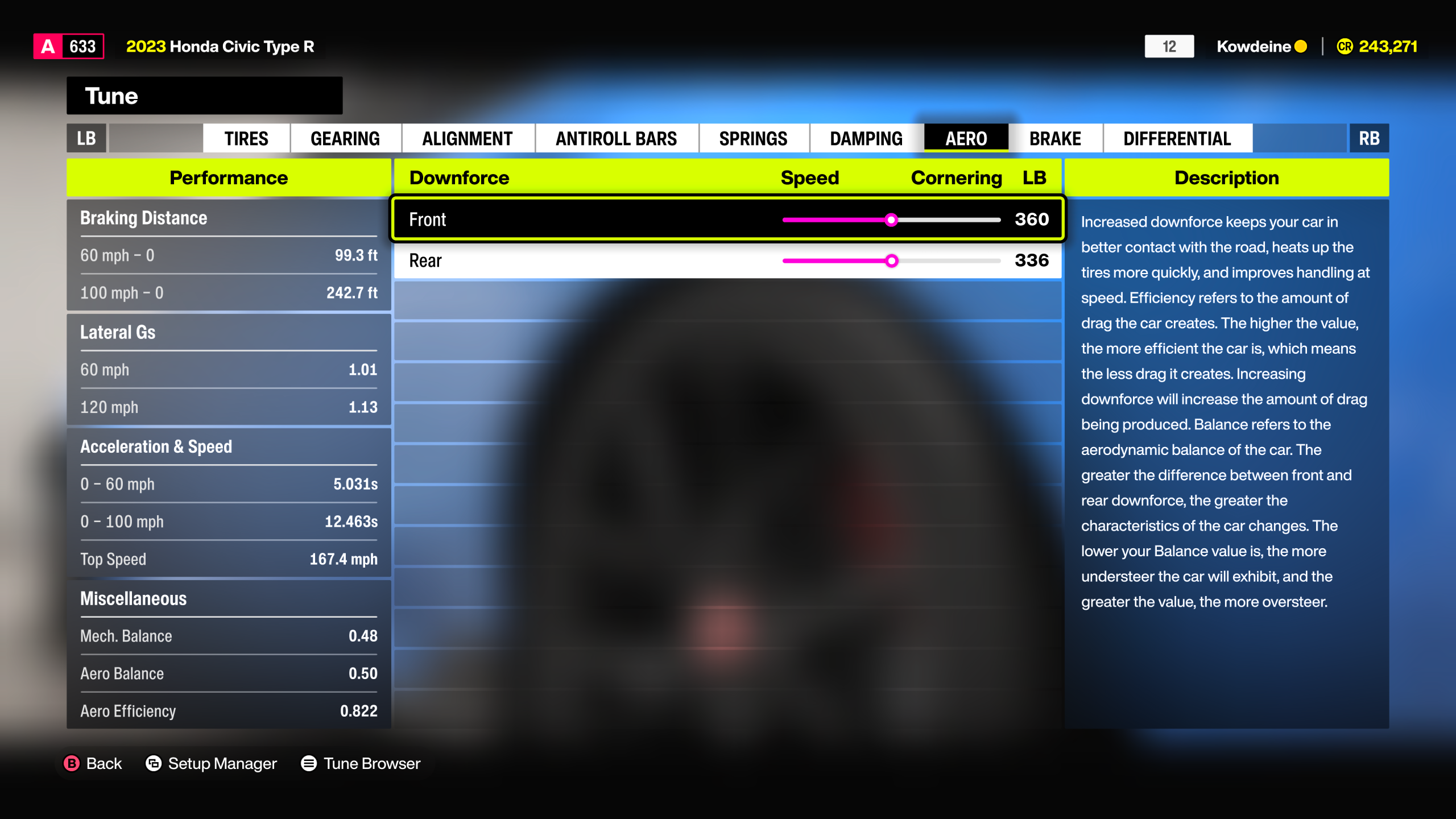
The easiest point to gain grip. Front aero should have as much downforce as possible, as it improves cornering grip and helps the car turn better. Too much downforce slows the car on the straight lines:
- More aero = grip
- Less aero = speed
If you feel that the car is getting too slow, lower the front downforce. For the rear, run as little downforce as possible for maximum speed, and if the rear keeps sliding out, increase the rear downforce til you feel that the car is stable.


You got -20% OFF 
Gearing Tuning
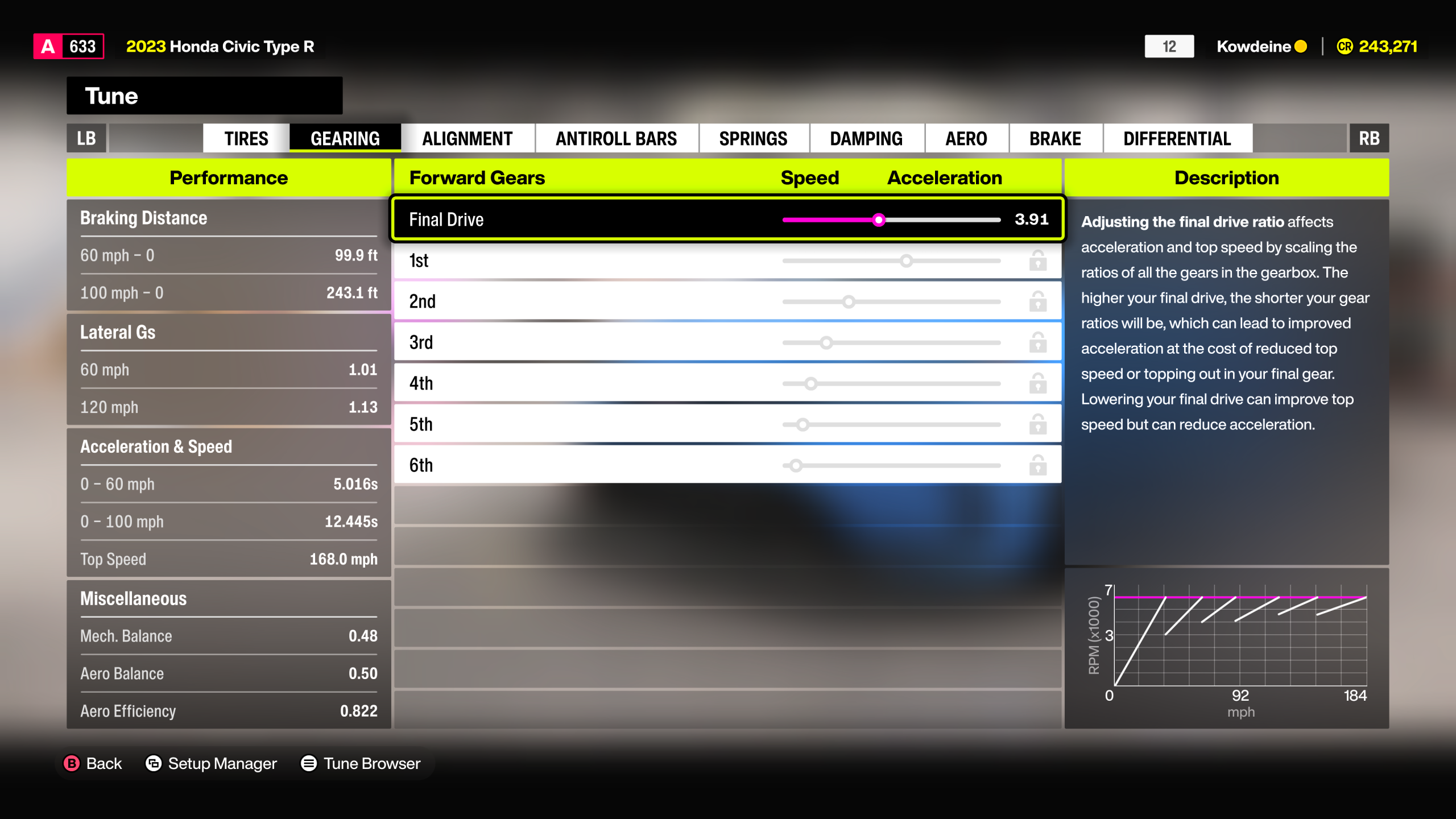
The final and one of the most important parts of tuning. Gearing is quite straightforward. It's balancing between speed and acceleration. Move the Final Drive towards speed to gain more max speed and towards acceleration if you feel that your car takes a long time to go fast. The goal is to make your car barely hit top speed at the end of the longest straight.
- If you're bouncing off the limiter too early, raise speed.
- If your car goes out of the corner slowly, increase acceleration.
As the base point, look at the final graph at the bottom right corner. You want to make the final gear hit the edge of the graph by moving the final drive. It gives you the best top speed. You adjust your gears from there. There's truly no one single solution to gearing, and it's, in my opinion, the longest and hardest part of tuning a car. These rules apply to standard track racing. Gearing for cross country, dirt, and drift is very complex, and you're better off copying someone else's settings for your car.
Read our other Forza Horizon 6 guides:
F.A.Q.
What is the best way to start tuning in Forza Horizon 6?
Start with a car you enjoy driving, test it in stock form, then adjust one setting at a time. Tires, ride height, and suspension are usually the best first steps.
Should beginners tune cars manually in Forza Horizon 6?
Yes, but they should start simple. Always adjust sliders conservatively, and test the tuning after every change. Making this a habit will go far in making you a good tuner.
What causes oversteer/understeer in Forza Horizon 6?
Oversteer happens when the rear of the car rotates too much. It often comes from rear grip loss, aggressive differential settings, poor damping, or too much rear instability. Understeer happens when the car does not turn enough into a corner. It can come from tire pressure, camber, anti-roll bars, aero, and differential.
Should I use community tunes in Forza Horizon 6 or make my own?
Community tunes are useful for quick results, but making your own helps you understand the car and adjust it for your driving style.
In what order do I tune parts in Forza Horizon 6?
Tune parts in this order: tires, then springs and ride height, then camber, toe, and caster. After that, move to anti-roll bars, damping, brakes, differential, aero, and finally gearing.