 Dallon Avery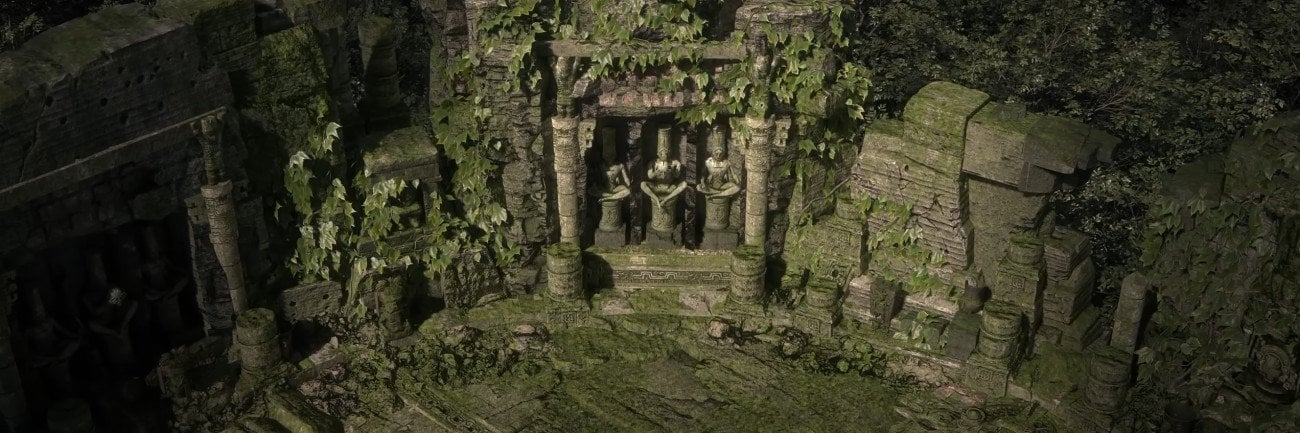
Trial of Chaos Guide Quick Overview:
- Trial of Chaos is one of Path of Exile 2’s Ascendancy trials, combining combat rooms, escalating modifiers, boss encounters, and increasingly valuable rewards.
- Each run becomes harder as you progress, with Tribulations and Wager Modifiers adding extra danger in exchange for stronger rewards and higher Item Rarity.
- Endgame runs can continue for up to 30 rooms, and you can leave between rooms and resume the Trial later without losing your progress.
- Major rewards include currency, Soul Cores, Abyss-related crafting materials, and Trialmaster fragments, with additional reward chests appearing between rooms.
- Deep Trial runs lead toward the Trialmaster, and skilled players can collect all three required fragments in a single run while also facing tougher bosses along the way.
By the way, if you struggle to complete this trial or the endgame version proves too difficult to reach the reward chests at the end, you can Buy PoE 2 Trial of Chaos Boost at Skycoach. With this service, you’ll get any desired amount of completion for this trial and any difficulty. The service is handled by professional ARPG gamers with tons of experience under their belt. You can trust them to run the trial with or for you. Don’t waste your nerves if the trial is too hard; let Skycoach lend a hand!
Note: At Skycoach, you can Buy Path of Exile 2 Boost at the best prices with fast delivery. Use our special PROMO CODE (in green) hidden in this article for a 20% DISCOUNT.
Browse our hottest PoE 2 Boosting services




What Is The Trial of Chaos?
Ascension in PoE 2 requires completing the great Trials you encounter while progressing through Wraeclast. Each reflects the culture and beliefs of the civilization that created it. The Trial of Chaos belongs to the ancient Vaal, and understanding that background explains a lot about why the Trial works the way it does.
A Temple of Chaos lies hidden within the Vaal Jungle. Long before the Vaal became infamous for corruption and increasingly dangerous experiments, their civilization worshiped Chaos.
Chaos represented freedom, randomness, possibility, and the limitless potential created by chance. That made it an unusual fit for a civilization obsessed with obtaining power through knowledge and control. Where the Vaal attempted to understand and manipulate almost everything around them, Chaos represented the one force that refused to remain predictable.
The Trial was once used to test prospective Vaal High Priests. Anyone seeking that position needed to prove more than simple strength. A High Priest had to demonstrate a willingness to risk everything in pursuit of greater power.
Mechanically, the Trial is based around the same risk-and-reward idea as Ultimatum from the original Path of Exile. After completing encounters, the Trialmaster offers additional modifiers that make the rest of your run more dangerous. You accept another disadvantage, continue deeper, and hope your build can survive the consequences.
It starts fairly innocently. One environmental hazard or monster modifier usually feels manageable. Several rooms later, however, you may be dealing with stronger enemies, dangerous ground effects, weaker defenses, and multiple hazards simultaneously.
That is the real challenge of the Trial. You are not simply trying to clear the room in front of you. You are deciding which problems your build can still handle several rooms from now.
The Trialmaster himself remains closely associated with Chaos. The old Vaal lore even leaves room for the idea that he may be something more than a simple servant of the deity, perhaps even one of Chaos’ physical manifestations. Whatever the truth is, his role fits the philosophy perfectly: he constantly encourages you to gamble what you already have for the possibility of obtaining more.
For character progression, Trial of Chaos serves the same fundamental purpose as the Trial of the Sekhemas. Completing the appropriate difficulty can grant Ascendancy Points, and increasingly difficult Trials provide a route toward obtaining all eight.
How to Unlock the Trial of Chaos
Your first journey to the Temple of Chaos happens during Act 3.
While exploring the Chimeral Wetlands, you will eventually encounter Xyclucian, the Chimera. Defeating it rewards the Chimeral Inscribed Ultimatum, which acts as your first token of entry into the Trial.
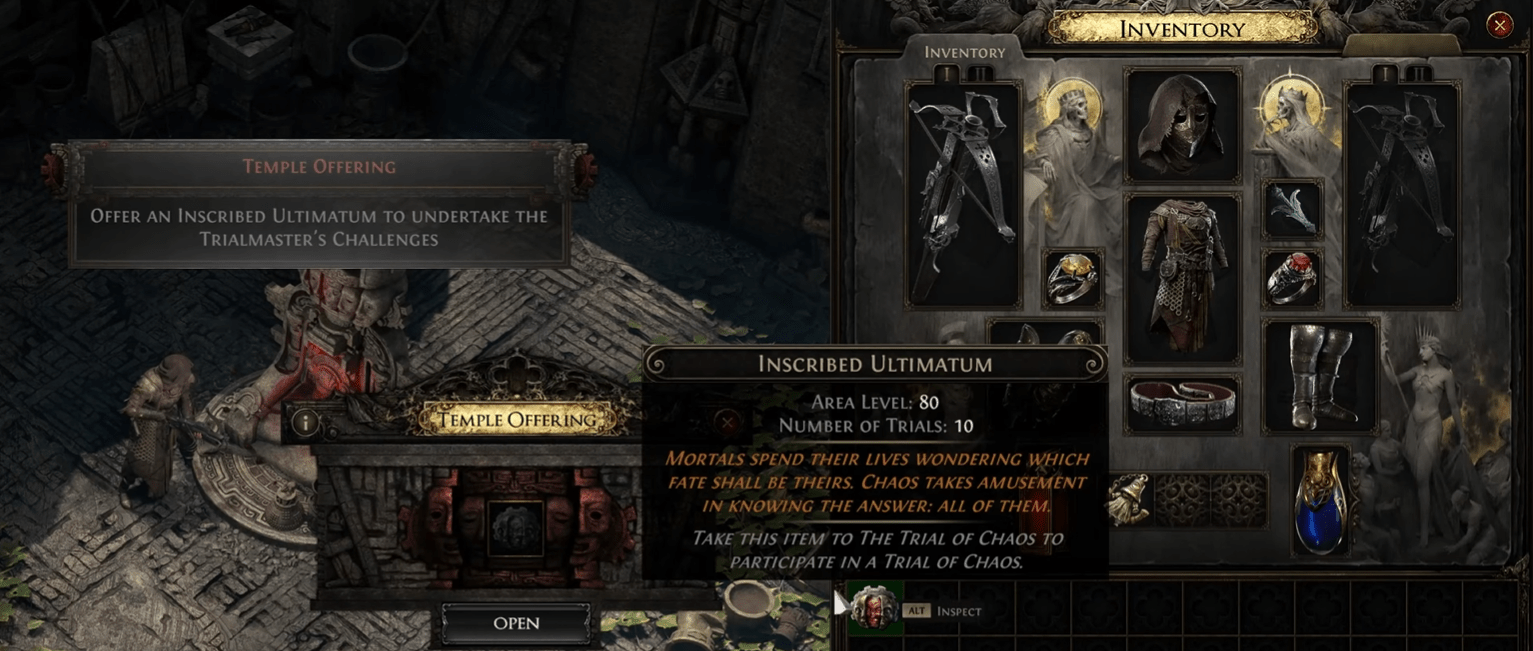
Take this Ultimatum to the Temple of Chaos and place it into the Temple Offering. The Trialmaster will then allow you to begin your first run.
Unlike ordinary Inscribed Ultimatums, this quest version is designed to introduce you to the mechanic rather than permanently punish an early mistake. If you fail, you can recover the quest item and attempt the Trial again.
After completing the introductory version, additional Inscribed Ultimatums allow you to return to the Temple at higher levels. Their difficulty determines the length and strength of the Trial you are about to enter.
The general Ascendancy progression looks like this:
| Trial Progression | Ascendancy Reward |
|---|---|
| 4-room Trial | First eligible Ascension tier |
| 7-room Trial | Up to 4 total Ascendancy Points |
| 10-room Trial | Up to 6 total Ascendancy Points |
| Trialmaster completion | Up to 8 total Ascendancy Points |
Each successful Ascension tier grants 2 Ascendancy Points, with eight available in total.
The important thing to check is the Inscribed Ultimatum itself. It indicates whether that Trial is capable of granting your character another Ascension. Running a lower-level Trial after you have already progressed beyond its reward tier will not magically give you another two points.
Patch 0.5.5 does not replace this traditional Ascendancy structure. Its biggest changes apply to what happens inside the Trial and how far endgame players can push beyond the familiar ten-room progression.
Trial of Chaos Walkthrough
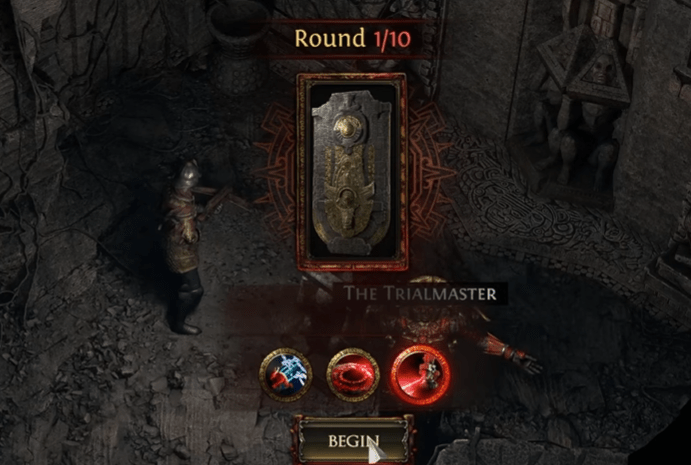
Once you enter the Temple, the Trial follows a repeating pattern. The Trialmaster presents a challenge, you complete it, and then you accept another modifier before moving deeper.
The basic flow looks like this:
- Enter using an Inscribed Ultimatum.
- Choose a Trial modifier.
- Complete the current room.
- Collect any available rewards.
- Accept another modifier.
- Continue deeper into the Temple.
- Defeat bosses when they appear.
- Finish the required progression or keep pushing for endgame rewards.
That sounds simple on paper. The problem is that every modifier you accept follows you deeper into the Trial.
The first few rooms are therefore less about raw mechanical difficulty and more about building the rules of your own future disaster.
Trial of Chaos Rooms
The Trial of Chaos includes several encounter types. Some rooms ask you to kill every enemy, while others can revolve around survival objectives, escorting a statue, moving Vaal Soul Cores, sacrificing enemies in designated areas, or defeating one of the Trial bosses.
Historically, some of these objectives were considerably less popular than others. Escorting something through an arena while several Trial modifiers were active could feel far more frustrating than simply fighting the monsters.
Patch 0.5.5 addresses this directly.
Far more rooms are now focused on simply killing all enemies, allowing builds to spend more time doing what they were designed to do. The more specialized room types have not necessarily vanished, but GGG has made improvements across the encounter pool.
The physical Temple is faster to move through as well. Distances between rooms have been shortened, doors open more quickly and from farther away, and the infamous elevator is now larger and more responsive.
The Trialmaster also interrupts the action less often. Previously, his time-freeze sequence could repeatedly appear while monsters spawned in different rooms. In 0.5.5, the Trialmaster uses that time freeze to spawn the monsters once at the beginning of the run rather than continually interrupting later encounters.
None of these changes radically alter what the Temple is supposed to be. They simply remove a lot of the friction between its actual challenges.
And that matters much more now that a serious endgame run can last 30 rooms.
Trial of Chaos Modifiers
Trial modifiers are the heart of the activity.
As you continue through the Temple, the Trialmaster repeatedly forces you to choose another disadvantage. Older players may also know these effects as Tribulations.
They can affect almost every part of combat. Depending on what appears, modifiers may:
- Strengthen enemies.
- Create environmental hazards.
- Reduce your defenses.
- Interfere with movement.
- Restrict recovery.
- Add damaging projectiles.
- Create dangerous ground effects.
- Upgrade an existing modifier into a stronger version.
The important part is that these effects accumulate.
A modifier that is harmless during Room 2 can become miserable by Room 8 once several other hazards start interacting with it. Likewise, something another build considers dangerous may barely matter to yours.
That makes modifier selection almost as important as the combat itself.
A character with excellent mobility may comfortably ignore hazards that would destroy a slower build. A build dependent on crowd control should be much more careful around modifiers that interfere with stun or other control effects.
Patch 0.5.5 also gives the entire modifier system a major balance pass.
Lower-tier modifiers are now significantly less dangerous, while higher tiers still rise toward the intended maximum difficulty. Modifier descriptions have also been improved so you can better understand exactly what you are accepting before the Trialmaster locks it into your run.
More importantly, modifiers are no longer purely punishment.
Every modifier now grants additional Item Rarity.
That fits the original philosophy of the Trial much better. The Trialmaster is supposed to tempt you into accepting danger for greater rewards, not simply make the next room worse because he finds it amusing.
Well, not only because he finds it amusing.
Wager Modifiers
Patch 0.5.5 takes that original gambling theme even further with Wager Modifiers.
These are not simply another fire patch or monster buff. Wagers are meta modifiers that alter the broader risk-and-reward structure of your Trial.
GGG has revealed roughly a dozen of them, and their value depends heavily on when you encounter them.
One example increases the tier of every modifier already active in your run but doubles all Currency you have earned so far.
That creates exactly the kind of decision the Temple of Chaos should be asking you to make.
If your existing modifiers barely affect your build, increasing all their tiers might be a fantastic trade. If the arena is already covered in hazards and your defenses are barely holding together, doubling your Currency may simply double the value of the run you are about to lose.
Some Wagers are more useful early because you have many rooms remaining to exploit their benefits. Others become increasingly attractive late in a run once you already have substantial rewards on the line.
This turns modifier selection into much more than choosing the least annoying option.
Trial of Chaos Bosses
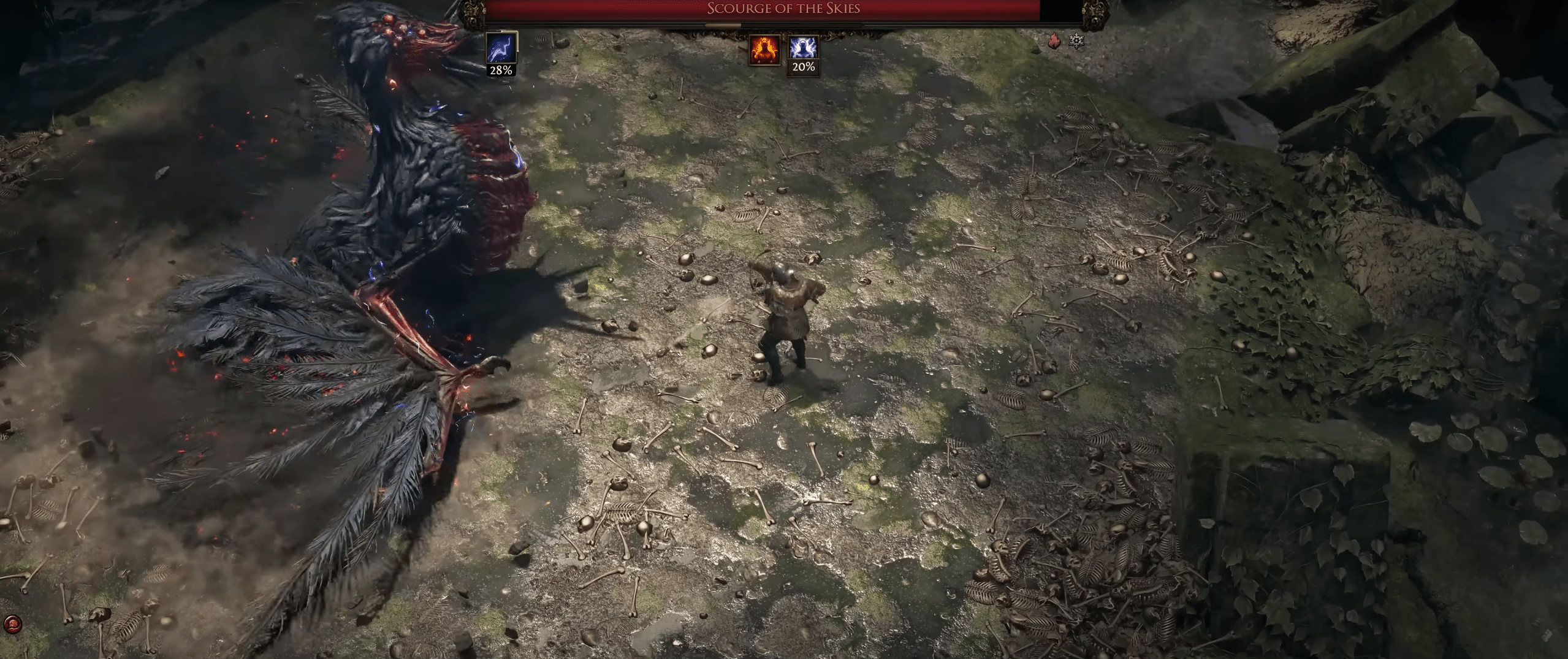
The Trial of Chaos has three regular bosses:
- Uxmal, the Beastlord
- Chetza, the Feathered Plague
- Bahlak, the Sky Seer
Each acts as a major checkpoint during Trial progression.
These encounters also expose one of the nastiest properties of the Trial: you do not fight its bosses in a vacuum.
All those modifiers you accepted earlier still matter.
A boss you normally find easy can become considerably more dangerous once the arena contains extra hazards or your character is suffering from defensive penalties. In many runs, the worst part of a boss encounter is not actually the boss.
Uxmal, the Beastlord
Uxmal, the Beastlord is a monstrous three-headed chimera capable of combining heavy physical attacks with several elemental threats.
Expect an aggressive fight where remaining stationary for too long can quickly become a mistake. Uxmal can pressure you with powerful attacks while forcing you to reposition around whatever additional Trial hazards you have accumulated.
Patch 0.5.5 gives this encounter one of the most significant boss changes in the Trial.
Uxmal’s arena has been completely redesigned, and GGG summarized the new version rather neatly: less flying, more attacking.
That should mean less time waiting for the Beastlord to become vulnerable and more time actually engaging with the fight.
When facing Uxmal, prioritize movement and avoid committing to long attack animations unless you are confident the boss has finished its current sequence.
Chetza, the Feathered Plague
Chetza, the Feathered Plague is another of the creatures waiting within the Trialmaster’s arena rotation.
This encounter focuses heavily on physical pressure, Bleeding, and attacks that force you to keep repositioning. Chetza can cover portions of the arena with dangerous effects while threatening you with direct attacks and falling projectiles.
Mobility matters more than greed here.
It is usually better to interrupt a damage rotation and move than to finish another cast or attack while Birdstorm or another major ability is about to land.
This becomes even more important if your current Trial modifiers have already reduced your mobility or filled additional parts of the arena with hazards.
Bahlak, the Sky Seer
Bahlak, the Sky Seer brings a different kind of pressure to the Trial.
The fight combines physical attacks with Lightning abilities, projectiles, aerial movement, and tornado-like hazards that can gradually restrict safe parts of the arena.
Bahlak can quickly become overwhelming when several Trial effects are already active. Pay particular attention to where you are standing rather than chasing the boss blindly around the arena.
A few seconds of lost damage is usually preferable to being boxed into a corner by Bahlak’s attacks and two different modifiers you voluntarily selected ten minutes earlier.
The Trialmaster will not feel sorry for you.
Trial of Chaos Rewards
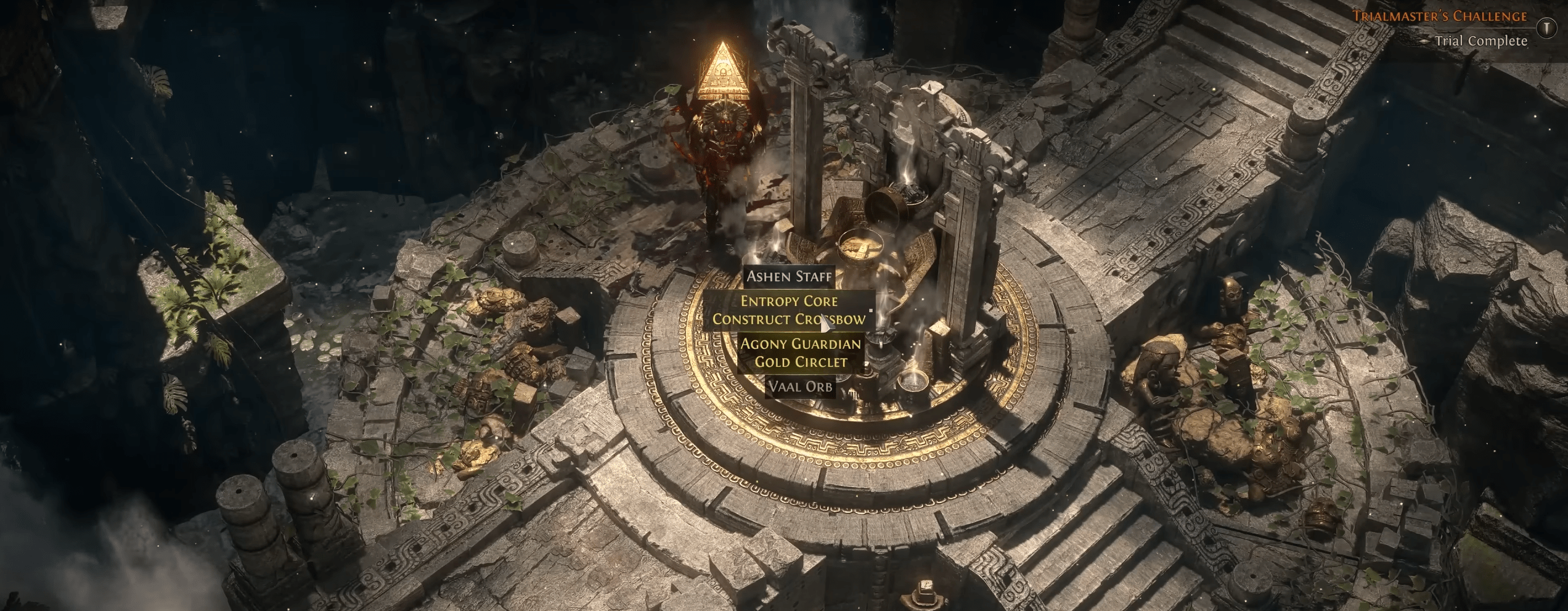
Risk without reward would make for a very poor temple dedicated to Chaos.
Trial of Chaos therefore offers several reward layers depending on why you are running it and how far you are willing to push.
The major rewards include:
- Ascendancy Points.
- Currency items.
- Soul Cores.
- Reward chests between rooms.
- Increased Item Rarity from modifiers.
- Trialmaster fragments.
- Boss and monster drops.
The 0.5.5 overhaul makes these rewards substantially more focused.
Previously, some reward selections could offer random Corrupted equipment that frequently had little value to your character.
Those have been removed from the mod
ifier-selection reward pool.
These choices now exclusively offer Currency items and Soul Cores.
This does not mean ordinary equipment suddenly stops dropping anywhere inside the Trial. The change specifically affects the rewards offered alongside your modifier choices.
You can also now encounter reward chests between rooms, giving you additional loot simply for progressing farther through the Temple.
Combined with the Item Rarity bonuses attached to Trial modifiers, this creates a much clearer relationship between difficulty and reward.
The Trialmaster makes your life worse.
You should at least get paid for it.
Trial of Chaos Soul Cores
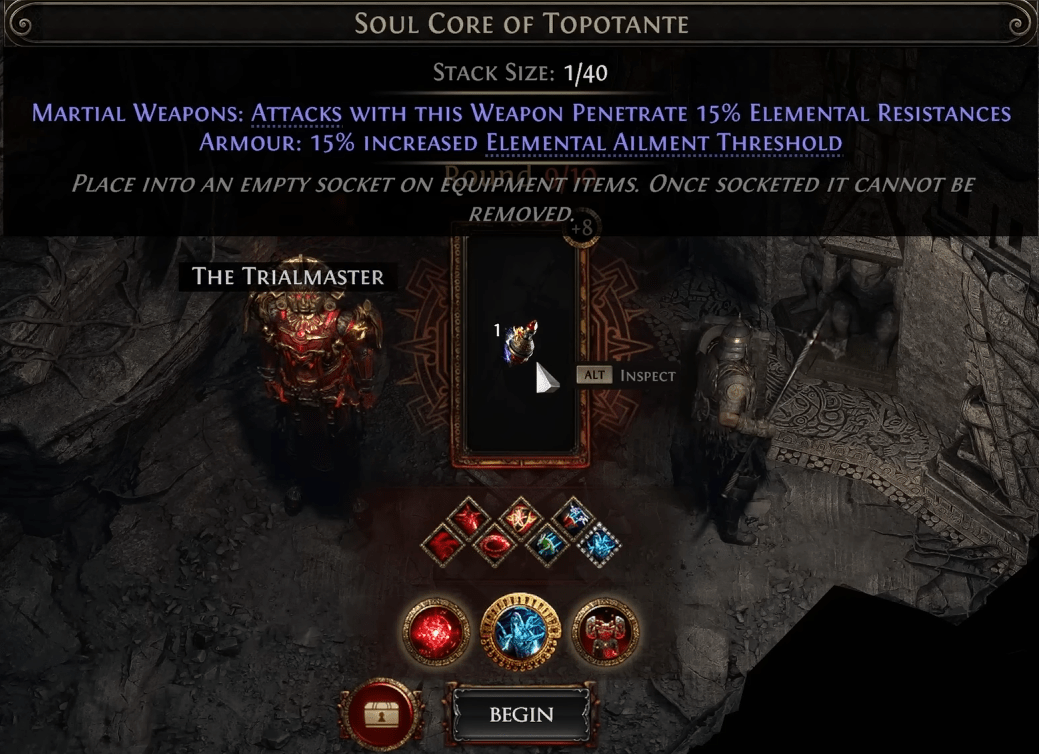
Soul Cores are among the most recognizable rewards associated with Trial of Chaos. These ancient Vaal Augments can be inserted into compatible equipment sockets to provide special bonuses that regular Runes cannot offer.
Different Soul Cores provide different effects depending on whether they are placed into martial weapons or armour, giving you another way to customize your equipment around a particular build.
Lore-wise, they fit the Trial perfectly. Vaal civilization constantly blurred the line between spiritual power, magical experimentation, and technology. Soul Cores feel like another surviving piece of that obsession with forcing additional power into objects that probably should have been left alone.
Be deliberate when using them.
Soul Cores cannot simply be pulled back out and transferred freely between items through normal means. They can be replaced by another compatible Augment, but you should generally treat socketing one as a meaningful equipment decision.
Patch 0.5.5 also gives Soul Cores a full balance pass, making them more powerful overall while introducing additional Soul Cores to Trial of Chaos and the wider endgame.
Because individual Soul Core values are changing, older numerical lists can become misleading very quickly. It is better to evaluate the current version of a Soul Core rather than relying on pre-0.5.5 stat values.
Browse our hottest PoE 2 Boosting services






Trial of Chaos as the Endgame Activity
Leaving and Resuming Trial of Chaos
Fortunately, GGG does not expect you to complete 30 rooms without interruption.
Patch 0.5.5 allows you to leave the Trial of Chaos between rooms and resume the same run later.
This is one of the biggest quality-of-life improvements in the entire overhaul.
It lets you break long Trials into manageable sessions, deal with your inventory, or simply stop without throwing away a promising run.
There is an important distinction, though.
You can leave between rooms.
This is not an emergency escape button you press after realizing the boss is about to kill you. Once an encounter starts, you still need to survive it.
Chaos may allow freedom, but apparently not that much freedom.
Trialmaster Fragments
The deepest Trial progression ultimately leads back to the figure who has been judging you the entire time.
To challenge the Trialmaster, you need three different Fate fragments tied to the regular Trial bosses:
- Cowardly Fate
- Victorious Fate
- Deadly Fate
Traditionally, collecting all three could require repeated Trial runs and favorable boss progression.
Patch 0.5.5 gives strong players a much clearer path.
By reaching the later rooms of a deep Trial, you can now obtain all three Trialmaster fragments during a single run.
This removes much of the randomness from Trialmaster access. Rather than repeatedly waiting for the correct fragment progression, a sufficiently powerful character can push deeper and deliberately work toward the full set.
Another older wagering mechanic has also been incorporated into the normal Trial.
The currency-wager functionality previously associated with Magic Inscribed Ultimatums can now be accessed through the base mechanic at the end of every tenth room.
That makes Rooms 10, 20, and 30 natural milestones during an extended endgame run.
How to Fight the Trialmaster
The Trialmaster is the pinnacle encounter of the entire Trial of Chaos system.
After spending most of the Temple watching you gamble with modifiers and occasionally mocking your decisions, he eventually becomes the challenge himself.
The encounter is also required for the highest Trial of Chaos Ascension progression.
Once you have the necessary Fate fragments and complete the required Trial progression, you can open access to his arena.
The Trialmaster uses several powerful attacks built around heavy melee pressure and his ability to manipulate time.
Some of the main threats include:
- Powerful mace attacks.
- Sunder-like ground attacks.
- Delayed attacks prepared during time stops.
- Large explosions around his weapon.
- Moving Cyclone sequences.
- Shockwaves.
- Teleports around the arena.
The time manipulation is particularly fitting for the character.
Throughout the Trial, the Trialmaster behaves almost as though the ordinary rules governing everyone else are optional. The boss fight finally lets him use that advantage directly against you.
The safest approach is to respect his telegraphs.
Do not force another damage rotation while a major attack is beginning. Create space, let the sequence finish, and then return to dealing damage.
Positioning matters heavily during Sunder and Cyclone-style attacks. Avoid letting yourself become trapped against the edge of the arena, particularly if other effects are limiting where you can safely move.
Defeating the Trialmaster completes the highest Trial of Chaos Ascension requirement for eligible characters and gives access to his exclusive reward pool.
It also provides a fitting ending to the philosophy established when you first entered the Temple.
The Trialmaster spends the entire run asking how much you are willing to risk for power.
Eventually, you get to answer by fighting him for it.
Changelog
September 1, 2026: massive guide overhaul that now encapsulates the most complete Trials of Chaos information, including the latest changes in patch 0.5.5
Read our other PoE 2 guides:
- Trial of Sekhema Guide
- Beginner's Guide
- Endgame Guide
- Gearing Guide
- Leveling Guide
- Classes Tier List
- Best Builds
- Trading Guide
- Divine Orb Farming Guide
F.A.Q.
What are the Trial of Chaos in Path of Exile 2?
The Trial of Chaos is one of two Ascension trials available during the three campaign acts in Path of Exile 2. They are inspired by the Vaal culture, where Chaos symbolizes randomness and freedom. Completing the trial unlocks one of the Ascendancy subclasses and offers significant rewards.
How to Complete the Trial of Chaos in PoE 2?
The trial requires players to complete a series of rooms, each with specific objectives while choosing modifiers (Tribulations) that increase the difficulty and potential rewards. Players face bosses after completing several rooms, with a chance to either take their earned rewards or risk continuing for greater rewards.
What are the rewards for completing the Trial of Chaos?
Completing the Trial of Chaos grants players various rewards, including weapons, accessories, and currency. Additionally, players gain two Ascendancy points for their passive skill tree and can collect Soul Cores in the endgame version of the trial.
What are Soul Cores in Path of Exile 2?
Soul Cores are special socketable items offered during the trial. They grant unique bonuses, such as increased attack speed or critical damage bonus, when placed into an equipment socket. However, Soul Cores cannot be removed once socketed, so use them wisely.